

How Investors Are Reacting To AbbVie (ABBV) Leaning On Immunology After Q1 Profit Decline
AbbVie, Inc. ABBV | 0.00 |
- In late April and early May 2026, AbbVie reported first‑quarter revenue of US$15.00 billion alongside a year-on-year drop in net income to US$695 million, while unveiling extensive new clinical and regulatory updates for immunology drugs SKYRIZI and RINVOQ in inflammatory bowel disease, rheumatoid arthritis and alopecia areata.
- Together with fresh Canadian formulary listings for SKYRIZI in ulcerative colitis and new real‑world data showing lower switch rates and healthcare utilization in Crohn’s disease, these developments underline how AbbVie is increasingly anchored on its newer immunology portfolio to support growth as older therapies face intensifying competition.
- We’ll now examine how the stronger-than-expected Q1 immunology performance, especially from Skyrizi and Rinvoq, reshapes AbbVie’s existing investment narrative.
Outshine the giants: these 19 early-stage AI stocks could fund your retirement.
AbbVie Investment Narrative Recap
For me, the AbbVie story still rests on whether newer immunology drugs like Skyrizi and Rinvoq can offset pressure on older blockbusters while supporting the dividend. The latest Q1 beat in immunology and fresh data in inflammatory bowel disease reinforce that near term catalyst, but do not fundamentally change key risks around pricing pressure and product concentration.
The DDW 2026 data on Skyrizi and Rinvoq in Crohn’s and ulcerative colitis looks especially relevant here, as it backs up management’s emphasis on these drugs after raising their combined sales outlook to more than US$31,000 million this year. Stronger clinical and real world support in high-need conditions helps underpin the thesis that AbbVie’s newer immunology portfolio can carry more of the load as Humira and other mature products face tougher competition.
Yet, despite this progress, investors still need to think carefully about how exposed AbbVie remains if pricing pressure intensifies or if dependence on a handful of immunology assets starts to...
AbbVie’s narrative projects $77.7 billion revenue and $22.4 billion earnings by 2029. This requires 8.3% yearly revenue growth and a $18.2 billion earnings increase from $4.2 billion today.
Uncover how AbbVie's forecasts yield a $249.43 fair value, a 22% upside to its current price.
Exploring Other Perspectives
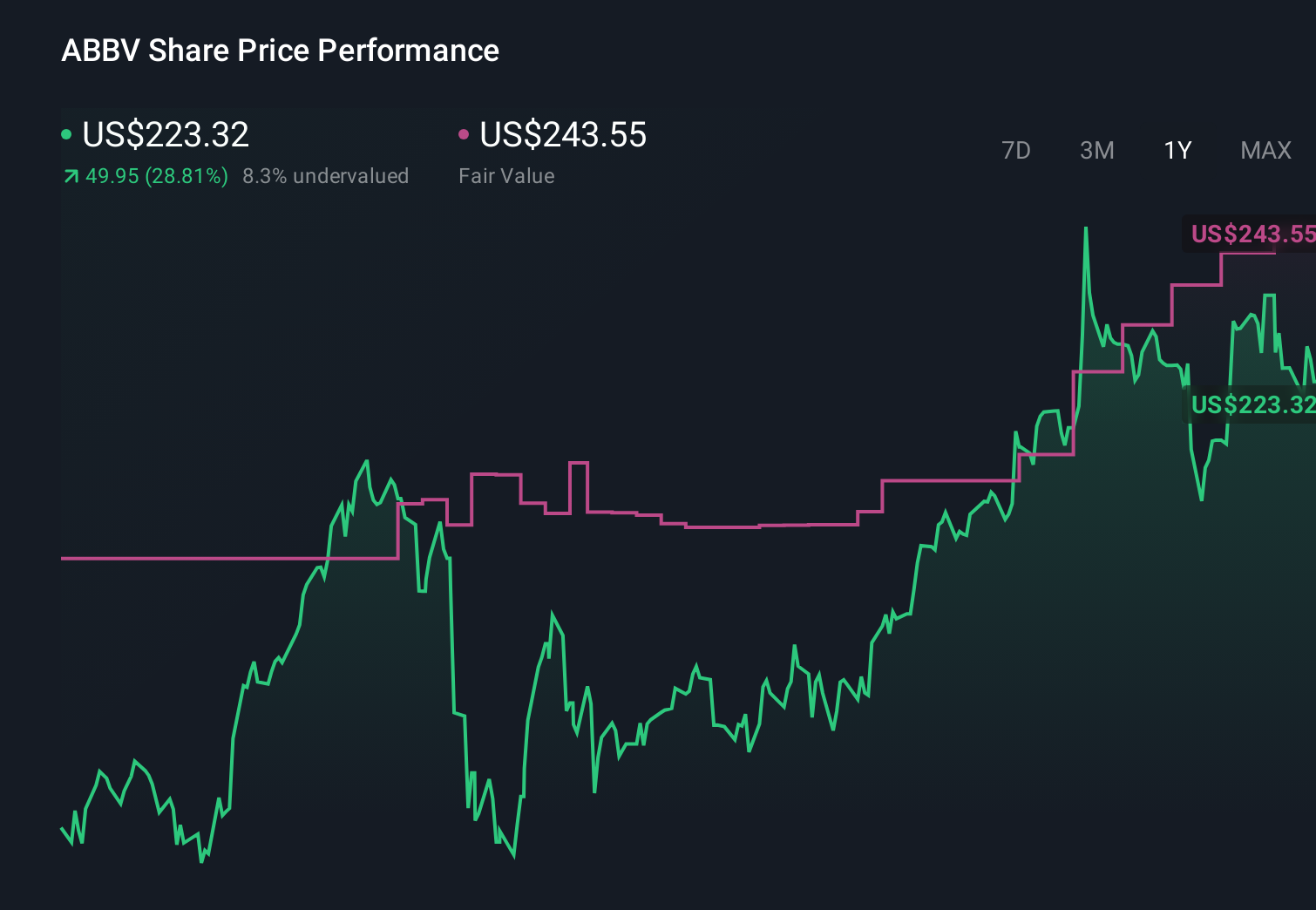
Four fair value estimates from the Simply Wall St Community range from about US$249 to US$420 per share, highlighting how differently individual investors are weighing AbbVie’s Skyrizi and Rinvoq driven immunology story. With such a spread of views, it is worth looking closely at how concentrated product exposure and future pricing pressure could affect the company’s ability to keep growing its earnings and supporting shareholder returns over time.
Explore 4 other fair value estimates on AbbVie - why the stock might be worth just $249.43!
Decide For Yourself
Don't just follow the ticker - dig into the data and build a conviction that's truly your own.
- A great starting point for your AbbVie research is our analysis highlighting 3 key rewards and 5 important warning signs that could impact your investment decision.
- Our free AbbVie research report provides a comprehensive fundamental analysis summarized in a single visual - the Snowflake - making it easy to evaluate AbbVie's overall financial health at a glance.
Seeking Other Investments?
Early movers are already taking notice. See the stocks they're targeting before they've flown the coop:
- This technology could replace computers: discover 26 stocks that are working to make quantum computing a reality.
- Invest in the nuclear renaissance through our list of 91 elite nuclear energy infrastructure plays powering the global AI revolution.
- Find 44 companies with promising cash flow potential yet trading below their fair value.
This article by Simply Wall St is general in nature. We provide commentary based on historical data and analyst forecasts only using an unbiased methodology and our articles are not intended to be financial advice. It does not constitute a recommendation to buy or sell any stock, and does not take account of your objectives, or your financial situation. We aim to bring you long-term focused analysis driven by fundamental data. Note that our analysis may not factor in the latest price-sensitive company announcements or qualitative material. Simply Wall St has no position in any stocks mentioned.