

How Investors Are Reacting To Compass (COMP) Ending Its Long-Running Zillow Marketing Dispute
Compass COMP | 0.00 |
- Earlier this week, Compass Inc. formally dismissed its lawsuit against Zillow, ending the long-running “Zillow Ban” that had limited how listings could be marketed on Zillow’s platform and reshaping how agents and home sellers can promote properties.
- This resolution removes a key point of friction between Compass and a major listings portal, potentially clarifying Compass’s competitive positioning in an industry already wrestling with technology, regulation, and shifting brokerage models.
- With the lawsuit now dismissed and Compass regaining broader access to Zillow’s marketing channels, we’ll assess how this outcome may recalibrate its investment narrative.
The latest GPUs need a type of rare earth metal called Neodymium and there are only 27 companies in the world exploring or producing it. Find the list for free.
Compass Investment Narrative Recap
To own Compass, you need to believe its tech-first, agent-centric model can convert market share and higher agent productivity into sustainable profitability, despite ongoing losses and a commission-based revenue mix tied to housing activity. The end of the Zillow lawsuit likely reduces near term platform-access risk but does not materially change the central near term catalyst: evidence that Compass can turn rising revenue into consistent positive earnings, while its biggest risk remains pressure on transaction volumes and industry commission economics.
The recent alliance with Rocket Companies and Redfin sits in the same orbit as the Zillow development, highlighting how much Compass depends on broad, flexible listing exposure and partner channels. That partnership, which could put hundreds of thousands of Compass-related listings in front of Redfin’s high-traffic audience, is closely linked to the same catalyst investors are watching now: whether expanded digital distribution can lift agent productivity enough to improve margins and move Compass toward sustained profitability.
Yet behind Compass’s tech story, investors also need to weigh how much regulatory scrutiny of commissions could reshape the economics of every transaction...
Compass' narrative projects $15.9 billion revenue and $668.9 million earnings by 2029. This requires 31.6% yearly revenue growth and a $727.4 million earnings increase from -$58.5 million.
Uncover how Compass' forecasts yield a $13.58 fair value, a 90% upside to its current price.
Exploring Other Perspectives
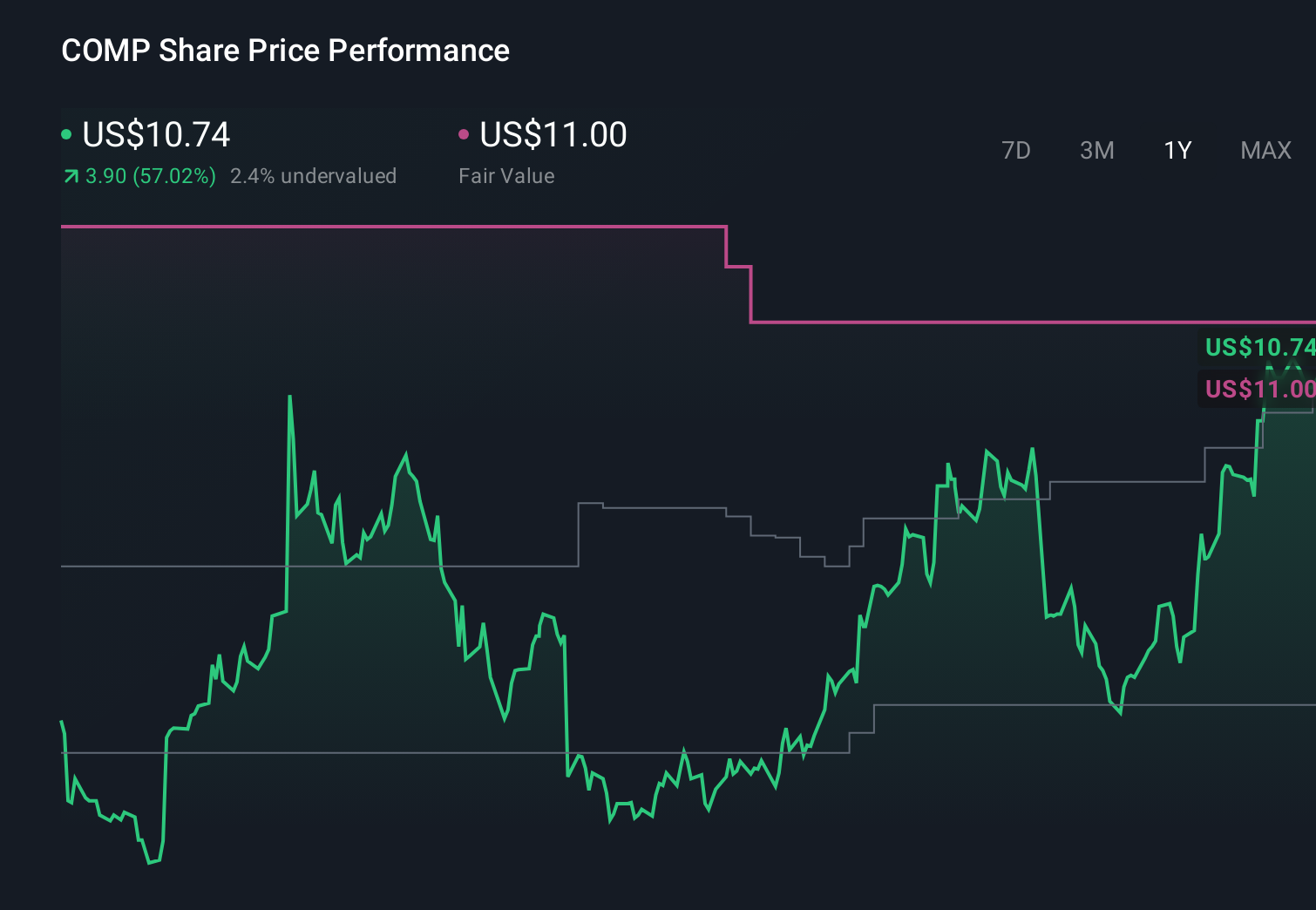
While consensus focuses on steady tech driven gains, the most optimistic analysts see Compass potentially reaching about US$17.4 billion in revenue and US$1.1 billion in earnings, highlighting how differently you might view the Zillow and distribution news if you worry more about rising AI driven platforms displacing agents and pressuring Compass’s model.
Explore 4 other fair value estimates on Compass - why the stock might be worth over 3x more than the current price!
Reach Your Own Conclusion
Don't just follow the ticker - dig into the data and build a conviction that's truly your own.
- A great starting point for your Compass research is our analysis highlighting 3 key rewards and 1 important warning sign that could impact your investment decision.
- Our free Compass research report provides a comprehensive fundamental analysis summarized in a single visual - the Snowflake - making it easy to evaluate Compass' overall financial health at a glance.
Seeking Other Investments?
The market won't wait. These fast-moving stocks are hot now. Grab the list before they run:
- Invest in the nuclear renaissance through our list of 93 elite nuclear energy infrastructure plays powering the global AI revolution.
- Capitalize on the AI infrastructure supercycle with our selection of the 36 best 'picks and shovels' of the AI gold rush converting record-breaking demand into massive cash flow.
- We've uncovered the 11 dividend fortresses yielding 5%+ that don't just survive market storms, but thrive in them.
This article by Simply Wall St is general in nature. We provide commentary based on historical data and analyst forecasts only using an unbiased methodology and our articles are not intended to be financial advice. It does not constitute a recommendation to buy or sell any stock, and does not take account of your objectives, or your financial situation. We aim to bring you long-term focused analysis driven by fundamental data. Note that our analysis may not factor in the latest price-sensitive company announcements or qualitative material. Simply Wall St has no position in any stocks mentioned.