

How Investors Are Reacting To General Motors (GM) Canada Tariff Threats And New Labor Peace
General Motors Company GM | 0.00 |
- Earlier in August 2026, Unifor reached tentative three-year labour agreements with General Motors covering more than 4,600 workers across key Canadian plants, while U.S.–Canada tensions intensified after President Trump announced plans for 50% tariffs on Canadian auto and parts imports starting January 1, 2027.
- At the same time, GM’s role in backing EVgo’s expanding fast‑charging network highlights how its long-term EV infrastructure commitments sit alongside rising cost uncertainty from potential cross-border tariffs.
- We’ll now examine how the prospective 50% U.S. tariffs on Canadian autos could reshape General Motors’ investment narrative and risk profile.
Invest in the nuclear renaissance through our list of 92 elite nuclear energy infrastructure plays powering the global AI revolution.
General Motors Investment Narrative Recap
To own General Motors today, you need to believe the company can turn a low-margin, capital intensive business into a more profitable mix of EVs, software and resilient North American truck and SUV earnings. In the near term, the biggest swing factor is how effectively GM can protect margins while funding that EV shift, with the proposed 50% U.S. tariffs on Canadian autos now a potentially material new cost risk layered on top of already rising warranty and quality expenses.
The Unifor tentative three year agreements matter here because they reduce the near term risk of production disruptions at key Canadian plants just as tariff uncertainty increases. In contrast, GM’s ongoing support of EVgo’s fast charging buildout, including nearly 2,400 stalls across 32 states, speaks directly to the core EV growth catalyst, underscoring how capital and partnership commitments continue even as trade and regulatory risks for the underlying vehicle business increase.
Yet against that EV growth story, the expanded federal probe into GM’s 6.2 liter L87 V8 engine failures could become a material risk investors need to understand...
General Motors' narrative projects $195.5 billion revenue and $8.2 billion earnings by 2029. This requires 1.8% yearly revenue growth and a $6.3 billion earnings increase from $1.9 billion today.
Uncover how General Motors' forecasts yield a $100.04 fair value, a 15% upside to its current price.
Exploring Other Perspectives
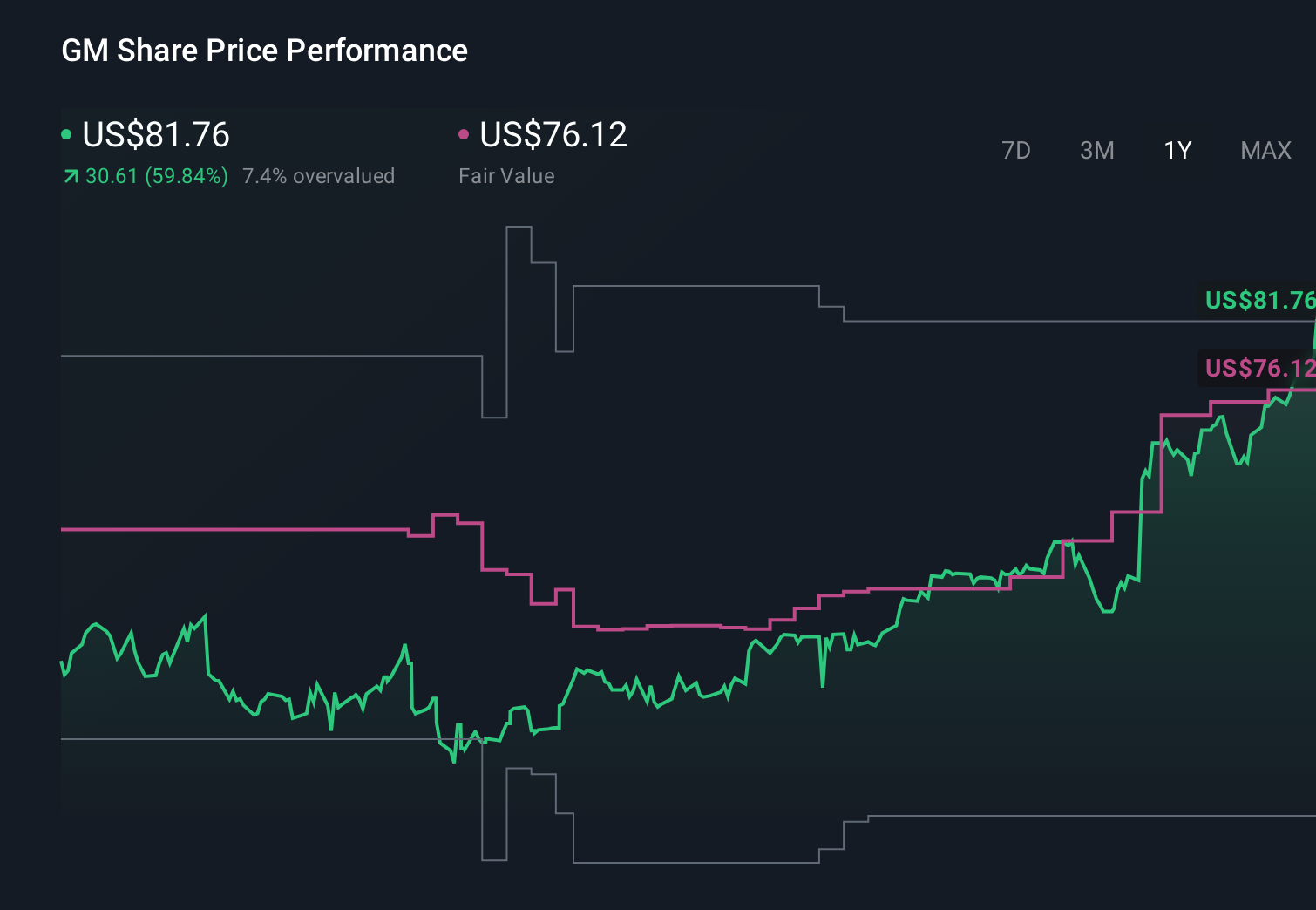
While consensus focuses on EV growth and tariff risks, the most bearish analysts already assumed fairly flat revenue around US$187.5 billion and earnings near US$10.6 billion by 2029, so you may find their much more cautious view on trade and quality headwinds useful to compare with the upside narrative.
Explore 7 other fair value estimates on General Motors - why the stock might be worth as much as 59% more than the current price!
Form Your Own Verdict
Don't just follow the ticker - dig into the data and build a conviction that's truly your own.
- A great starting point for your General Motors research is our analysis highlighting 2 key rewards and 4 important warning signs that could impact your investment decision.
- Our free General Motors research report provides a comprehensive fundamental analysis summarized in a single visual - the Snowflake - making it easy to evaluate General Motors' overall financial health at a glance.
Interested In Other Possibilities?
Opportunities like this don't last. These are today's most promising picks. Check them out now:
- Find 49 companies with promising cash flow potential yet trading below their fair value.
- This technology could replace computers: discover 24 stocks that are working to make quantum computing a reality.
- Uncover the next big thing with 22 elite penny stocks that balance risk and reward.
This article by Simply Wall St is general in nature. We provide commentary based on historical data and analyst forecasts only using an unbiased methodology and our articles are not intended to be financial advice. It does not constitute a recommendation to buy or sell any stock, and does not take account of your objectives, or your financial situation. We aim to bring you long-term focused analysis driven by fundamental data. Note that our analysis may not factor in the latest price-sensitive company announcements or qualitative material. Simply Wall St has no position in any stocks mentioned.