

How Investors Are Reacting To Johnson & Johnson (JNJ) Multiple Myeloma Trial Data For TALVEY Combinations
Johnson & Johnson JNJ | 0.00 |
- Earlier this month, Johnson & Johnson reported late-stage trial results showing its bispecific antibody TALVEY, combined with DARZALEX FASPRO with or without pomalidomide, meaningfully reduced disease progression and death in relapsed/refractory multiple myeloma versus a standard regimen.
- At 24 months, the TALVEY combinations delivered higher progression-free and overall survival rates than standard care, reinforcing Johnson & Johnson’s push into next-generation oncology treatments that aim to attack tumor cells while largely sparing healthy immune cells.
- We’ll now examine how these TALVEY data, as a first-in-class GPRC5D bispecific combination in earlier-line myeloma, may reshape Johnson & Johnson’s investment narrative.
Uncover the next big thing with 24 elite penny stocks that balance risk and reward.
Johnson & Johnson Investment Narrative Recap
To own Johnson & Johnson today, you have to believe its newer Innovative Medicine and MedTech franchises can more than offset patent losses and legal overhangs, with oncology a key proof point. The MonumenTAL-3 TALVEY data directly reinforce that thesis by strengthening J&J’s multiple myeloma story, which many see as the most important near term growth catalyst. By contrast, talc litigation and the execution risk around portfolio reshuffling remain the biggest swing factors in the near term.
Among recent announcements, the US$1 billion Firefly Bio acquisition matters most alongside TALVEY. Firefly’s degrader antibody conjugate platform, aimed at KRAS driven tumors, sits in the same high expectation oncology bucket as TALVEY and CARVYKTI. Together, these moves highlight how much of J&J’s investment case now rests on complex cancer platforms delivering in earlier treatment lines while the company manages tariff, restructuring and legal risks in the background.
Yet beneath the strong trial headlines, investors should also weigh the risk that oncology uptake falls short just as orthopedics separation and tariffs pressure margins...
Johnson & Johnson's narrative projects $116.6 billion revenue and $26.9 billion earnings by 2029. This requires 6.6% yearly revenue growth and about a $5.9 billion earnings increase from $21.0 billion today.
Uncover how Johnson & Johnson's forecasts yield a $252.87 fair value, a 5% upside to its current price.
Exploring Other Perspectives
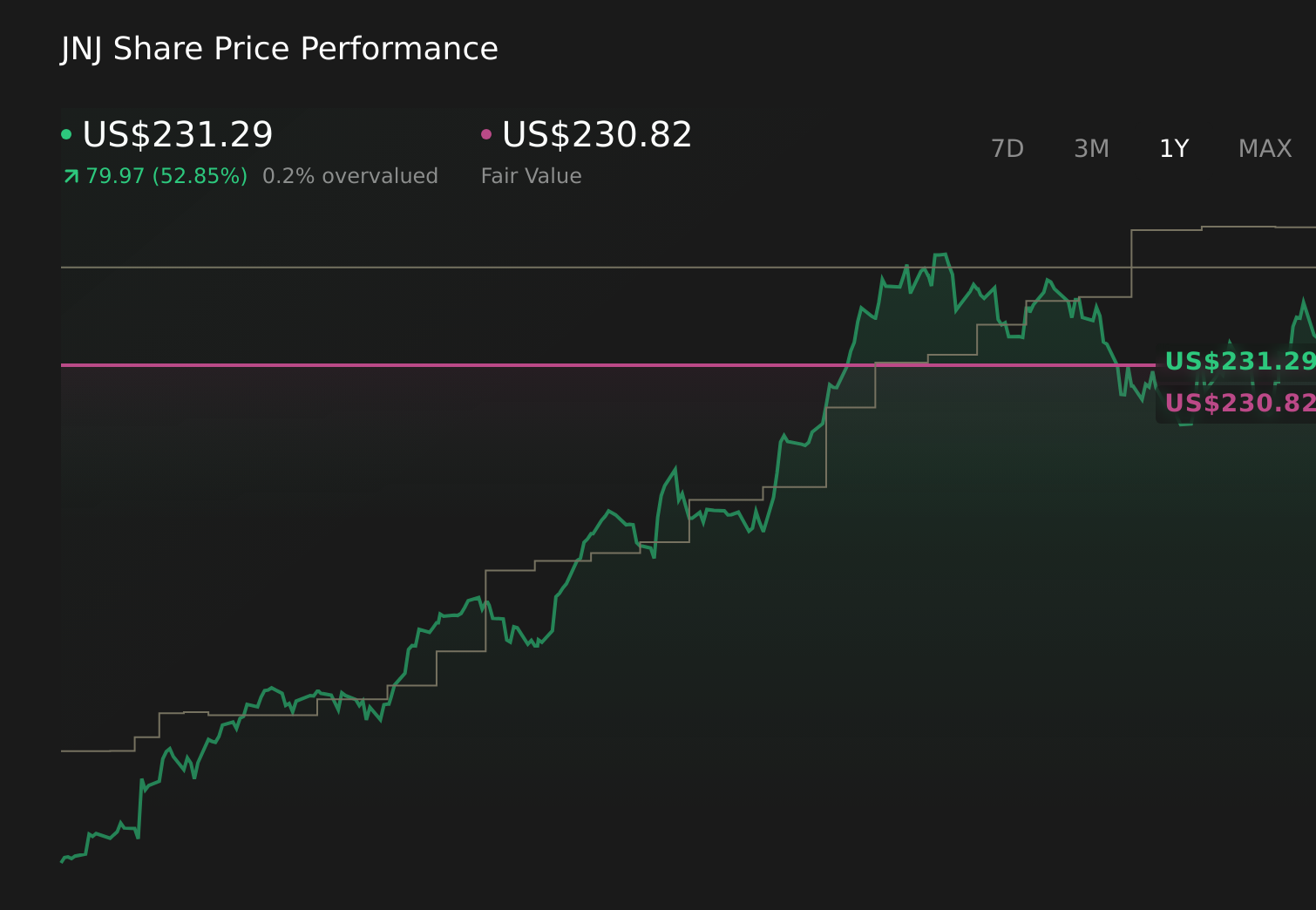
Some of the lowest ranked analysts were assuming revenue of about US$109.9 billion and earnings of roughly US$21.9 billion by 2029, so if you worry that oncology underperformance or MedTech execution issues could still compress margins despite TALVEY’s success, their more pessimistic view may resonate and it is worth comparing that with your own expectations.
Explore 7 other fair value estimates on Johnson & Johnson - why the stock might be worth 12% less than the current price!
The Verdict Is Yours
Don't just follow the ticker - dig into the data and build a conviction that's truly your own.
- A great starting point for your Johnson & Johnson research is our analysis highlighting 3 key rewards and 1 important warning sign that could impact your investment decision.
- Our free Johnson & Johnson research report provides a comprehensive fundamental analysis summarized in a single visual - the Snowflake - making it easy to evaluate Johnson & Johnson's overall financial health at a glance.
Seeking Other Investments?
Early movers are already taking notice. See the stocks they're targeting before they've flown the coop:
- Capitalize on the AI infrastructure supercycle with our selection of the 48 best 'picks and shovels' of the AI gold rush converting record-breaking demand into massive cash flow.
- We've uncovered the 8 dividend fortresses yielding 5%+ that don't just survive market storms, but thrive in them.
- Rare earth metals are the new gold rush. Find out which 31 stocks are leading the charge.
This article by Simply Wall St is general in nature. We provide commentary based on historical data and analyst forecasts only using an unbiased methodology and our articles are not intended to be financial advice. It does not constitute a recommendation to buy or sell any stock, and does not take account of your objectives, or your financial situation. We aim to bring you long-term focused analysis driven by fundamental data. Note that our analysis may not factor in the latest price-sensitive company announcements or qualitative material. Simply Wall St has no position in any stocks mentioned.