

How Investors Are Reacting To Maplebear (CART) Expanding AI Caper Carts And Health-Focused Partnerships
Maplebear Inc. CART | 0.00 |
- Recently, Instacart (Maplebear) expanded its AI-driven Caper Carts to select Weis Markets stores in Pennsylvania and deepened its health-focused reach through a new Vida Health partnership that uses Instacart Health Fresh Funds to connect nutrition guidance with shoppable, same-day grocery delivery.
- These moves highlight Instacart’s push to blend in-store Physical AI, retail media, and health-oriented grocery access, reinforcing its role as both a technology partner for retailers and an infrastructure layer for food-as-medicine programs.
- We’ll now examine how Instacart’s Caper Carts rollout at Weis could influence the company’s investment narrative built around AI-enabled retail partnerships.
The future of work is here. Discover the 33 top robotics and automation stocks leading the charge in AI-driven automation and industrial transformation.
Maplebear Investment Narrative Recap
To own Maplebear, you need to believe Instacart can turn its grocery marketplace, advertising, and in-store tech into a durable, higher-margin ecosystem. In the near term, the key catalyst is whether AI-enabled partnerships like Caper Carts and health programs translate into deeper retailer integration and higher non-transaction revenue, while the biggest risk remains rising competitive and regulatory pressure on its core fulfillment economics. The Weis and Vida announcements are encouraging, but not yet clearly material to either.
The Weis Markets Caper Carts rollout is the clearest tie-in here, because it sits at the intersection of Instacart’s Physical AI ambitions and its push into higher-margin enterprise and retail media revenue. The pilot extends Caper coverage across more banners and states, supporting the consensus catalyst around omnichannel integrations and software-like income streams. At the same time, it indirectly reinforces the risk that retailers may still pursue their own in-house solutions if Instacart’s tech fails to prove indispensable.
Yet investors should also be aware that rising labor and regulatory pressures on gig work could quietly reshape Instacart’s cost base and unit economics over time...
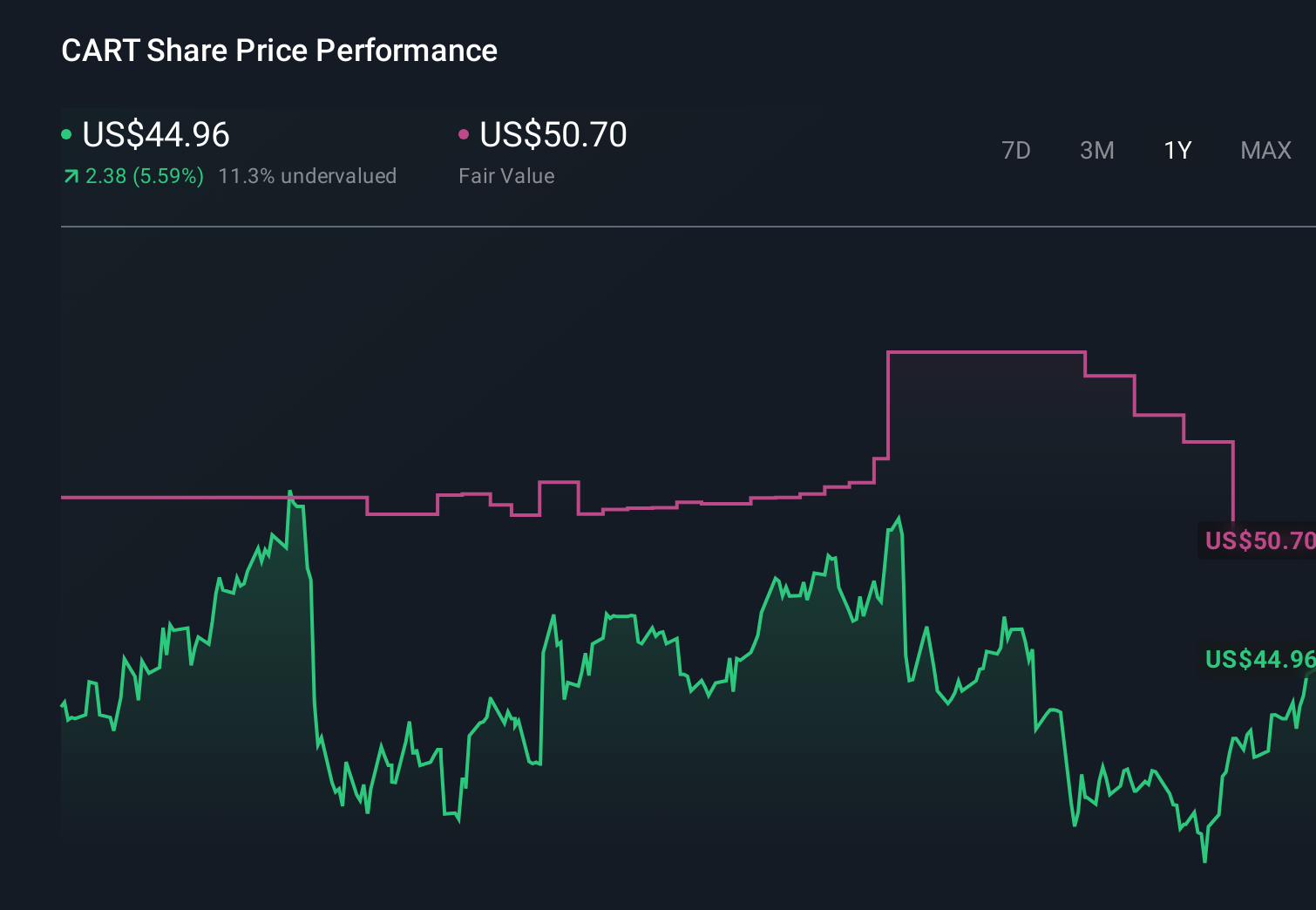
Maplebear's narrative projects $4.9 billion revenue and $800.3 million earnings by 2029. This requires 9.4% yearly revenue growth and an earnings increase of about $362 million from $438.0 million today.
Uncover how Maplebear's forecasts yield a $50.14 fair value, a 21% upside to its current price.
Exploring Other Perspectives
More optimistic analysts were already assuming about US$5.0 billion of revenue and US$1.0 billion of earnings by 2028, so news like the Weis Caper rollout could either reinforce that bullish AI driven thesis or prompt a rethink if affordability and regulatory risks start to look more pressing.
Explore 2 other fair value estimates on Maplebear - why the stock might be worth just $50.14!
Form Your Own Verdict
Disagree with existing narratives? Extraordinary investment returns rarely come from following the herd, so go with your instincts.
- A great starting point for your Maplebear research is our analysis highlighting 3 key rewards that could impact your investment decision.
- Our free Maplebear research report provides a comprehensive fundamental analysis summarized in a single visual - the Snowflake - making it easy to evaluate Maplebear's overall financial health at a glance.
Looking For Alternative Opportunities?
Our top stock finds are flying under the radar-for now. Get in early:
- Find 46 companies with promising cash flow potential yet trading below their fair value.
- Explore 30 top quantum computing companies leading the revolution in next-gen technology and shaping the future with breakthroughs in quantum algorithms, superconducting qubits, and cutting-edge research.
- Invest in the nuclear renaissance through our list of 88 elite nuclear energy infrastructure plays powering the global AI revolution.
This article by Simply Wall St is general in nature. We provide commentary based on historical data and analyst forecasts only using an unbiased methodology and our articles are not intended to be financial advice. It does not constitute a recommendation to buy or sell any stock, and does not take account of your objectives, or your financial situation. We aim to bring you long-term focused analysis driven by fundamental data. Note that our analysis may not factor in the latest price-sensitive company announcements or qualitative material. Simply Wall St has no position in any stocks mentioned.