

How Investors Are Reacting To PG&E (PCG) Credit Extension And Growing Solar-Linked Grid Complexity
PG&E Corporation PCG | 0.00 |
- In June 2026, PG&E Corporation amended its revolving credit agreement with JPMorgan Chase and other lenders, extending the facility’s maturity to June 22, 2029, revising interest and commitment fee grids, and introducing collateral release terms tied to investment grade credit ratings and limits on secured debt.
- Separately, PG&E surpassed 1 million customer solar connections on its grid and warned of evolving utility scam tactics, underscoring both its expanding role in California’s clean energy transition and the ongoing need to protect customers in a more complex energy landscape.
- We’ll now consider how the extended credit facility and potential collateral release conditions may influence PG&E’s longer-term investment narrative.
We've uncovered the 10 dividend fortresses yielding 5%+ that don't just survive market storms, but thrive in them.
PG&E Investment Narrative Recap
To own PG&E, you have to believe a heavily regulated utility with a complex wildfire history can keep strengthening its balance sheet while funding large grid upgrades and managing political, climate and affordability pressures. The revolving credit amendment modestly supports this by extending liquidity visibility, but it does not meaningfully change the nearer term swing factors like wildfire liability outcomes or future regulatory decisions on cost recovery and allowed returns.
The revolving credit facility amendment is the most relevant update here, because its extended 2029 maturity and collateral release terms directly intersect with PG&E’s aim of reaching and maintaining investment grade ratings, a key enabler for funding ongoing grid modernization and wildfire mitigation at acceptable financing costs.
Yet investors should also be aware that potential shifts in California’s wildfire liability rules could still...
PG&E's narrative projects $28.5 billion revenue and $4.3 billion earnings by 2029. This requires 3.4% yearly revenue growth and a $1.5 billion earnings increase from $2.8 billion today.
Uncover how PG&E's forecasts yield a $22.59 fair value, a 34% upside to its current price.
Exploring Other Perspectives
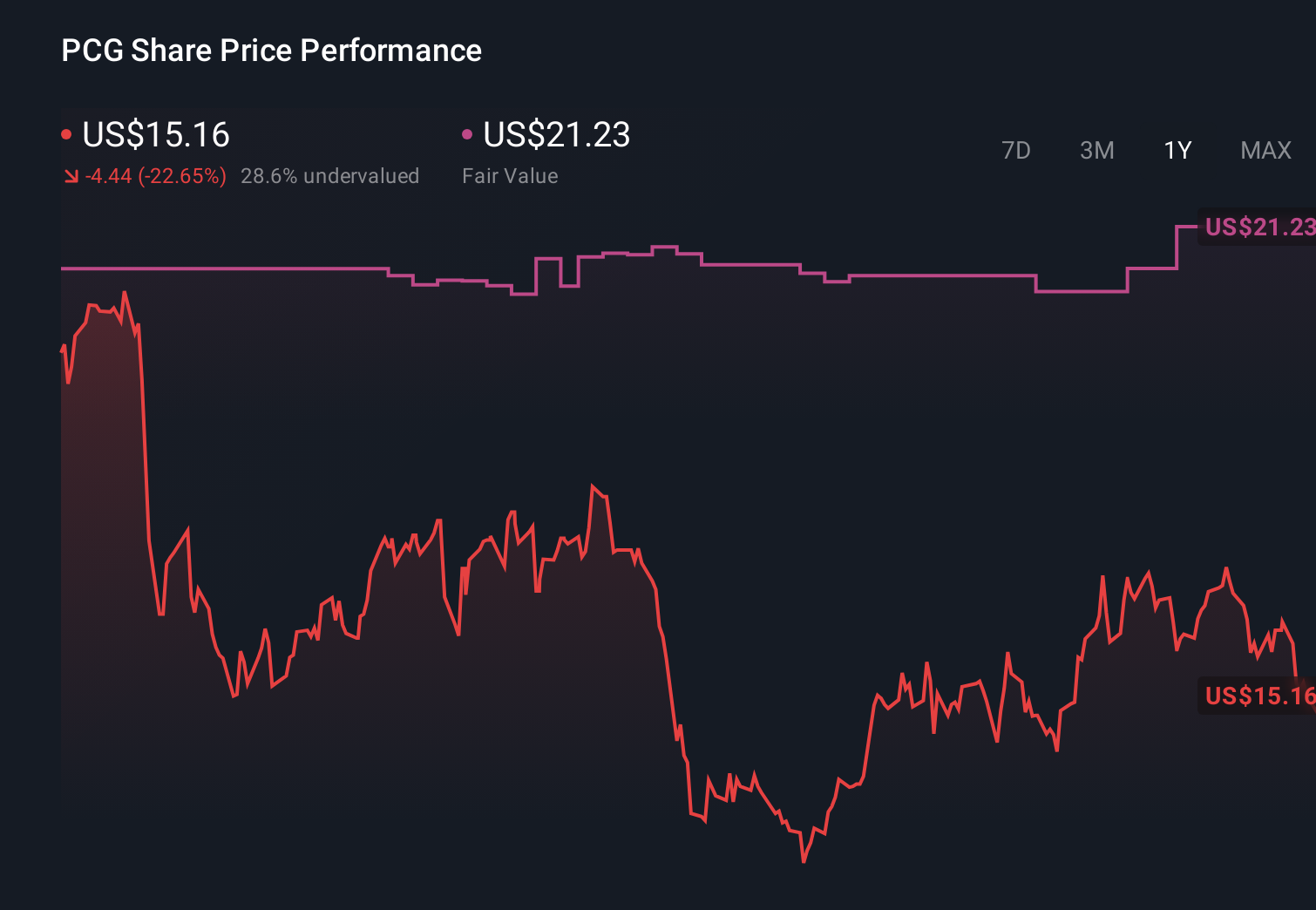
Three members of the Simply Wall St Community currently see PG&E’s fair value between US$9.51 and US$22.59 per share, underscoring very different return expectations. Set against that, the recent credit facility extension highlights how many are weighing balance sheet resilience and access to capital when thinking about PG&E’s future performance and invites you to consider how your own view fits among these competing perspectives.
Explore 3 other fair value estimates on PG&E - why the stock might be worth as much as 34% more than the current price!
Form Your Own Verdict
Disagree with existing narratives? Extraordinary investment returns rarely come from following the herd, so go with your instincts.
- A great starting point for your PG&E research is our analysis highlighting 5 key rewards and 2 important warning signs that could impact your investment decision.
- Our free PG&E research report provides a comprehensive fundamental analysis summarized in a single visual - the Snowflake - making it easy to evaluate PG&E's overall financial health at a glance.
Seeking Other Investments?
Right now could be the best entry point. These picks are fresh from our daily scans. Don't delay:
- The best AI stocks today may lie beyond giants like Nvidia and Microsoft. Find the next big opportunity with these 15 smaller AI-focused companies with strong growth potential through early-stage innovation in machine learning, automation, and data intelligence that could fund your retirement.
- Uncover the next big thing with 22 elite penny stocks that balance risk and reward.
- Capitalize on the AI infrastructure supercycle with our selection of the 51 best 'picks and shovels' of the AI gold rush converting record-breaking demand into massive cash flow.
This article by Simply Wall St is general in nature. We provide commentary based on historical data and analyst forecasts only using an unbiased methodology and our articles are not intended to be financial advice. It does not constitute a recommendation to buy or sell any stock, and does not take account of your objectives, or your financial situation. We aim to bring you long-term focused analysis driven by fundamental data. Note that our analysis may not factor in the latest price-sensitive company announcements or qualitative material. Simply Wall St has no position in any stocks mentioned.