

How Investors Are Reacting To Stryker (SYK) Landing A US$100 Million Defense Logistics Contract
Stryker Corporation SYK | 0.00 |
- The U.S. Department of Defense recently awarded Stryker’s sales unit a US$100.00 million contract modification through the Defense Logistics Agency, reinforcing the company’s role as a key medical supplier to government healthcare systems.
- This new contract adds a significant, multi-year government revenue stream at a time when Stryker is balancing growth investments with cost and regulatory pressures.
- Next, we’ll examine how this sizable Defense Logistics Agency contract shapes Stryker’s investment narrative and its long-term earnings profile.
The best AI stocks today may lie beyond giants like Nvidia and Microsoft. Find the next big opportunity with these 16 smaller AI-focused companies with strong growth potential through early-stage innovation in machine learning, automation, and data intelligence that could fund your retirement.
Stryker Investment Narrative Recap
To own Stryker, you need to believe in long term growth in medical procedures, powered by its innovation in surgery, orthopedics and hospital equipment. The new US$100.00 million Defense Logistics Agency contract strengthens Stryker’s government revenue base, but does not materially change the near term focus on supply chain reliability as a key catalyst, or on regulatory and pricing pressure as central risks to the story right now.
Alongside the contract win, Stryker’s recent Q2 2026 results showed higher revenue and earnings, which helps frame the Defense Logistics Agency award as incremental support rather than a turnaround event. Together with ongoing investments in its Mako robotic surgery platform, this reinforces the idea that procedure volume growth and technology adoption remain the primary drivers that investors are watching around the stock.
However, against this positive backdrop, persistent global pricing and reimbursement pressure from government payers is a risk investors should be aware of, especially if...
Stryker's narrative projects $32.6 billion revenue and $6.5 billion earnings by 2029. This requires 8.9% yearly revenue growth and approximately a $3.2 billion earnings increase from $3.3 billion.
Uncover how Stryker's forecasts yield a $386.80 fair value, a 17% upside to its current price.
Exploring Other Perspectives
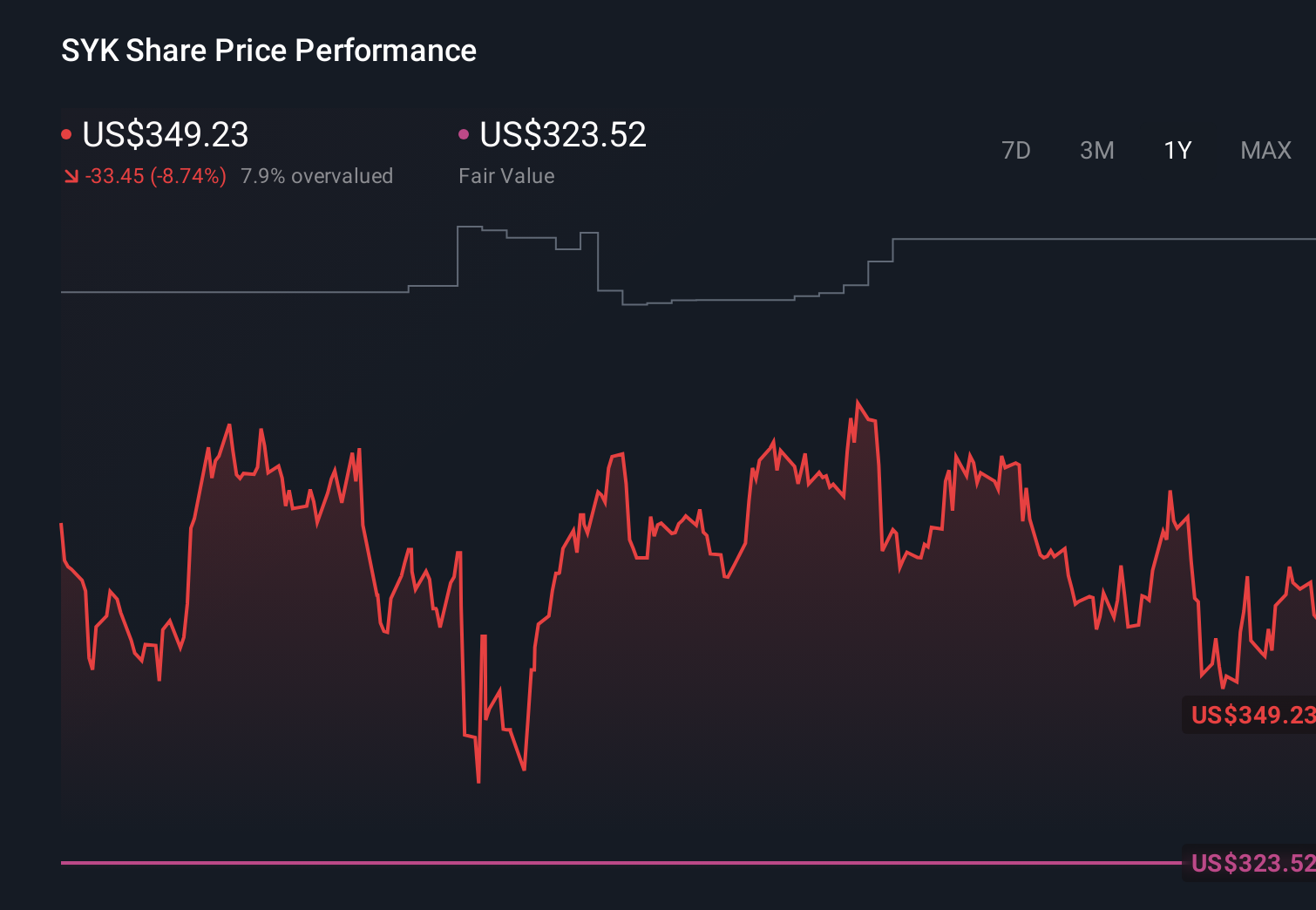
Six fair value estimates from the Simply Wall St Community span roughly US$331 to US$427 per share, underlining how far apart individual views can be. Set against this, ongoing pricing and reimbursement pressure from government payers could be an important swing factor for how Stryker’s future profitability, and those valuation views, evolve over time.
Explore 6 other fair value estimates on Stryker - why the stock might be worth just $331.44!
Form Your Own Verdict
Don't just follow the ticker - dig into the data and build a conviction that's truly your own.
- A great starting point for your Stryker research is our analysis highlighting 3 key rewards and 2 important warning signs that could impact your investment decision.
- Our free Stryker research report provides a comprehensive fundamental analysis summarized in a single visual - the Snowflake - making it easy to evaluate Stryker's overall financial health at a glance.
Looking For Alternative Opportunities?
Our daily scans reveal stocks with breakout potential. Don't miss this chance:
- We've uncovered the 12 dividend fortresses yielding 5%+ that don't just survive market storms, but thrive in them.
- Explore 24 top quantum computing companies leading the revolution in next-gen technology and shaping the future with breakthroughs in quantum algorithms, superconducting qubits, and cutting-edge research.
- AI is about to change healthcare. These 41 stocks are working on everything from early diagnostics to drug discovery. The best part - they are all under $10b in market cap - there's still time to get in early.
This article by Simply Wall St is general in nature. We provide commentary based on historical data and analyst forecasts only using an unbiased methodology and our articles are not intended to be financial advice. It does not constitute a recommendation to buy or sell any stock, and does not take account of your objectives, or your financial situation. We aim to bring you long-term focused analysis driven by fundamental data. Note that our analysis may not factor in the latest price-sensitive company announcements or qualitative material. Simply Wall St has no position in any stocks mentioned.