

How Investors May Respond To Bank of America (BAC) Dividend Hike Backed By Higher Quarterly Earnings
Bank of America Corp BAC | 0.00 |
- Bank of America recently raised its regular quarterly common stock dividend to US$0.32 per share, a US$0.04 increase, and reported second-quarter 2026 net income of US$9,074 million on net interest income of US$15,997 million, both higher than a year earlier.
- This higher shareholder payout, alongside improved credit costs with net charge-offs easing to US$1,412 million, underscores how the bank is balancing capital returns with loan portfolio risk management.
- Next, we’ll explore how this dividend increase, backed by stronger quarterly earnings, may influence Bank of America’s existing investment narrative.
The best AI stocks today may lie beyond giants like Nvidia and Microsoft. Find the next big opportunity with these 16 smaller AI-focused companies with strong growth potential through early-stage innovation in machine learning, automation, and data intelligence that could fund your retirement.
Bank of America Investment Narrative Recap
To own Bank of America, you need to be comfortable with a large, diversified lender that leans heavily on net interest income, disciplined credit costs, and consistent capital returns. The latest dividend increase and stronger second quarter earnings reinforce that story in the near term, while the most important short term catalyst remains how effectively the bank manages deposit costs. The biggest current risk is that shifting economic conditions could pressure credit quality and net interest margins, and this news does not materially change that.
Among the recent announcements, the board’s decision to redeem over US$6.1 billion of senior notes due 2027 stands out, as it sits alongside the higher common dividend and ongoing buybacks. Together, these moves give investors more context for how Bank of America is managing its balance sheet while returning capital, which ties back to the key catalyst around net interest income and earnings resilience.
Yet even with higher dividends and solid earnings, investors should be aware that rising competition for deposits could...
Bank of America's narrative projects $137.1 billion revenue and $38.0 billion earnings by 2029.
Uncover how Bank of America's forecasts yield a $68.11 fair value, a 10% upside to its current price.
Exploring Other Perspectives
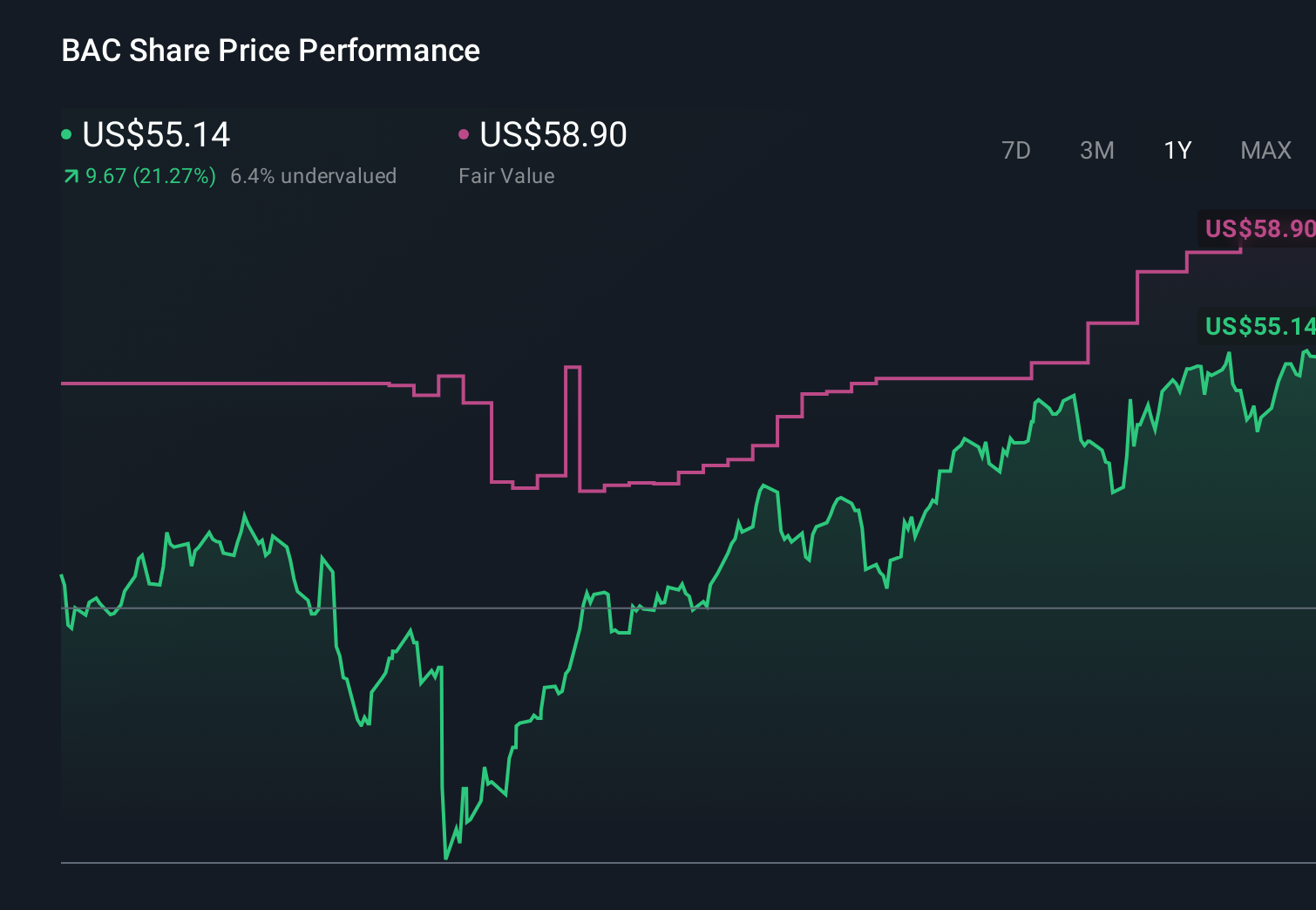
Three members of the Simply Wall St Community see Bank of America’s fair value between US$68.11 and US$75.88, underscoring how far opinions can stretch. Set this against the risk that funding costs rise faster than asset yields, and you start to see why it helps to weigh several different views on the bank’s earnings power.
Explore 3 other fair value estimates on Bank of America - why the stock might be worth just $68.11!
The Verdict Is Yours
Don't just follow the ticker - dig into the data and build a conviction that's truly your own.
- A great starting point for your Bank of America research is our analysis highlighting 4 key rewards and 1 important warning sign that could impact your investment decision.
- Our free Bank of America research report provides a comprehensive fundamental analysis summarized in a single visual - the Snowflake - making it easy to evaluate Bank of America's overall financial health at a glance.
Curious About Other Options?
Opportunities like this don't last. These are today's most promising picks. Check them out now:
- Uncover the next big thing with 20 elite penny stocks that balance risk and reward.
- Rare earth metals are the new gold rush. Find out which 29 stocks are leading the charge.
- Capitalize on the AI infrastructure supercycle with our selection of the 55 best 'picks and shovels' of the AI gold rush converting record-breaking demand into massive cash flow.
This article by Simply Wall St is general in nature. We provide commentary based on historical data and analyst forecasts only using an unbiased methodology and our articles are not intended to be financial advice. It does not constitute a recommendation to buy or sell any stock, and does not take account of your objectives, or your financial situation. We aim to bring you long-term focused analysis driven by fundamental data. Note that our analysis may not factor in the latest price-sensitive company announcements or qualitative material. Simply Wall St has no position in any stocks mentioned.