

How Investors May Respond To Brookfield Infrastructure Partners (BIP) Keeping Payout Steady As Losses Widen
Brookfield Infrastructure Partners L.P. BIP | 0.00 |
- Brookfield Infrastructure Partners L.P. reported past second-quarter 2026 results showing sales rising to US$6,482 million from US$5,429 million a year earlier, while net loss widened to US$24 million and basic loss per share from continuing operations moved to US$0.07 from US$0.03.
- Despite reporting a larger loss for both the quarter and first half of 2026, the partnership continued to declare its regular common and preferred distributions, underscoring management’s emphasis on maintaining cash returns to unitholders.
- We’ll now examine how Brookfield Infrastructure Partners’ decision to maintain its US$0.455 quarterly distribution influences the existing investment narrative.
Find 49 companies with promising cash flow potential yet trading below their fair value.
Brookfield Infrastructure Partners Investment Narrative Recap
To own Brookfield Infrastructure Partners, you have to be comfortable with a capital-intensive, acquisition-driven infrastructure model that prioritizes cash distributions even when reported earnings are under pressure. The latest quarter shows rising sales but a wider net loss, which keeps the spotlight on balance sheet resilience and funding costs as the key near-term catalyst and risk. For now, the Q2 loss does not appear to change that core tension in a material way.
The decision to affirm the US$0.455 quarterly distribution is the clearest signal in this update, especially alongside a six-month net loss of US$110 million. It ties directly to the central catalyst of BIP’s story: its ability to keep funding and growing cash payouts while managing higher leverage and refinancing needs. That same commitment, however, is also where the biggest risk lies if interest costs or regulatory pressures start to bite harder than expected.
Yet beneath the steady US$0.455 payout, investors should be aware that refinancing risk and higher borrowing costs could...
Brookfield Infrastructure Partners' narrative projects $16.7 billion revenue and $547.8 million earnings by 2029. This assumes an 11.3% yearly revenue decline and an earnings increase of about $243.8 million from $304.0 million today.
Uncover how Brookfield Infrastructure Partners' forecasts yield a $44.18 fair value, a 12% upside to its current price.
Exploring Other Perspectives
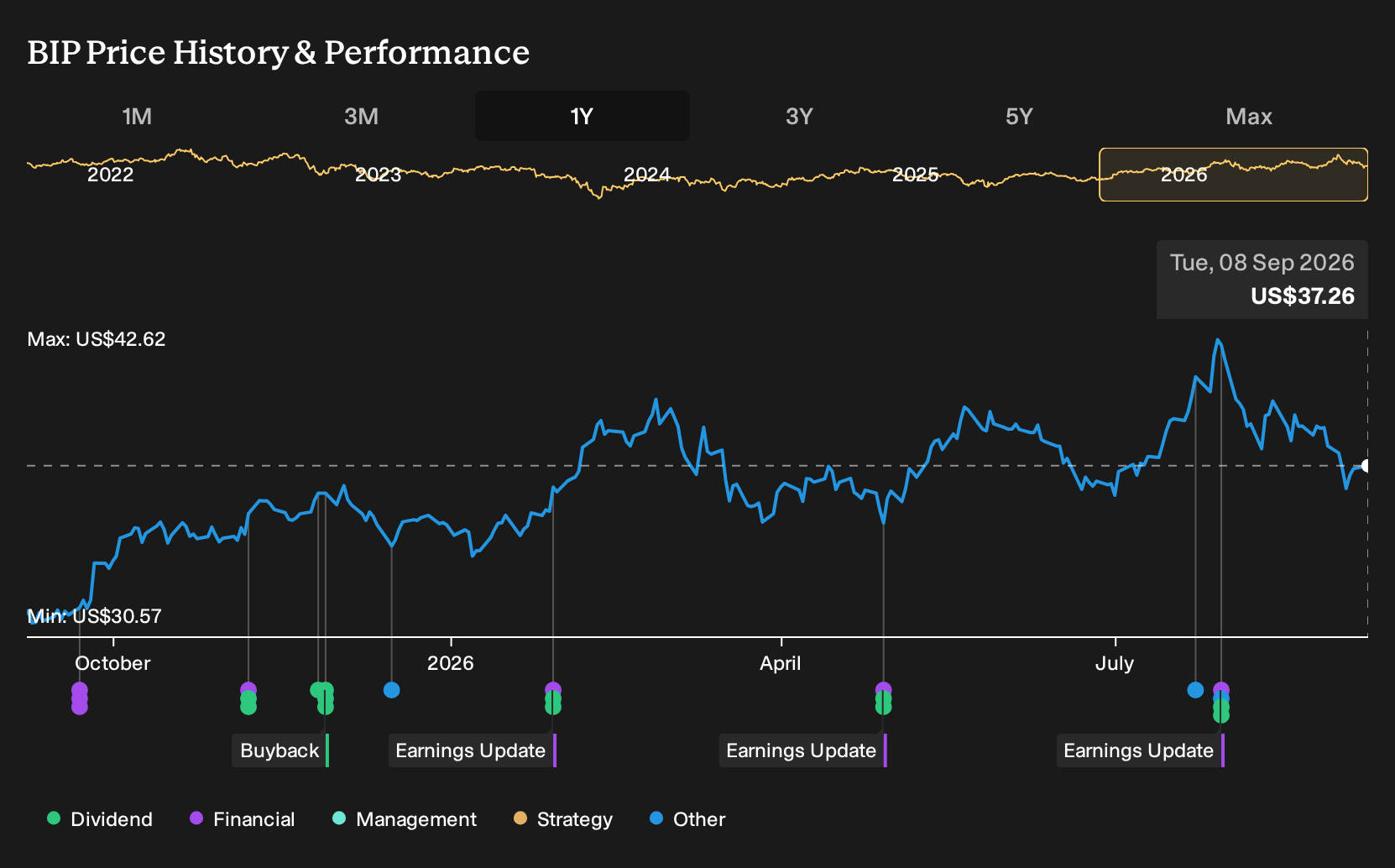
Before this Q2 loss, the most pessimistic analysts already expected BIP’s revenue to fall about 25% a year even as earnings climbed toward roughly US$1.2 billion by 2029, which is a much harsher view than the more balanced narrative and shows just how differently you might weigh the same risks and potential rewards.
Explore 5 other fair value estimates on Brookfield Infrastructure Partners - why the stock might be worth over 5x more than the current price!
Reach Your Own Conclusion
Don't just follow the ticker - dig into the data and build a conviction that's truly your own.
- A great starting point for your Brookfield Infrastructure Partners research is our analysis highlighting 2 key rewards and 3 important warning signs that could impact your investment decision.
- Our free Brookfield Infrastructure Partners research report provides a comprehensive fundamental analysis summarized in a single visual - the Snowflake - making it easy to evaluate Brookfield Infrastructure Partners' overall financial health at a glance.
Seeking Other Investments?
Every day counts. These free picks are already gaining attention. See them before the crowd does:
- Outshine the giants: these 16 early-stage AI stocks could fund your retirement.
- The future of work is here. Discover the 39 top robotics and automation stocks leading the charge in AI-driven automation and industrial transformation.
- AI is about to change healthcare. These 43 stocks are working on everything from early diagnostics to drug discovery. The best part - they are all under $10b in market cap - there's still time to get in early.
This article by Simply Wall St is general in nature. We provide commentary based on historical data and analyst forecasts only using an unbiased methodology and our articles are not intended to be financial advice. It does not constitute a recommendation to buy or sell any stock, and does not take account of your objectives, or your financial situation. We aim to bring you long-term focused analysis driven by fundamental data. Note that our analysis may not factor in the latest price-sensitive company announcements or qualitative material. Simply Wall St has no position in any stocks mentioned.