

How Investors May Respond To Copart (CPRT) Losing Insurance Volume To Rival IAA
Copart, Inc. CPRT | 0.00 |
- In 2025, commentators highlighted that Copart, Inc. faced rising competitive pressure as a major national insurance carrier shifted business to rival IAA, backed by RB Global, raising concerns about market share and earnings pressure in its core insurance-salvage segment.
- This comes despite Copart’s historically strong revenue expansion and healthy free cash flow margins, sharpening the contrast between its past operational strength and emerging questions about the resilience of its competitive position.
- Next, we’ll examine how the threat of insurers moving volume to competitors could reshape Copart’s investment narrative and long-term appeal.
Explore 29 top quantum computing companies leading the revolution in next-gen technology and shaping the future with breakthroughs in quantum algorithms, superconducting qubits, and cutting-edge research.
Copart Investment Narrative Recap
To own Copart, you have to believe its online salvage auctions and service ecosystem can stay central to how insurers dispose of totaled vehicles, even as competition and technology evolve. The recent loss of volume to IAA highlights that insurer relationships are the key near term catalyst and the primary risk: any further carrier shifts could weigh on growth and pricing, while stability or wins in these contracts would likely matter more than short term share price swings.
The most relevant recent update against this backdrop is Copart’s Q1 2026 result, with revenue of US$1,155.03 million and net income of US$403.71 million, both higher than a year earlier. That performance suggests the competitive pressure highlighted by commentators has not yet translated into a broad deterioration in reported results, but it keeps the focus firmly on how resilient Copart’s insurance volumes and fee economics will be if large carriers test alternative auction partners.
Yet investors should be aware that heavy dependence on large insurance relationships could start to matter much more if...
Copart's narrative projects $6.4 billion revenue and $2.1 billion earnings by 2028. This requires 11.1% yearly revenue growth and about a $0.5 billion earnings increase from $1.6 billion today.
Uncover how Copart's forecasts yield a $48.89 fair value, a 25% upside to its current price.
Exploring Other Perspectives
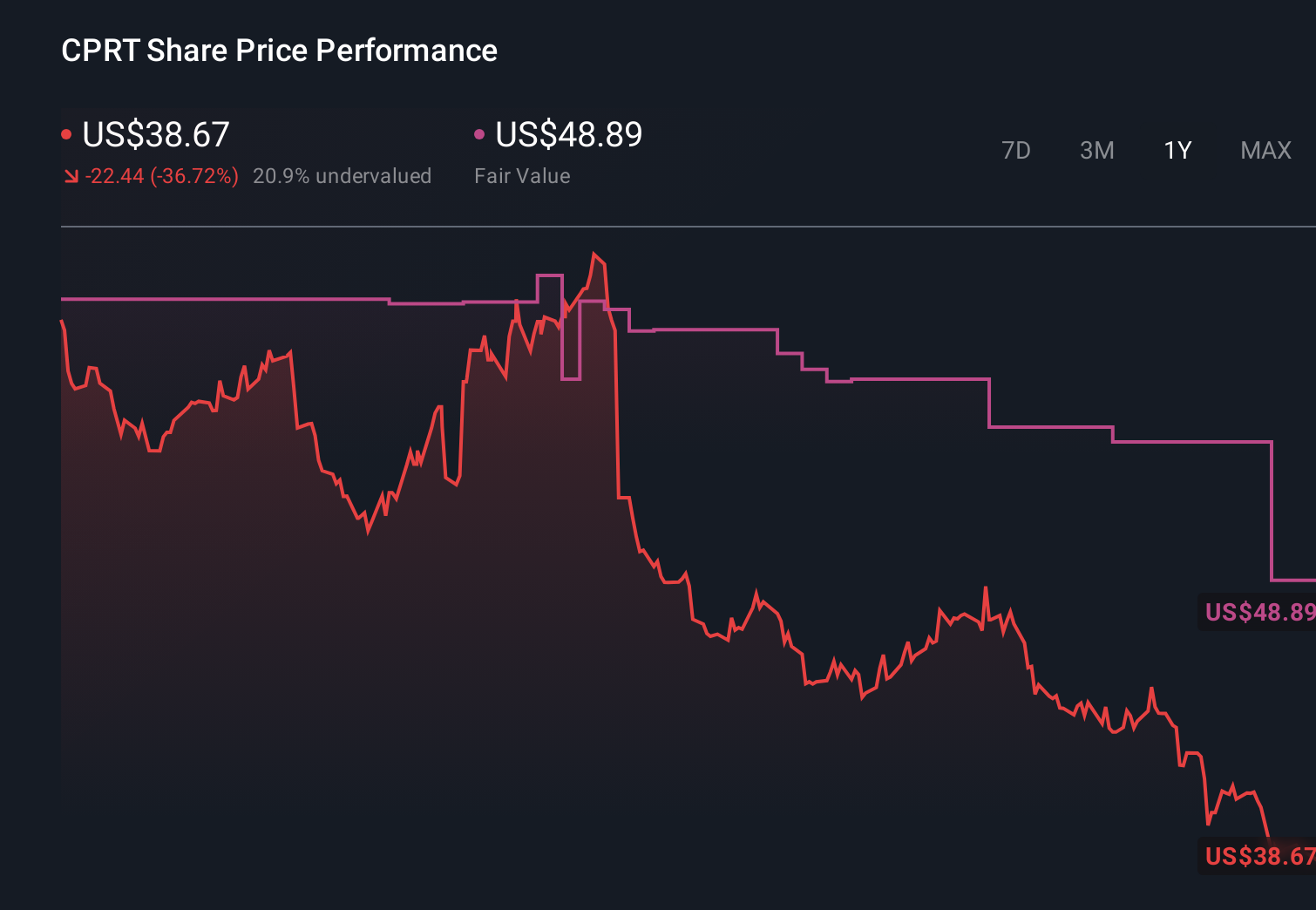
Ten members of the Simply Wall St Community currently estimate Copart’s fair value between US$38.55 and US$55.89, reflecting a wide span of individual expectations. Against this, the recent signs of intensified competition for insurer volumes raise practical questions about how resilient Copart’s core insurance salvage earnings can be over time, which readers may want to explore across several contrasting viewpoints.
Explore 10 other fair value estimates on Copart - why the stock might be worth as much as 43% more than the current price!
Build Your Own Copart Narrative
Disagree with existing narratives? Create your own in under 3 minutes - extraordinary investment returns rarely come from following the herd.
- A great starting point for your Copart research is our analysis highlighting 4 key rewards that could impact your investment decision.
- Our free Copart research report provides a comprehensive fundamental analysis summarized in a single visual - the Snowflake - making it easy to evaluate Copart's overall financial health at a glance.
Ready For A Different Approach?
The market won't wait. These fast-moving stocks are hot now. Grab the list before they run:
- We've found 11 US stocks that are forecast to pay a dividend yield of over 6% next year. See the full list for free.
- AI is about to change healthcare. These 29 stocks are working on everything from early diagnostics to drug discovery. The best part - they are all under $10b in market cap - there's still time to get in early.
- Find companies with promising cash flow potential yet trading below their fair value.
This article by Simply Wall St is general in nature. We provide commentary based on historical data and analyst forecasts only using an unbiased methodology and our articles are not intended to be financial advice. It does not constitute a recommendation to buy or sell any stock, and does not take account of your objectives, or your financial situation. We aim to bring you long-term focused analysis driven by fundamental data. Note that our analysis may not factor in the latest price-sensitive company announcements or qualitative material. Simply Wall St has no position in any stocks mentioned.