

How Investors May Respond To Halliburton (HAL) Earnings Beat And VoltaGrid New Energy Investment
Halliburton Company HAL | 0.00 |
- Earlier in 2026, Halliburton reported first-quarter adjusted earnings of US$0.55 per share, ahead of analyst expectations, after implementing cost reduction initiatives and limiting capital expenditure to US$192 million while holding about US$2.00 billion in cash and a debt-to-capitalization ratio of 39.6%.
- In a separate move, Halliburton joined Blackstone in a US$1.00 billion equity investment in VoltaGrid, underscoring its interest in behind-the-meter power solutions that support data centers, microgrids, and industrial customers.
- We’ll now explore how Halliburton’s cost-driven earnings beat and VoltaGrid investment may influence its investment narrative around new energy projects.
Rare earth metals are an input to most high-tech devices, military and defence systems and electric vehicles. The global race is on to secure supply of these critical minerals. Beat the pack to uncover the 33 best rare earth metal stocks of the very few that mine this essential strategic resource.
Halliburton Investment Narrative Recap
To own Halliburton, you need to believe it can offset long term fossil fuel headwinds with technology, international growth, and disciplined capital returns. The Q1 2026 earnings beat, driven by cost cuts, supports the near term margin story but does not materially change the key risk that decarbonization and shifting capital away from oilfield services could weigh on long run demand.
The US$1.00 billion equity investment in VoltaGrid, alongside Blackstone, is the most relevant development here. It directly connects Halliburton to behind the meter power solutions for data centers and industrial users, which ties into its newer energy technologies and could become an important counterweight to its dependence on North American shale activity over time.
Yet, against that upside, the real information investors should be watching is how exposed Halliburton remains if North American drilling weakens and...
Halliburton's narrative projects $24.6 billion revenue and $2.6 billion earnings by 2029. This requires 3.5% yearly revenue growth and about a $1.1 billion earnings increase from $1.5 billion today.
Uncover how Halliburton's forecasts yield a $41.64 fair value, in line with its current price.
Exploring Other Perspectives
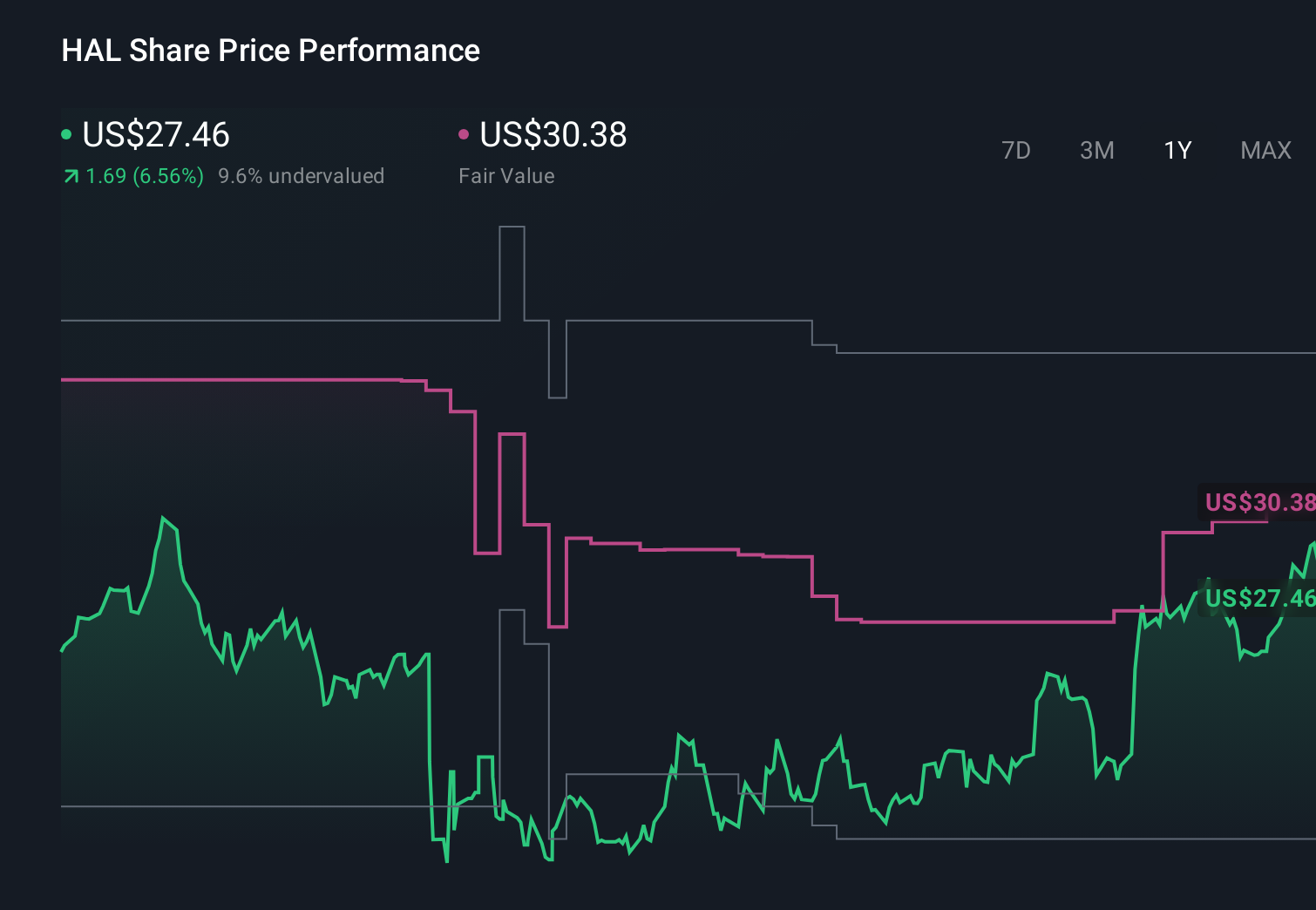
Some of the lowest ranked analysts were assuming roughly flat revenue near US$22.0 billion and 2029 earnings of about US$2.4 billion, which is a far more cautious view than the consensus. When you compare that to Halliburton’s recent cost driven earnings beat and its push into areas like VoltaGrid, it shows just how wide the range of opinions can be and why it is worth weighing different scenarios before you decide what this latest news might mean for you.
Explore 6 other fair value estimates on Halliburton - why the stock might be worth 31% less than the current price!
The Verdict Is Yours
Don't just follow the ticker - dig into the data and build a conviction that's truly your own.
- A great starting point for your Halliburton research is our analysis highlighting 3 key rewards and 3 important warning signs that could impact your investment decision.
- Our free Halliburton research report provides a comprehensive fundamental analysis summarized in a single visual - the Snowflake - making it easy to evaluate Halliburton's overall financial health at a glance.
Interested In Other Possibilities?
These stocks are moving-our analysis flagged them today. Act fast before the price catches up:
- Capitalize on the AI infrastructure supercycle with our selection of the 39 best 'picks and shovels' of the AI gold rush converting record-breaking demand into massive cash flow.
- Find 46 companies with promising cash flow potential yet trading below their fair value.
- Explore 26 top quantum computing companies leading the revolution in next-gen technology and shaping the future with breakthroughs in quantum algorithms, superconducting qubits, and cutting-edge research.
This article by Simply Wall St is general in nature. We provide commentary based on historical data and analyst forecasts only using an unbiased methodology and our articles are not intended to be financial advice. It does not constitute a recommendation to buy or sell any stock, and does not take account of your objectives, or your financial situation. We aim to bring you long-term focused analysis driven by fundamental data. Note that our analysis may not factor in the latest price-sensitive company announcements or qualitative material. Simply Wall St has no position in any stocks mentioned.