

How Investors May Respond To Halliburton (HAL) Losing a Key Board Voice on Risk Oversight
Halliburton Company HAL | 0.00 |
- Halliburton reported the recent passing of longtime director Abdulaziz F. Al Khayyal, who had served on its Board since 2014 and was a member of both the Audit and Health, Safety and Environment Committees at the time of his death on June 24, 2026.
- His death removes an experienced voice on financial oversight and operational risk, prompting investors to reassess Halliburton’s boardroom depth just as the company manages shifting oilfield activity patterns worldwide.
- We’ll now explore how the loss of a key board member intersects with Halliburton’s international growth focus and evolving investment narrative.
Rare earth metals are the new gold rush. Find out which 31 stocks are leading the charge.
Halliburton Investment Narrative Recap
To own Halliburton, you need to believe its international oilfield services, digital tools, and capital returns can offset softer North American shale activity and long term decarbonization risks. The loss of Abdulaziz F. Al Khayyal is a personal and governance setback but, given Halliburton’s broadly independent and experienced board, it does not appear to materially alter the near term focus on international execution or the key risk around fossil fuel exposure.
The most relevant recent announcement alongside this governance change is Halliburton’s Q1 2026 earnings, which highlighted solid international activity while North American revenues felt oil price pressure. That context matters here: investors now have to weigh the impact of losing an audit and HSE committee member at the same time the company is leaning on overseas growth and operational discipline to support margins and earnings consistency.
Yet behind Halliburton’s global growth story, there is a governance and fossil fuel concentration risk that investors should be aware of...
Halliburton's narrative projects $24.7 billion revenue and $2.6 billion earnings by 2029. This requires 3.7% yearly revenue growth and about a $1.1 billion earnings increase from $1.5 billion today.
Uncover how Halliburton's forecasts yield a $44.24 fair value, a 31% upside to its current price.
Exploring Other Perspectives
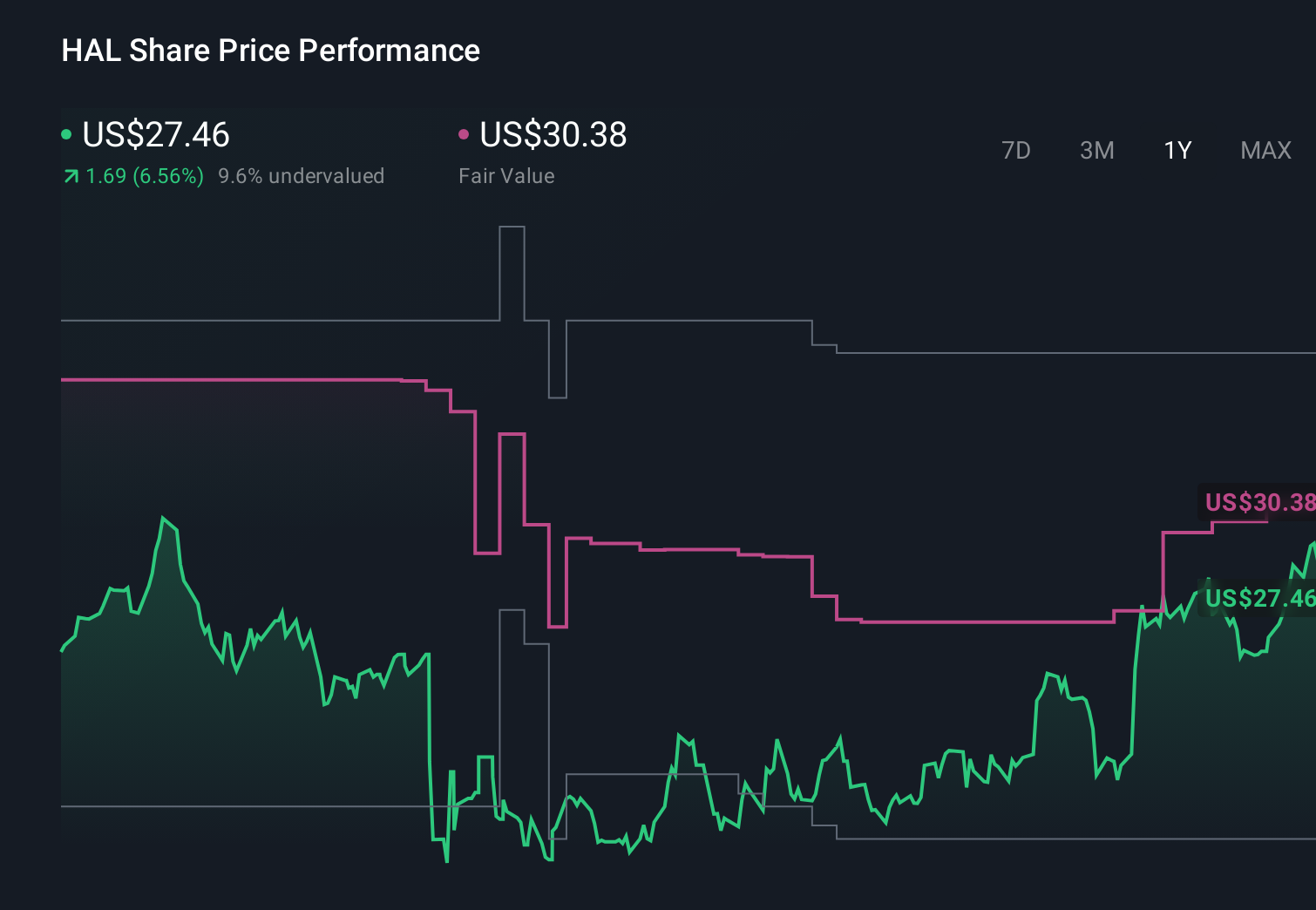
The most bullish analysts were expecting Halliburton to reach about US$25.8 billion in revenue and US$2.9 billion in earnings by 2029, which is a much more optimistic story than consensus. Their view that faster international growth and higher margins could justify those numbers may look different once the board change and current governance and fossil fuel risks are fully reflected, so it is worth comparing these contrasting opinions before you decide what you believe.
Explore 5 other fair value estimates on Halliburton - why the stock might be worth as much as 97% more than the current price!
The Verdict Is Yours
Disagree with existing narratives? Extraordinary investment returns rarely come from following the herd, so go with your instincts.
- A great starting point for your Halliburton research is our analysis highlighting 4 key rewards and 3 important warning signs that could impact your investment decision.
- Our free Halliburton research report provides a comprehensive fundamental analysis summarized in a single visual - the Snowflake - making it easy to evaluate Halliburton's overall financial health at a glance.
Ready To Venture Into Other Investment Styles?
The market won't wait. These fast-moving stocks are hot now. Grab the list before they run:
- AI is about to change healthcare. These 40 stocks are working on everything from early diagnostics to drug discovery. The best part - they are all under $10b in market cap - there's still time to get in early.
- Invest in the nuclear renaissance through our list of 89 elite nuclear energy infrastructure plays powering the global AI revolution.
- Uncover the next big thing with 20 elite penny stocks that balance risk and reward.
This article by Simply Wall St is general in nature. We provide commentary based on historical data and analyst forecasts only using an unbiased methodology and our articles are not intended to be financial advice. It does not constitute a recommendation to buy or sell any stock, and does not take account of your objectives, or your financial situation. We aim to bring you long-term focused analysis driven by fundamental data. Note that our analysis may not factor in the latest price-sensitive company announcements or qualitative material. Simply Wall St has no position in any stocks mentioned.