

How Investors May Respond To UnitedHealth Group (UNH) Covering Guardant’s Shield Blood Test For Colon Cancer
UnitedHealth Group Incorporated UNH | 0.00 |
- In recent days, Guardant Health announced that its Shield blood test for colorectal cancer screening is now covered for eligible UnitedHealth Group members aged 45 and over, making UnitedHealth the first major commercial insurer to reimburse this non-invasive test across its roughly 40 million-strong US membership base.
- This coverage expansion could strengthen UnitedHealth’s role in preventive care by widening access to innovative cancer screening technology at a time of rising colorectal cancer incidence in younger adults.
- Next, we’ll examine how becoming the first major insurer to cover the Shield blood test may influence UnitedHealth’s long-term investment narrative.
AI is about to change healthcare. These 40 stocks are working on everything from early diagnostics to drug discovery. The best part - they are all under $10b in market cap - there's still time to get in early.
UnitedHealth Group Investment Narrative Recap
To own UnitedHealth Group, you need to believe its scale, integrated insurance and services model, and execution on Medicare Advantage can support resilient earnings despite policy and cost pressures. The new coverage for Guardant’s Shield test fits its preventive care focus but is unlikely to change the key near term catalyst, which remains margin recovery in Medicare, or the main risk, that higher care utilization and policy changes could still weigh on earnings.
In that context, the upcoming second quarter 2026 earnings release on 16 July looks particularly relevant. Earlier this year, UnitedHealth reported quarterly revenue of US$111,721 million and raised earnings guidance, which reinforced investor focus on whether its repricing and cost-control efforts in Medicare Advantage are stabilizing margins. The Shield coverage decision now gives investors one more piece of information to weigh as they assess how sustainable that recovery might be.
But against this, investors should also be aware of mounting regulatory pressures and rising healthcare costs that could...
UnitedHealth Group's narrative projects $492.0 billion revenue and $21.8 billion earnings by 2029. This requires 3.0% yearly revenue growth and an earnings increase of about $9.8 billion from $12.0 billion today.
Uncover how UnitedHealth Group's forecasts yield a $411.31 fair value, in line with its current price.
Exploring Other Perspectives
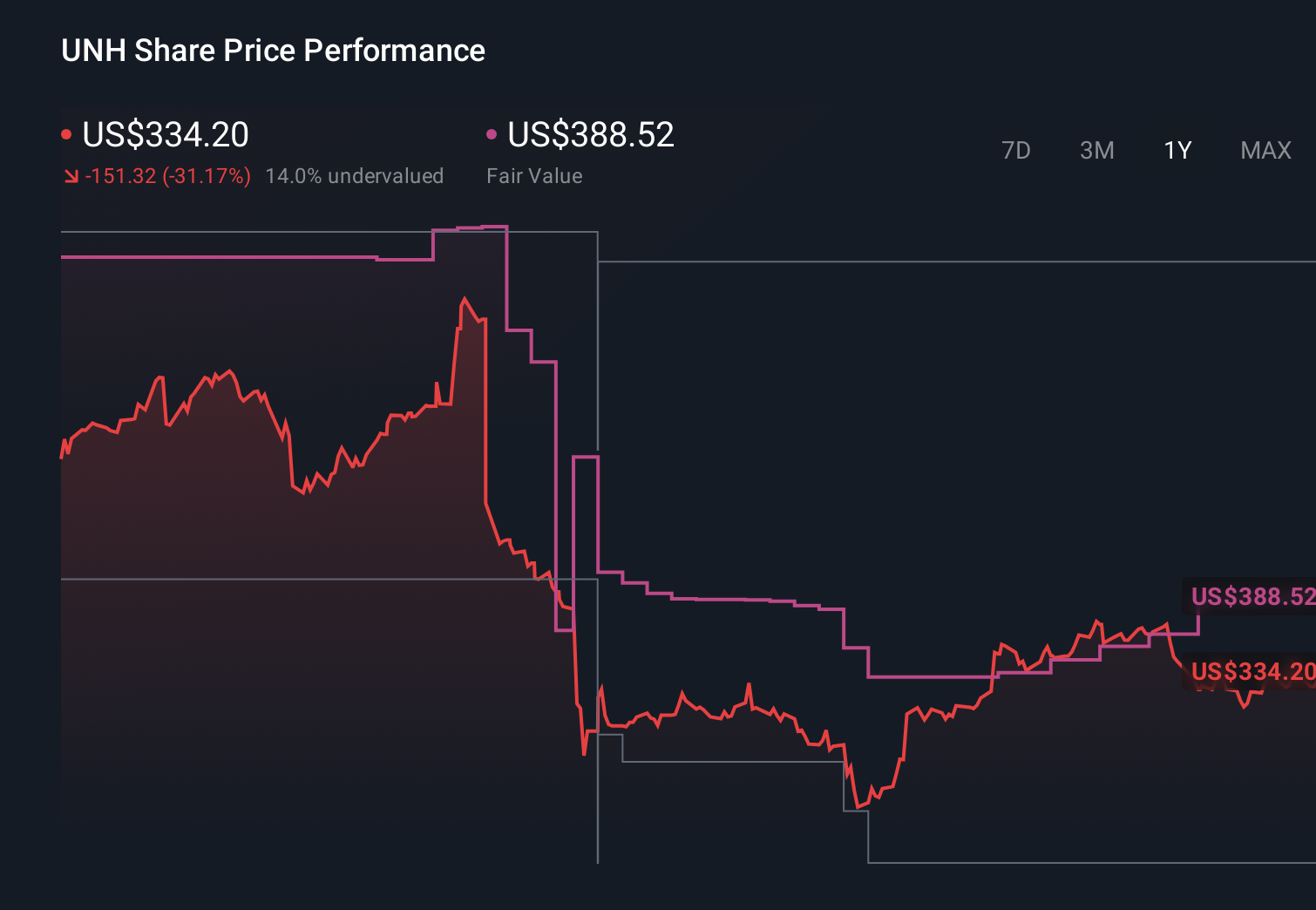
Some of the most optimistic analysts were already assuming earnings could reach about US$24.0 billion by 2029, yet today’s Shield coverage news and mounting regulatory pressures highlight how differently you and other investors might weigh upside catalysts against these unresolved risks.
Explore 55 other fair value estimates on UnitedHealth Group - why the stock might be worth over 2x more than the current price!
Form Your Own Verdict
Don't just follow the ticker - dig into the data and build a conviction that's truly your own.
- A great starting point for your UnitedHealth Group research is our analysis highlighting 3 key rewards and 2 important warning signs that could impact your investment decision.
- Our free UnitedHealth Group research report provides a comprehensive fundamental analysis summarized in a single visual - the Snowflake - making it easy to evaluate UnitedHealth Group's overall financial health at a glance.
No Opportunity In UnitedHealth Group?
Every day counts. These free picks are already gaining attention. See them before the crowd does:
- This technology could replace computers: discover 27 stocks that are working to make quantum computing a reality.
- Invest in the nuclear renaissance through our list of 89 elite nuclear energy infrastructure plays powering the global AI revolution.
- Uncover the next big thing with 20 elite penny stocks that balance risk and reward.
This article by Simply Wall St is general in nature. We provide commentary based on historical data and analyst forecasts only using an unbiased methodology and our articles are not intended to be financial advice. It does not constitute a recommendation to buy or sell any stock, and does not take account of your objectives, or your financial situation. We aim to bring you long-term focused analysis driven by fundamental data. Note that our analysis may not factor in the latest price-sensitive company announcements or qualitative material. Simply Wall St has no position in any stocks mentioned.