

How Investors May Respond To Walt Disney (DIS) Q2 Results And Disney+ “Super App” Strategy
Walt Disney Company DIS | 0.00 |
- In early May 2026, The Walt Disney Company reported fiscal Q2 results showing revenue of US$25.17 billion, up from US$23.62 billion a year earlier, while net income declined to US$2.25 billion from US$3.28 billion and earnings per share also decreased, alongside confirmation of share repurchases totaling 112,376,398 shares for US$12.06 billion since February 2024.
- The earnings release doubled as new CEO Josh D’Amaro’s first major update, highlighting plans to make Disney+ the central hub connecting streaming, sports, video games and theme parks, with greater use of AI and capital-light initiatives to improve how Disney earns money across its businesses.
- We’ll now examine how D’Amaro’s Disney+ “super app” vision and ecosystem focus may reshape the existing investment narrative for Disney.
Invest in the nuclear renaissance through our list of 91 elite nuclear energy infrastructure plays powering the global AI revolution.
Walt Disney Investment Narrative Recap
To own Disney today, you need to believe its content, parks and sports can work better together than they do apart, with Disney+ at the center. The latest quarter shows higher revenue but lower earnings, so the key near term catalyst remains execution on the Disney+ “super app” vision, while the biggest risk is that heavier digital and experiences spending does not translate into stronger profitability in a more cautious consumer backdrop.
The completion of Disney’s US$12.06 billion buyback since February 2024, retiring about 6.2% of shares, is the clearest recent signal of how management is allocating capital alongside this pivot toward an integrated streaming and experiences ecosystem. For investors, that program sits directly against the same risk that rising content, sports rights and park investment could pressure margins if engagement and spending across the Disney+ led bundle fall short.
But as attractive as the “super app” story sounds, investors should also be aware of the growing risk that younger audiences keep shifting toward short form, user generated content...
Walt Disney's narrative projects $110.7 billion revenue and $13.2 billion earnings by 2029. This requires 5.0% yearly revenue growth and about a $0.9 billion earnings increase from $12.3 billion today.
Uncover how Walt Disney's forecasts yield a $128.25 fair value, a 18% upside to its current price.
Exploring Other Perspectives
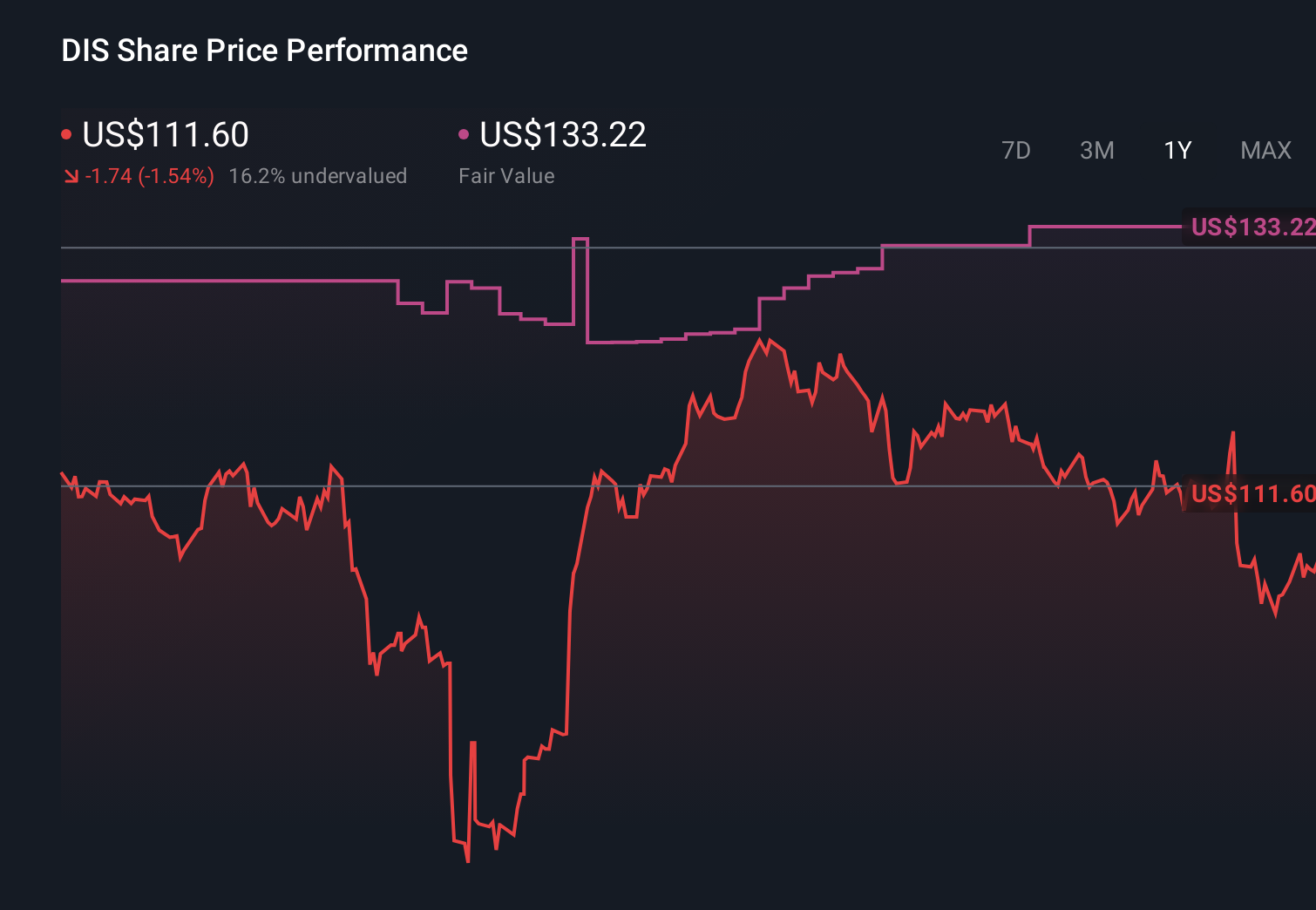
Seven members of the Simply Wall St Community currently see Disney’s fair value between US$110.33 and US$133.53, underlining how far opinions can spread. Set that against Disney’s higher revenue but lower recent earnings, and it becomes even more important to weigh how the Disney+ “super app” plan might influence future profitability and your own expectations for the business.
Explore 7 other fair value estimates on Walt Disney - why the stock might be worth just $110.33!
Form Your Own Verdict
Disagree with existing narratives? Extraordinary investment returns rarely come from following the herd, so go with your instincts.
- A great starting point for your Walt Disney research is our analysis highlighting 5 key rewards that could impact your investment decision.
- Our free Walt Disney research report provides a comprehensive fundamental analysis summarized in a single visual - the Snowflake - making it easy to evaluate Walt Disney's overall financial health at a glance.
Ready For A Different Approach?
Early movers are already taking notice. See the stocks they're targeting before they've flown the coop:
- This technology could replace computers: discover 27 stocks that are working to make quantum computing a reality.
- Uncover the next big thing with 25 elite penny stocks that balance risk and reward.
- Outshine the giants: these 16 early-stage AI stocks could fund your retirement.
This article by Simply Wall St is general in nature. We provide commentary based on historical data and analyst forecasts only using an unbiased methodology and our articles are not intended to be financial advice. It does not constitute a recommendation to buy or sell any stock, and does not take account of your objectives, or your financial situation. We aim to bring you long-term focused analysis driven by fundamental data. Note that our analysis may not factor in the latest price-sensitive company announcements or qualitative material. Simply Wall St has no position in any stocks mentioned.