

How Kinder Morgan’s New Long‑Dated Debt And Stronger Earnings At Kinder Morgan (KMI) Has Changed Its Investment Story
Kinder Morgan Inc Class P KMI | 0.00 |
- Kinder Morgan, Inc. recently completed two fixed‑income offerings totaling about US$1.75 billion, issuing 5.550% senior unsecured notes due August 1, 2036 and 6.150% senior unsecured notes due August 1, 2056, alongside reporting higher second‑quarter 2026 sales and net income than a year earlier.
- The combination of stronger earnings and sizable new long‑dated debt raises fresh questions about Kinder Morgan’s balance sheet flexibility and long‑term funding costs.
- Next, we’ll examine how Kinder Morgan’s new long‑maturity fixed‑rate notes reshape its existing investment narrative around leverage and earnings quality.
Explore 26 top quantum computing companies leading the revolution in next-gen technology and shaping the future with breakthroughs in quantum algorithms, superconducting qubits, and cutting-edge research.
Kinder Morgan Investment Narrative Recap
To own Kinder Morgan, you have to believe its large, mostly fee‑based energy infrastructure can keep generating steady cash flows despite high leverage and energy transition pressures. The new US$1.75 billion of long‑dated, fixed‑rate notes slightly tightens near‑term balance sheet flexibility but does not materially change the main near‑term catalyst, which is how consistently Kinder Morgan can convert current earnings into cash that supports its capital spending and dividends. The biggest risk remains that elevated debt and financing costs could weigh on future financial flexibility.
The recent second quarter 2026 results, with higher sales and net income than a year earlier, are the most relevant backdrop to the new bond issuance. Stronger earnings give Kinder Morgan more room to service its already sizable net debt of about US$32.3 billion, but they also bring renewed scrutiny to how much additional borrowing the business can comfortably support before leverage starts to constrain growth options or pressure its credit profile.
Yet investors should also be aware that Kinder Morgan's high net debt could become a more important issue if ...
Kinder Morgan's narrative projects $20.2 billion revenue and $3.7 billion earnings by 2029. This requires 4.8% yearly revenue growth and about a $0.4 billion earnings increase from $3.3 billion today.
Uncover how Kinder Morgan's forecasts yield a $35.33 fair value, a 10% upside to its current price.
Exploring Other Perspectives
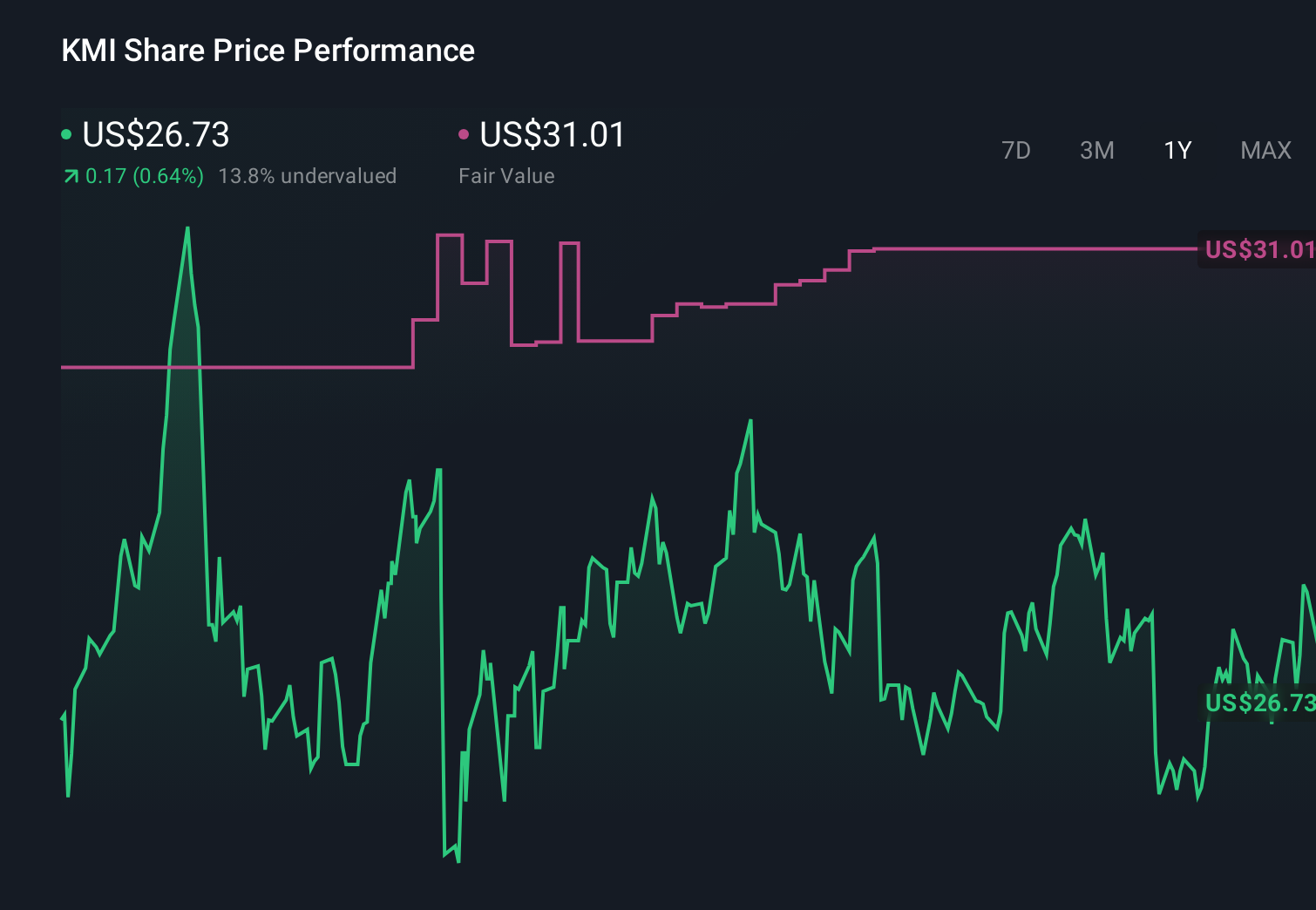
Three fair value estimates from the Simply Wall St Community span roughly US$35 to US$55 per share, showing how far apart individual views can be. When you set those side by side with Kinder Morgan’s sizable net debt and higher long term funding costs, it becomes even more important to weigh multiple perspectives on how sustainable its current earnings and capital structure really are.
Explore 3 other fair value estimates on Kinder Morgan - why the stock might be worth just $35.33!
Form Your Own Verdict
Don't just follow the ticker - dig into the data and build a conviction that's truly your own.
- A great starting point for your Kinder Morgan research is our analysis highlighting 3 key rewards and 2 important warning signs that could impact your investment decision.
- Our free Kinder Morgan research report provides a comprehensive fundamental analysis summarized in a single visual - the Snowflake - making it easy to evaluate Kinder Morgan's overall financial health at a glance.
Interested In Other Possibilities?
Every day counts. These free picks are already gaining attention. See them before the crowd does:
- We've uncovered the 9 dividend fortresses yielding 5%+ that don't just survive market storms, but thrive in them.
- AI is about to change healthcare. These 41 stocks are working on everything from early diagnostics to drug discovery. The best part - they are all under $10b in market cap - there's still time to get in early.
- Rare earth metals are an input to most high-tech devices, military and defence systems and electric vehicles. The global race is on to secure supply of these critical minerals. Beat the pack to uncover the 29 best rare earth metal stocks of the very few that mine this essential strategic resource.
This article by Simply Wall St is general in nature. We provide commentary based on historical data and analyst forecasts only using an unbiased methodology and our articles are not intended to be financial advice. It does not constitute a recommendation to buy or sell any stock, and does not take account of your objectives, or your financial situation. We aim to bring you long-term focused analysis driven by fundamental data. Note that our analysis may not factor in the latest price-sensitive company announcements or qualitative material. Simply Wall St has no position in any stocks mentioned.