

How Lower EPS, Steady Dividend and New 2026 Guidance At Honeywell (HON) Has Changed Its Investment Story
Honeywell International Inc. HON | 0.00 |
- Honeywell International’s Board of Directors recently declared a quarterly dividend of US$1.19 per share, payable on June 5, 2026, to shareholders of record as of May 15, 2026, and the company reported first quarter 2026 revenue of US$9.14 billion and net income of US$821 million.
- The combination of modest revenue growth with sharply lower earnings per share and fresh full-year guidance gives investors a clearer view of Honeywell’s 2026 profit profile and cash-return capacity.
- We’ll now examine how Honeywell’s lower quarterly earnings but reaffirmed dividend and updated 2026 guidance affect its investment narrative.
This technology could replace computers: discover 26 stocks that are working to make quantum computing a reality.
Honeywell International Investment Narrative Recap
To own Honeywell, you generally need to believe in its ability to convert a diversified industrial and aerospace footprint into steady cash generation through cycles. The latest results, with lower quarterly earnings but modest revenue growth and reaffirmed dividends, highlight that the most immediate catalyst and risk both center on execution: can Honeywell support its separation plan and capital returns while managing margin pressure from softer profitability and one off costs? This news does not materially change that focus.
The most relevant update here is Honeywell’s revised 2026 earnings guidance, which now calls for full year diluted EPS from continuing operations of US$8.88 to US$9.18. Set against a quarter where net income fell to US$821 million on US$9.14 billion of revenue, that range frames how management currently sees profitability recovering over the year, an important reference point when weighing the separation catalyst against cost and margin risks.
Yet investors should also be aware that separation related execution costs and tariff exposure could still pressure Honeywell’s margins and cash returns...
Honeywell International's narrative projects $44.8 billion revenue and $7.2 billion earnings by 2029. This requires 5.9% yearly revenue growth and a $3.2 billion earnings increase from $4.0 billion today.
Uncover how Honeywell International's forecasts yield a $247.90 fair value, a 14% upside to its current price.
Exploring Other Perspectives
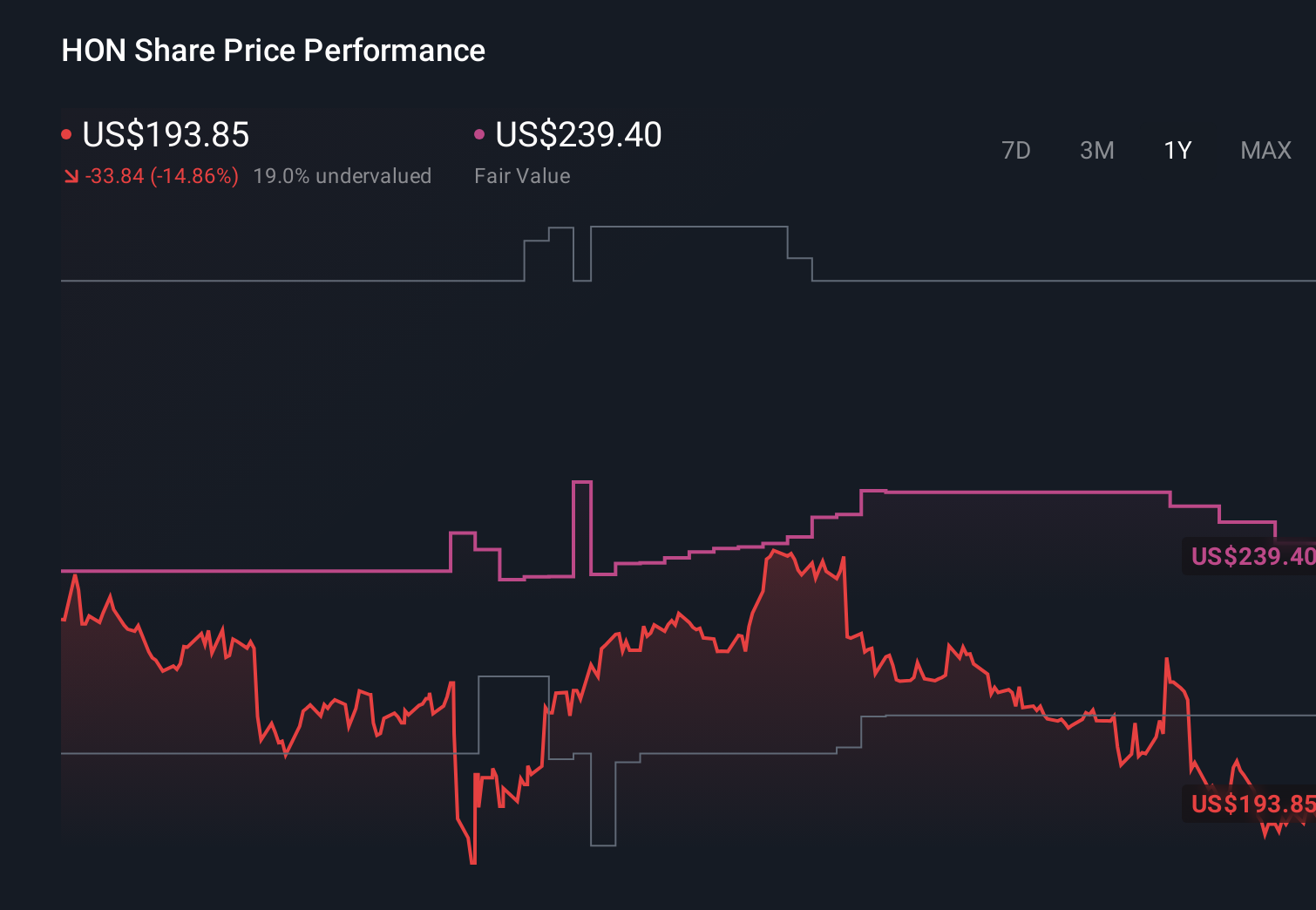
Some of the lowest estimate analysts were already more cautious, assuming revenue around US$43.1 billion and earnings near US$6.9 billion by 2029, which contrasts with the current guidance range and reminds you that informed views can differ widely and may shift again as this weaker quarter and new outlook are absorbed.
Explore 5 other fair value estimates on Honeywell International - why the stock might be worth 8% less than the current price!
The Verdict Is Yours
Disagree with existing narratives? Extraordinary investment returns rarely come from following the herd, so go with your instincts.
- A great starting point for your Honeywell International research is our analysis highlighting 3 key rewards and 2 important warning signs that could impact your investment decision.
- Our free Honeywell International research report provides a comprehensive fundamental analysis summarized in a single visual - the Snowflake - making it easy to evaluate Honeywell International's overall financial health at a glance.
No Opportunity In Honeywell International?
Early movers are already taking notice. See the stocks they're targeting before they've flown the coop:
- Capitalize on the AI infrastructure supercycle with our selection of the 39 best 'picks and shovels' of the AI gold rush converting record-breaking demand into massive cash flow.
- Outshine the giants: these 19 early-stage AI stocks could fund your retirement.
- The future of work is here. Discover the 33 top robotics and automation stocks leading the charge in AI-driven automation and industrial transformation.
This article by Simply Wall St is general in nature. We provide commentary based on historical data and analyst forecasts only using an unbiased methodology and our articles are not intended to be financial advice. It does not constitute a recommendation to buy or sell any stock, and does not take account of your objectives, or your financial situation. We aim to bring you long-term focused analysis driven by fundamental data. Note that our analysis may not factor in the latest price-sensitive company announcements or qualitative material. Simply Wall St has no position in any stocks mentioned.