

How Pitney Bowes’ New Automated Phoenix Presort Hub (PBI) Has Changed Its Investment Story
Pitney Bowes PBI | 0.00 |
- Pitney Bowes recently opened a 75,000-square-foot, highly automated Presort Services operating center in Phoenix, equipped with eight high-speed sorters, a connected conveyor system, and 17 dock doors, staffed across three shifts to handle First-Class Mail within its nationwide network.
- This expansion underscores the company’s push to boost processing capacity and efficiency across its Presort network, even as overall mail volumes face structural pressure.
- We’ll now examine how this new automated Phoenix facility could influence Pitney Bowes’ investment narrative and its push toward higher-quality recurring revenue.
Invest in the nuclear renaissance through our list of 88 elite nuclear energy infrastructure plays powering the global AI revolution.
Pitney Bowes Investment Narrative Recap
To own Pitney Bowes, you need to believe its shift toward higher quality, recurring SendTech and Presort revenues can offset structural mail decline and high leverage. The new automated Phoenix Presort facility modestly supports the near term earnings and efficiency catalyst, but it does not materially change the central risk that physical mail volumes could keep eroding faster than the company can streamline or win share.
The Phoenix expansion sits alongside management’s broader push on operational efficiency, including the company wide cost program targeting US$50 million to US$60 million of savings by the end of 2026. That initiative, if executed without hurting service, is closely tied to the same margin and free cash flow catalysts investors are watching in Presort, and it frames how this new facility might feed into a leaner, more automated network over time.
Yet behind this operational progress, investors should also be aware that if Presort volumes fall below expectations, the high fixed cost base could...
Pitney Bowes' narrative projects $1.8 billion revenue and $239.7 million earnings by 2029. This implies a 1.8% yearly revenue decline and a $95.0 million earnings increase from $144.7 million today.
Uncover how Pitney Bowes' forecasts yield a $15.05 fair value, a 11% downside to its current price.
Exploring Other Perspectives
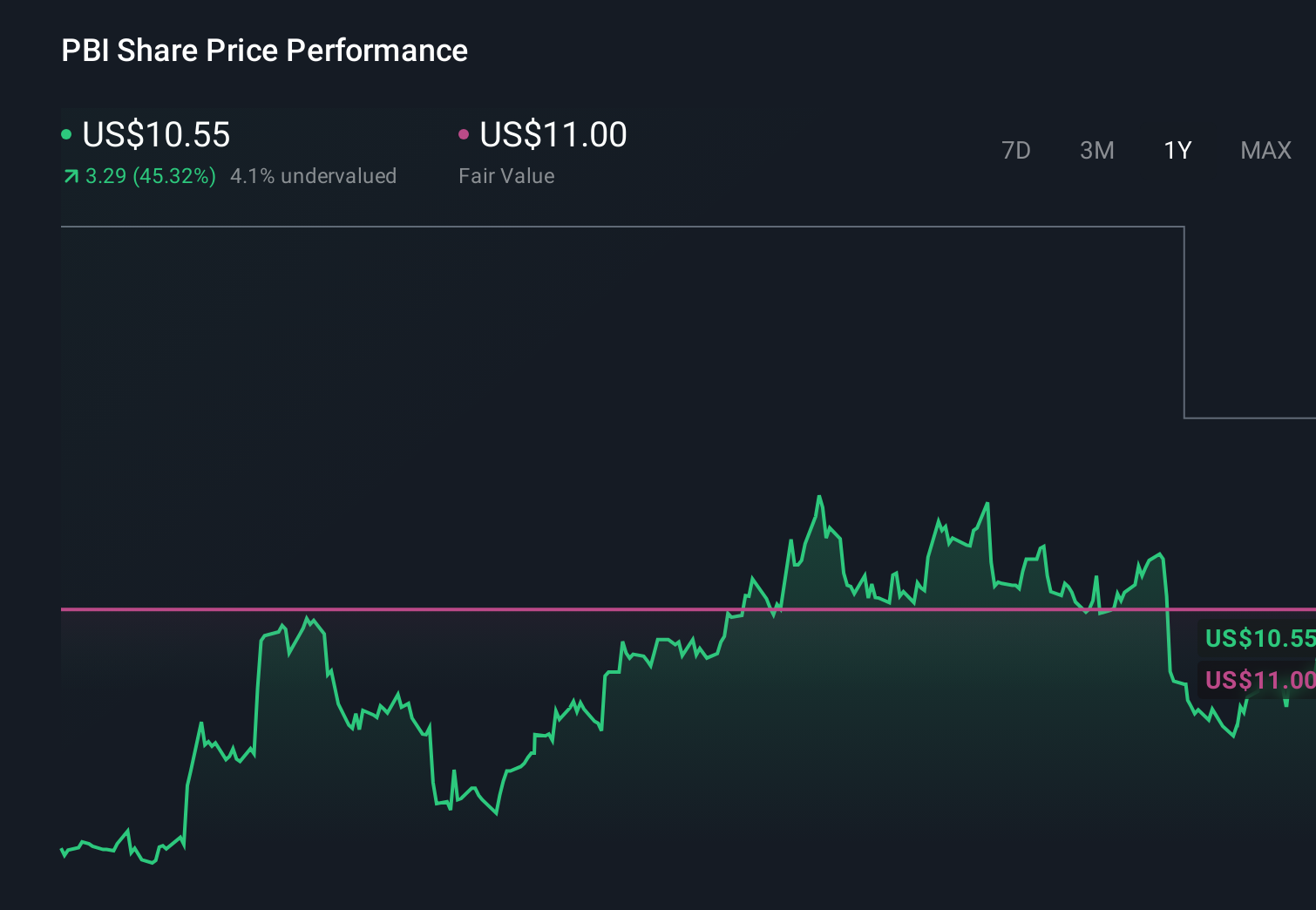
More optimistic analysts were already modeling roughly US$1.9 billion of revenue and about US$340 million of earnings by 2029, so this Phoenix build out may either reinforce their view or force a rethink of how fast Presort consolidation and efficiency gains can offset mail decline.
Explore 5 other fair value estimates on Pitney Bowes - why the stock might be worth 14% less than the current price!
Decide For Yourself
Don't just follow the ticker - dig into the data and build a conviction that's truly your own.
- A great starting point for your Pitney Bowes research is our analysis highlighting 4 key rewards and 3 important warning signs that could impact your investment decision.
- Our free Pitney Bowes research report provides a comprehensive fundamental analysis summarized in a single visual - the Snowflake - making it easy to evaluate Pitney Bowes' overall financial health at a glance.
Seeking Other Investments?
Early movers are already taking notice. See the stocks they're targeting before they've flown the coop:
- The future of work is here. Discover the 34 top robotics and automation stocks leading the charge in AI-driven automation and industrial transformation.
- AI is about to change healthcare. These 39 stocks are working on everything from early diagnostics to drug discovery. The best part - they are all under $10b in market cap - there's still time to get in early.
- Capitalize on the AI infrastructure supercycle with our selection of the 48 best 'picks and shovels' of the AI gold rush converting record-breaking demand into massive cash flow.
This article by Simply Wall St is general in nature. We provide commentary based on historical data and analyst forecasts only using an unbiased methodology and our articles are not intended to be financial advice. It does not constitute a recommendation to buy or sell any stock, and does not take account of your objectives, or your financial situation. We aim to bring you long-term focused analysis driven by fundamental data. Note that our analysis may not factor in the latest price-sensitive company announcements or qualitative material. Simply Wall St has no position in any stocks mentioned.