

How Truist’s CEO Transition and Stress Test Results Could Shape Truist Financial (TFC) Investors’ Outlook
TRUIST FINANCIAL CORPORATION TFC | 0.00 |
- Earlier this month, Truist Financial Corporation said Michael P. Lyons, former CEO of Fiserv and senior leader at PNC and Bank of America, will become its next president and chief executive officer on September 1, 2026, with current CEO Bill Rogers transitioning to executive chair until his planned retirement in April 2027.
- Together with favorable regulatory stress test results and ongoing support for community small-business programs, this leadership transition highlights Truist’s focus on disciplined risk management, digital capabilities, and long-term growth initiatives.
- We’ll now examine how Truist’s appointment of Michael Lyons as incoming CEO could influence its existing investment narrative and risk-reward profile.
Find 44 companies with promising cash flow potential yet trading below their fair value.
Truist Financial Investment Narrative Recap
To own Truist, you need to be comfortable with a large regional bank that is leaning into digital capabilities while still carrying meaningful exposure to traditional branches and commercial real estate. The Michael Lyons succession plan, together with steady regulatory stress test outcomes, supports the existing investment story and does not materially change the near term focus on credit quality and expense discipline as the key catalyst and risk.
Among recent updates, the 2026 Dodd Frank stress test results stand out, with regulators keeping Truist’s stress capital buffer at 2.5% until September 30, 2027. For investors watching how a new CEO might eventually balance growth initiatives against capital and credit risk, this outcome provides a current reference point for Truist’s risk management posture and its capacity to keep funding technology investments and community focused programs without immediate capital pressure.
But investors should also be aware of Truist’s above average commercial real estate exposure and what that could mean if...
Truist Financial's narrative projects $24.1 billion revenue and $6.1 billion earnings by 2029.
Uncover how Truist Financial's forecasts yield a $55.88 fair value, a 11% upside to its current price.
Exploring Other Perspectives
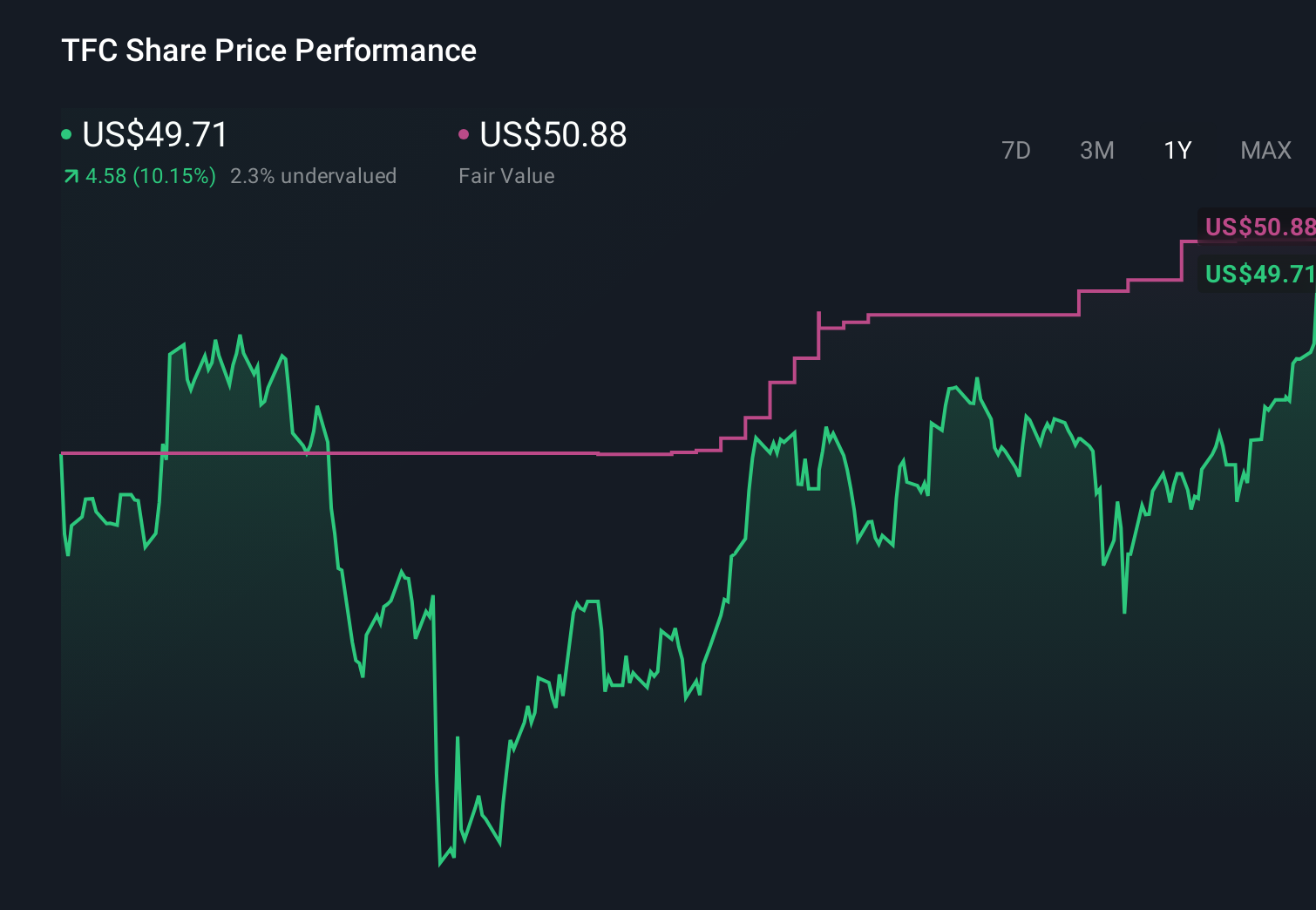
Two fair value estimates from the Simply Wall St Community span roughly US$55.88 to US$74.44 per share, showing how far apart individual views can be. When you set those opinions against Truist’s emphasis on digital adoption as a key earnings catalyst, it underlines why it can help to weigh several different perspectives before deciding what the stock is worth.
Explore 2 other fair value estimates on Truist Financial - why the stock might be worth just $55.88!
Reach Your Own Conclusion
Don't just follow the ticker - dig into the data and build a conviction that's truly your own.
- A great starting point for your Truist Financial research is our analysis highlighting 5 key rewards that could impact your investment decision.
- Our free Truist Financial research report provides a comprehensive fundamental analysis summarized in a single visual - the Snowflake - making it easy to evaluate Truist Financial's overall financial health at a glance.
Curious About Other Options?
Opportunities like this don't last. These are today's most promising picks. Check them out now:
- The future of work is here. Discover the 29 top robotics and automation stocks leading the charge in AI-driven automation and industrial transformation.
- Explore 30 top quantum computing companies leading the revolution in next-gen technology and shaping the future with breakthroughs in quantum algorithms, superconducting qubits, and cutting-edge research.
- Invest in the nuclear renaissance through our list of 89 elite nuclear energy infrastructure plays powering the global AI revolution.
This article by Simply Wall St is general in nature. We provide commentary based on historical data and analyst forecasts only using an unbiased methodology and our articles are not intended to be financial advice. It does not constitute a recommendation to buy or sell any stock, and does not take account of your objectives, or your financial situation. We aim to bring you long-term focused analysis driven by fundamental data. Note that our analysis may not factor in the latest price-sensitive company announcements or qualitative material. Simply Wall St has no position in any stocks mentioned.