

How Viasat’s New Protected Tactical SATCOM‑Global Contract (VSAT) Has Changed Its Investment Story
ViaSat, Inc. VSAT | 0.00 |
- Earlier in June 2026, Viasat announced it had been awarded a prime contract by the U.S. Space Force to build, launch and operate the first small, maneuverable geosynchronous satellite under the Protected Tactical SATCOM‑Global program, including ground systems and five years of operations support.
- This Swarm 1 Delivery Order advances Viasat’s role in secure, anti‑jam military communications and could deepen its position as a key supplier of resilient GEO satellite infrastructure to the U.S. defense community.
- We’ll now examine how this new Protected Tactical SATCOM‑Global satellite award may influence Viasat’s investment narrative and longer-term contract visibility.
Capitalize on the AI infrastructure supercycle with our selection of the 48 best 'picks and shovels' of the AI gold rush converting record-breaking demand into massive cash flow.
Viasat Investment Narrative Recap
To own Viasat today, you have to believe its pivot toward secure government and mobility connectivity can eventually outweigh fixed broadband erosion, high leverage and heavy CapEx. The new Protected Tactical SATCOM Global award looks supportive for the near term contract pipeline and visibility, but it does not directly change the fact that balance sheet pressure and execution on ViaSat 3 remain the key swing factors for the story.
The recent FTZ production request in Georgia, focused on advanced ground antenna systems and RF components, ties neatly into the Space Force award. If approved, it could help Viasat align manufacturing and supply chains with its growing defense and government backlog, reinforcing the near term catalyst around contract execution while still leaving the longer term questions about capital intensity, competition and integration open.
Yet, while contracts like PTS G can look reassuring, the potential implications of rising legal, regulatory and competitive pressures are something investors should be very aware of...
Viasat's narrative projects $5.1 billion revenue and $557.4 million earnings by 2029.
Uncover how Viasat's forecasts yield a $51.14 fair value, a 22% downside to its current price.
Exploring Other Perspectives
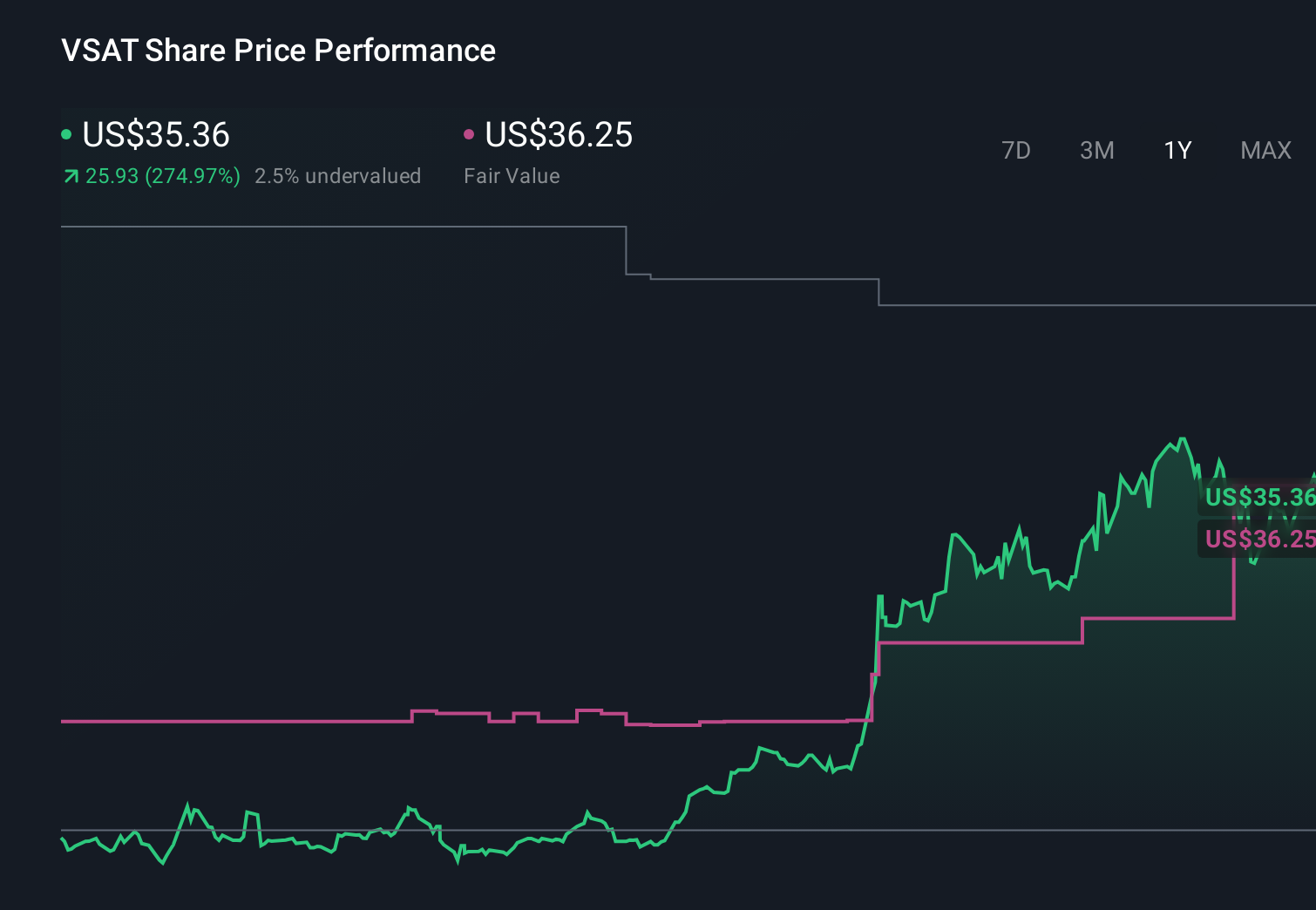
Some of the most optimistic analysts were already modeling revenue of about US$5.1 billion and earnings near US$569 million by 2029, but they also warned that rapid low Earth orbit competition could pressure Viasat’s GEO model, showing just how differently you and other investors might view this new Space Force win and why it is worth weighing multiple viewpoints before deciding what this stock represents for you.
Explore 8 other fair value estimates on Viasat - why the stock might be worth 27% less than the current price!
Form Your Own Verdict
Disagree with existing narratives? Extraordinary investment returns rarely come from following the herd, so go with your instincts.
- A great starting point for your Viasat research is our analysis highlighting 2 key rewards and 3 important warning signs that could impact your investment decision.
- Our free Viasat research report provides a comprehensive fundamental analysis summarized in a single visual - the Snowflake - making it easy to evaluate Viasat's overall financial health at a glance.
Want Some Alternatives?
Don't miss your shot at the next 10-bagger. Our latest stock picks just dropped:
- Outshine the giants: these 14 early-stage AI stocks could fund your retirement.
- Invest in the nuclear renaissance through our list of 88 elite nuclear energy infrastructure plays powering the global AI revolution.
- Find 47 companies with promising cash flow potential yet trading below their fair value.
This article by Simply Wall St is general in nature. We provide commentary based on historical data and analyst forecasts only using an unbiased methodology and our articles are not intended to be financial advice. It does not constitute a recommendation to buy or sell any stock, and does not take account of your objectives, or your financial situation. We aim to bring you long-term focused analysis driven by fundamental data. Note that our analysis may not factor in the latest price-sensitive company announcements or qualitative material. Simply Wall St has no position in any stocks mentioned.