

HP (HPQ) Stock May Be Below Fair Value On Raised EPS Guidance
HP Inc. HPQ | 0.00 |
HP stock has gained 36.1% year to date, and current valuation checks suggest the market price is still below an internally estimated intrinsic value based on a Discounted Cash Flow (DCF) approach and supporting earnings multiples.
- Year to date, HP has returned 36.1%, which puts recent momentum front and center for anyone assessing whether the current price already reflects improved expectations.
- Growing AI focused PC shipments can help support longer term cash flow expectations, while higher memory and storage costs may pressure margins and limit how much value investors are willing to ascribe to those future cash flows.
- On Simply Wall St’s broader checks, HP screens as undervalued in 5 of 6 areas, so the overall picture currently leans cheap rather than fully priced.
The issue now is whether HP’s recent rerating has already captured most of that perceived discount or still leaves a meaningful gap to intrinsic value.
Does HP Look Undervalued on Cash Flow?
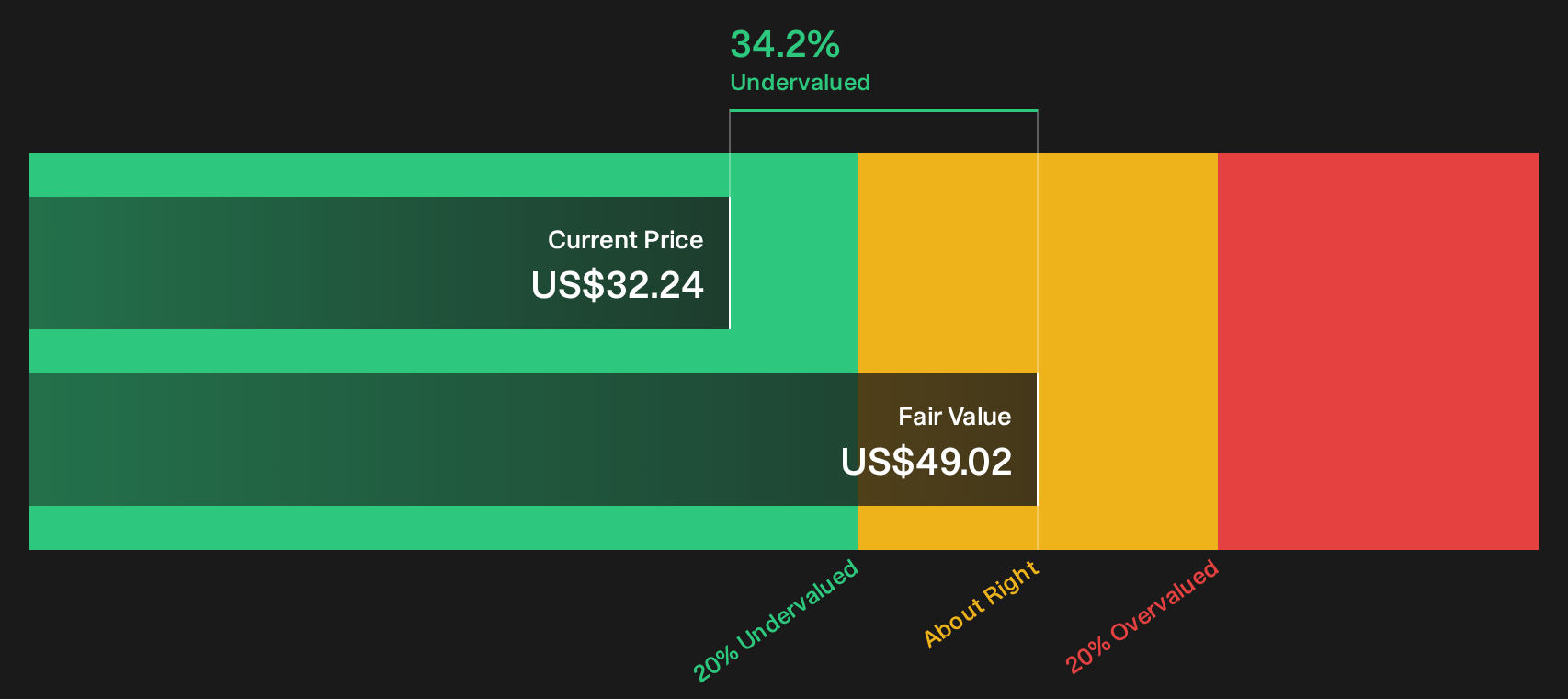
The Discounted Cash Flow (DCF) model values HP by projecting future free cash flows and discounting them back to today. For HP, the model starts from latest twelve month free cash flow of about $3.8b and then assumes that cash flows soften modestly over time rather than grow aggressively. On those assumptions, the DCF model points to an intrinsic value of about $43.87 per share in $.
That compares with a current share price that sits roughly 31.4% below the DCF estimate, which suggests HP looks undervalued on this cash flow view. HP’s recent Q2 2026 update, with AI PCs now a larger share of shipments and input costs pressuring margins, helps explain why the market is cautious even though the cash flow profile used in the model is still relatively steady.
On balance, HP appears undervalued, with the share price sitting well below what its discounted cash flows imply.
Our Discounted Cash Flow (DCF) analysis suggests HP is undervalued by 31.4%. Track this in your watchlist or portfolio, or discover 52 more high quality undervalued stocks.
Does HP Look Undervalued on Earnings?
The P/E ratio suits HP because earnings are still the main anchor for how this mature hardware business is priced. HP currently trades on a P/E of about 10.8x, which is well below the broader tech industry average of 20.7x and also below a peer group average of 67.8x. This alone points to a sizeable discount even before adjusting for the company’s specific risk and return profile.
On Simply Wall St’s more tailored fair value model, which weighs HP’s growth, margins, size and risks, a P/E of about 24.6x is suggested as reasonable. That is more than double the current P/E, so the stock screens as undervalued on earnings even after allowing for input cost pressures and mixed sentiment toward PC spending.
On this P/E view, HP stock appears undervalued, with the market pricing its earnings well below what the tailored fair multiple suggests.

The HP Narrative: What Would Justify Today's Price?
Simply Wall St Narratives take the valuation puzzle around HP and spell out which paths for HP's growth, margins and earnings would need to play out for the stock to be worth materially more or less than today, and they sit on the company’s Community page. Instead of giving a single number like a P/E or DCF output, they describe the future those numbers quietly assume so you can watch how HP's actual progress compares.
One of the top community narratives on HP: 67% overvalued
"Several firms with Underweight or Underperform ratings see margin risk as memory costs rise, PC demand is pulled forward into the first half, and the second half of 2026 absorbs lower volumes alongside higher component pricing…"
Do you think there's more to the story for HP? Head over to our Community to see what others are saying!
The Bottom Line
HP screens as undervalued on both the Discounted Cash Flow (DCF) intrinsic value estimate and on earnings multiples, which point in the same direction even after factoring in sector specific risks. The gap between market price and intrinsic value reflects investor concern that higher input costs and mixed PC demand could weigh on margins for longer. The key question from here is whether HP can translate AI focused PC demand into stable, cash generative growth without a sustained margin squeeze. That is what will decide whether the current discount is an opportunity or a fair warning about profit pressure.
This article by Simply Wall St is general in nature. We provide commentary based on historical data and analyst forecasts only using an unbiased methodology and our articles are not intended to be financial advice. It does not constitute a recommendation to buy or sell any stock, and does not take account of your objectives, or your financial situation. We aim to bring you long-term focused analysis driven by fundamental data. Note that our analysis may not factor in the latest price-sensitive company announcements or qualitative material. Simply Wall St has no position in any stocks mentioned.