

HP (HPQ) Stock Trades Below Fair Value As Caution Persists
HP Inc. HPQ | 0.00 |
HP stock has had a strong run so far this year, yet both the Discounted Cash Flow (DCF) intrinsic value estimate and market multiple checks still indicate that the shares are trading at a discount to what the underlying cash flows suggest.
- Year to date the stock is up about 33.5%, so investors are now weighing whether the recent gains have fully reflected HP's underlying cash generation.
- The recent multiyear global Wi Fi patent cross licensing agreement with Huawei can support long term cash flows, while ongoing pressure on PC and printing demand remains a key risk for how much of that cash ultimately materialises.
- A high value score of 5 out of 6 suggests the broader checks lean toward HP still looking inexpensive on both intrinsic value and earnings based measures.
The stock's next move may depend on whether HP's current price already reflects this implied discount to intrinsic value or if there is still a reasonable margin between the two.
Compare HP's setup to other companies that strong valuation checks also flag as potentially mispriced by scanning the hand picked 49 high quality undervalued stocks list.
Is HP a Bargain on Cash Flow?
The Discounted Cash Flow (DCF) approach looks at what HP's future cash generation could be worth in today's terms. HP produced about $3.84b of free cash flow over the last twelve months, and the model assumes these cash flows broadly stabilize and then gently decline rather than rely on aggressive expansion.
On those assumptions, the DCF model points to an intrinsic value of about $43.91 per share. Compared with the current market price, this suggests HP screens as roughly 32.8% undervalued. The recent multiyear Wi Fi patent cross licensing deal with Huawei provides extra visibility on part of HP's future cash flows, yet the share price remains below the level indicated by this discounted cash flow model.
Overall, the DCF analysis suggests HP stock currently appears undervalued relative to the cash flows implied in this model.
Our Discounted Cash Flow (DCF) analysis suggests HP is undervalued by 32.8%. Track this in your watchlist or portfolio, or discover 49 more high quality undervalued stocks.
Is HP a Bargain on Earnings?
The P/E multiple suits HP because earnings remain a key anchor for how investors value mature hardware and printing businesses. HP currently trades on a P/E of about 10.6x, which is well below the Tech industry average of roughly 19.5x and far under a broader peer average of about 60.1x.
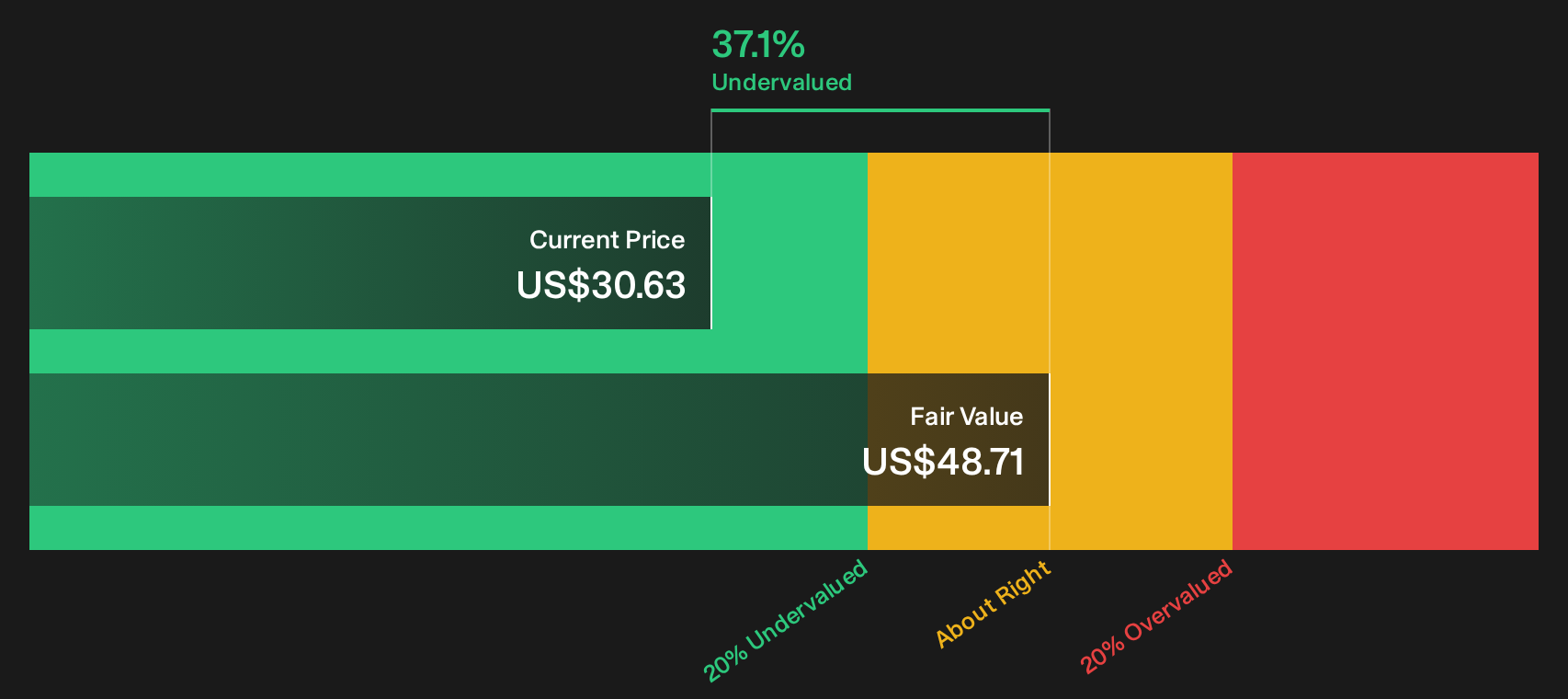
The model-based fair P/E for HP is about 24.5x, which reflects what investors might pay given its earnings profile, industry position and risk factors. The gap between this fair multiple and the current 10.6x level indicates that the stock screens as undervalued on earnings, even after the recent share price strength and the attention around the Huawei Wi Fi patent cross-licensing deal.
On this P/E comparison, HP stock looks undervalued relative to both its industry and the fair multiple implied by its fundamentals.

The HP Narrative: What Would Justify Today's Price?
Simply Wall St Narratives aim to close the gap between HP's valuation puzzle and the assumptions behind it by explaining what would need to happen to HP's growth, margins and earnings for the stock to be worth materially more or less than the current price. Rather than relying on a single multiple or model output, each Narrative sets out the assumptions underlying its view of fair value so you can compare them with HP's actual results on the Community page over time.
Community views on HP are sharply split, with one camp focused on AI and cost savings and the other fixated on margin pressure and slower PCs.
Bull case: roughly fairly valued
"HP's acquisition of Humane and integration of their AI-powered platform CosmOS is expected to accelerate the development of an intelligent ecosystem across HP's devices, likely contributing to an increase in revenue and net margins as the company positions itself at the forefront of workplace technology innovation…"
Bear case: 26% overvalued
"The print and PC hardware markets remain intensely competitive, as highlighted by "a more aggressive pricing environment" in Print and "disciplined pricing actions" needed to offset competitor moves. Ongoing commoditization and price competition threaten HP's net margins and profitability, despite cost mitigation efforts…"
Do you think there's more to the story for HP? Head over to our Community to see what others are saying!
The Bottom Line
HP screens as undervalued on both the Discounted Cash Flow (DCF) intrinsic value estimate and the current earnings multiple, so the valuation work broadly points in the same direction. That spread reflects a market that is still cautious on how durable HP's cash flows will be, especially with ongoing pressure on PCs and printing. For you as an investor, the key question is whether HP can sustain margins and cash generation in the face of that demand risk, or whether the current discount represents the market correctly pricing in a potential value trap.
This article by Simply Wall St is general in nature. We provide commentary based on historical data and analyst forecasts only using an unbiased methodology and our articles are not intended to be financial advice. It does not constitute a recommendation to buy or sell any stock, and does not take account of your objectives, or your financial situation. We aim to bring you long-term focused analysis driven by fundamental data. Note that our analysis may not factor in the latest price-sensitive company announcements or qualitative material. Simply Wall St has no position in any stocks mentioned.