

Immunome (IMNM) Reports A Wider Loss, Is The Premium Valuation Justified?
Immunome, Inc. IMNM | 0.00 |
Immunome (IMNM) reported second quarter 2026 results that showed a wider loss, which may be influencing how investors view the stock following the announcement earlier in August 2026.
At a share price of US$28.01, Immunome has seen a 26.11% 1-month share price return and a 34.53% year-to-date share price return, alongside a 1-year total shareholder return of 182.36%. This suggests that recent earnings news is being weighed against a much stronger longer-term rerating.
If Immunome's moves have caught your attention, this could be a moment to look at other healthcare related opportunities using the Simply Wall St screener for 40 healthcare AI stocks
For Immunome, the sharp 1 year share price gain sits beside a larger recent loss and a bigger net loss in the latest quarter. Is this mainly a story of improving business prospects, or of changing sentiment around the stock?
Preferred Price-to-Book Multiple of 6.1x for Immunome: Is it justified?
Immunome is currently trading at a P/B ratio of 6.1x, which is higher than both its closest peers and the broader US Biotechs industry average. At a last close of $28.01, that valuation level indicates that the market is placing a premium on the stock compared to many other biotech companies.
The P/B ratio compares a company's share price with its book value per share. For a business like Immunome that is still unprofitable and focused on oncology drug development, investors often look at P/B because traditional earnings based metrics such as P/E are less useful. A higher P/B can reflect expectations for future value creation from the pipeline, rather than current profitability.
However, Simply Wall St's checks indicate that Immunome looks expensive on this measure, both against its direct peers and against the wider US Biotechs group. The stock trades at 6.1x book value, while the peer average is 4.2x and the industry average is 2.5x. That is a meaningful premium, which suggests the market is pricing in stronger future outcomes than are currently visible in past earnings.
Result: Price-to-book of 6.1x (OVERVALUED)
However, you also need to weigh risks, such as Immunome's ongoing net losses of $254.323 million and the absence of reported revenue so far.
Another View on Immunome using the SWS DCF model
The earlier discussion characterized Immunome as expensive on a 6.1x P/B ratio compared with peers and the broader US Biotechs group. The SWS DCF model, however, points in a different direction. It estimates a fair value of about $115.29 per share, while Immunome trades at $28.01.
This difference suggests the stock is trading at roughly a quarter of this modelled future cash flow value. For you as an investor, the key question is which signal carries more weight right now: the premium P/B multiple or the much lower DCF-based price.
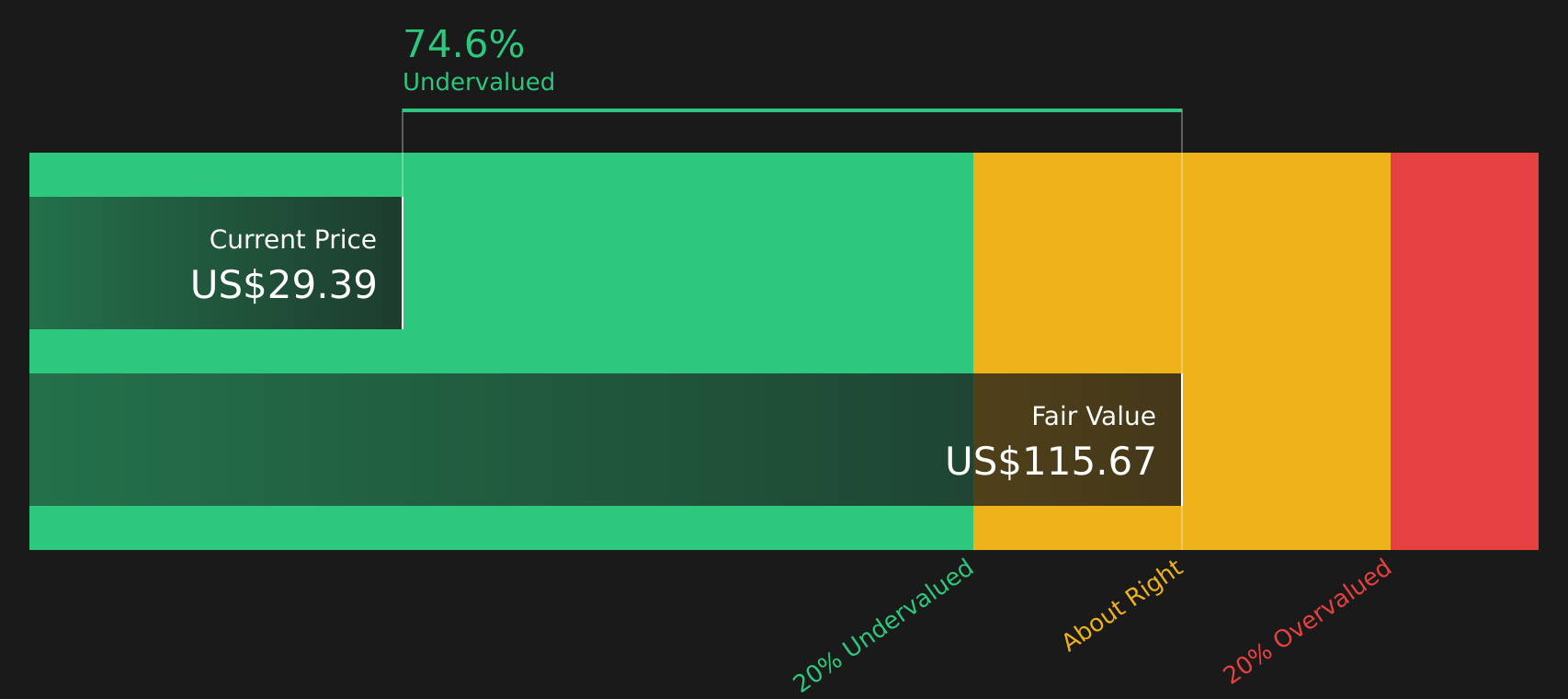
Simply Wall St performs a discounted cash flow (DCF) on every stock in the world every day (check out Immunome for example). We show the entire calculation in full. You can track the result in your watchlist or portfolio and be alerted when this changes, or use our stock screener to discover 49 high quality undervalued stocks. If you save a screener we even alert you when new companies match - so you never miss a potential opportunity.
Next Steps
Given the mixed signals around Immunome, it makes sense to move quickly, review the underlying data yourself, and decide how the stock fits your approach. To help you balance both the concerns and the potential upside, take a closer look at the 3 key rewards and 3 important warning signs
Looking for more investment ideas beyond Immunome?
Before moving on from Immunome, take a moment to widen your watchlist and line up a few fresh ideas that could better match your risk and return priorities.
- Target potential mispricings by scanning companies that combine quality fundamentals with attractive valuations using the 49 high quality undervalued stocks.
- Strengthen your income stream by reviewing stocks focused on reliable cash payouts through the 12 dividend fortresses.
- Reduce portfolio stress by checking companies that score well on resilience and stability through the 74 resilient stocks with low risk scores.
This article by Simply Wall St is general in nature. We provide commentary based on historical data and analyst forecasts only using an unbiased methodology and our articles are not intended to be financial advice. It does not constitute a recommendation to buy or sell any stock, and does not take account of your objectives, or your financial situation. We aim to bring you long-term focused analysis driven by fundamental data. Note that our analysis may not factor in the latest price-sensitive company announcements or qualitative material. Simply Wall St has no position in any stocks mentioned.