

In One Chart | Top 10 US Stock Buyback Leaders of 2025 Revealed! Apple Dominates with Nearly $100 Billion, Google and NVIDIA Among Tech Giants Leading the Charge
Apple Inc. AAPL | 0.00 | |
Alphabet Inc. Class A GOOGL | 0.00 | |
NVIDIA Corporation NVDA | 0.00 | |
Jpmorgan Chase JPM | 0.00 | |
Bank of America Corp BAC | 0.00 |
Stock buybacks refer to publicly listed companies repurchasing a portion of their outstanding shares from the market using cash or other resources. This practice serves as a strategic tool for signaling confidence, optimizing capital structure, and enhancing shareholder value. In Stock buybacks refer to publicly listed companies repurchasing a portion of their outstanding shares from the market using cash or other resources. This practice serves as a strategic tool for signaling confidence, optimizing capital structure, and enhancing shareholder value. In the U.S. stock market, buybacks have been a key driver of the decade-long bull market.
This year, tech and financial giants have unleashed a buyback frenzy, with U.S. publicly listed companies repurchasing shares at an unprecedented pace. The total buyback volume has surpassed $1 trillion at record speed, becoming a critical force behind the continuous highs of the S&P 500 and Nasdaq indices.
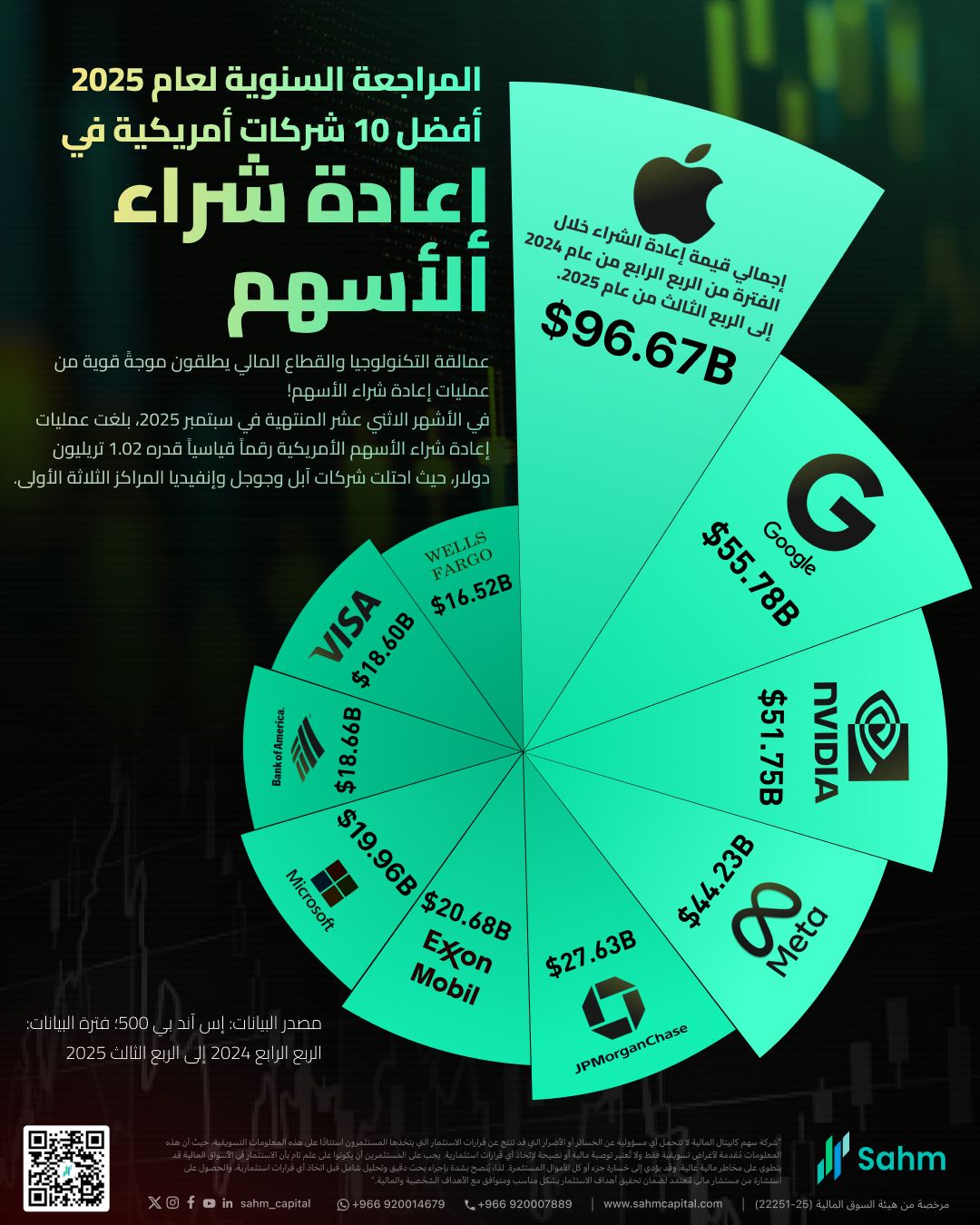
According to S&P Global data, U.S. stock buybacks reached a record $1.02 trillion during the 12 months from Q4 2024 to Q3 2025, reflecting an 11.1% year-over-year increase compared to $918.4 billion in the prior period. Buyback activity in 2025 is expected to set another all-time high.
The buyback landscape continues to be dominated by tech giants, alongside leading companies in the financial and energy sectors. Notable names among the top 10 buyback leaders include tech behemoths such as Apple Inc.(AAPL.US), Alphabet Inc. Class A(GOOGL.US), and NVIDIA Corporation(NVDA.US); financial powerhouses like JPMorgan Chase & Co.(JPM.US) and Bank of America Corporation(BAC.US); and energy giant Exxon Mobil Corporation(XOM.US).
Tech and Financial Giants Anchor Market Stability Amid Buyback Surge
Since the beginning of the year, tech and financial giants have spearheaded a capital buyback frenzy, emerging as the cornerstone of the U.S. market’s sustained rally.
In May, Apple Inc.(AAPL.US) announced a massive $100 billion buyback plan, while Alphabet Inc. Class A(GOOGL.US) followed suit with a $70 billion repurchase program. Most recently, AI chip leader NVIDIA Corporation(NVDA.US) joined the buyback wave, unveiling a $60 billion buyback plan after releasing its quarterly results in late August.
The financial sector has also been highly active, with major U.S. banks leading the charge. JPMorgan Chase & Co.(JPM.US) revealed a $50 billion buyback program in July, while Bank of America Corporation(BAC.US) committed to repurchasing $40 billion worth of shares. Morgan Stanley(MS.US) reinstated authorization for up to $20 billion in buybacks.
While tech giants are ramping up capital expenditures to strengthen their AI advantages, they are simultaneously increasing buyback volumes and dividend payouts to appease shareholders. For instance, during the 12 months from Q4 2024 to Q3 2025, Apple is expected to repurchase $96.67 billion worth of shares, securing its position as the leader in buyback activity. Over the past decade, Apple has invested approximately $755.23 billion in buybacks, a key factor behind its long-term stock appreciation.
Other major tech players, including Alphabet Inc. Class A(GOOGL.US), NVIDIA Corporation(NVDA.US), Meta Platforms(META.US), and Microsoft Corporation(MSFT.US), are also among the top 10 buyback leaders. Many of these companies have seen their stock prices hit record highs in the second half of the year, with NVIDIA’s market capitalization crossing the $5 trillion milestone, making it the first company globally to achieve this feat.
Despite the stock market’s upward momentum fueled by buybacks, the trend has sparked criticism among certain members of the Trump administration. While companies often justify buybacks as a natural outcome of surplus cash, U.S. Treasury Secretary Bessent publicly criticized companies like Boeing Company(BA.US) on August 27 for prioritizing large-scale buybacks over research and development investments.
A report by JPMorgan Chase highlights that S&P 500 companies have consistently returned excess capital to investors through buybacks and dividends, demonstrating strong performance. Over the past decade, total shareholder returns have grown from $905 billion to approximately $1.8 trillion, representing a compound annual growth rate of about 7%. This year, the number of buyback announcements reached a record high, with daily buyback volumes averaging $4–5billion, compared to $4 billion in 2024. However, slower execution in recent quarters has left a backlog of $1.3 trillion in “unexecuted buybacks.”
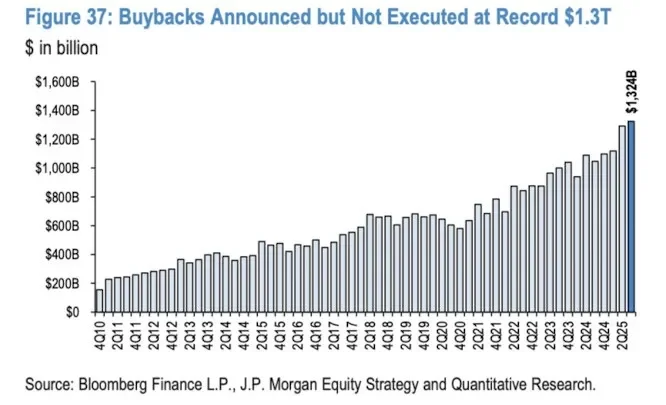
JPMorgan predicts that 86% of buybacks in 2025 will be funded by cash reserves. However, with multiple interest rate cuts expected and higher capital expenditure announcements on the horizon, debt financing is likely to play a greater role in next year’s buyback activity. Notably, around 60% of buyback announcements are concentrated among the top 20 companies, many of which are heavily investing in AI. While chipmakers are increasing buyback volumes, the pace of growth may moderate slightly.
Wall Street Bullish on S&P 500 Index, Targets 8,000 Points in 2026
Despite the S&P 500 hovering near historic highs, Wall Street remains optimistic about further gains. As the year-end approaches, major investment banks have set ambitious targets for the index, projecting levels well above its recent close of 6,834.5 points last Friday.
Citigroup has set a 2026 target of 7,700 points for the S&P 500, with a bullish scenario forecasting a rise to 8,300 points. Oppenheimer, Deutsche Bank, and Morgan Stanley have issued positive outlooks of 8,100 points, 8,000 points, and 7,800 points, respectively. Additionally, UBS, Goldman Sachs, and JPMorgan Chase have forecasted targets exceeding 7,500 points. Even the most conservative among the mainstream Wall Street banks, Bank of America, expects the index to close at around 7,100 points in December 2026.
The optimism is driven by several factors, including the Federal Reserve’s anticipated rate cuts, liquidity easing, accelerated corporate earnings growth fueled by AI, a soft landing for the U.S. economy, and continued fiscal stimulus.