
Institutional investors must be pleased after a 6.4% gain last week that adds to Accel Entertainment, Inc.'s (NYSE:ACEL) one-year returns
Accel Entertainment, Inc. Class A ACEL | 11.04 | +0.36% |
Key Insights
- Significantly high institutional ownership implies Accel Entertainment's stock price is sensitive to their trading actions
- 51% of the business is held by the top 6 shareholders
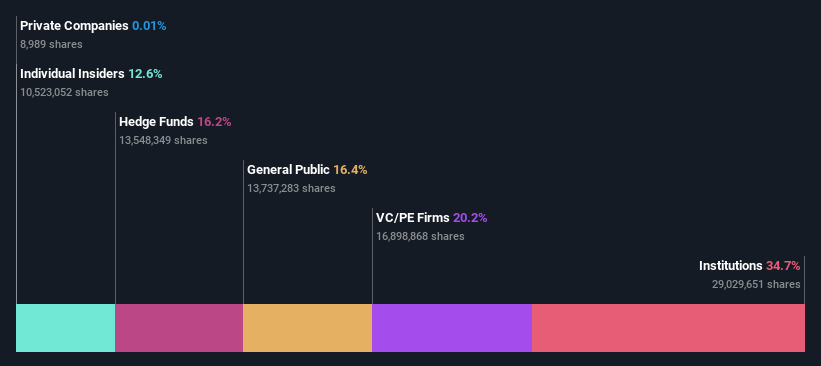
Every investor in Accel Entertainment, Inc. (NYSE:ACEL) should be aware of the most powerful shareholder groups. The group holding the most number of shares in the company, around 35% to be precise, is institutions. In other words, the group stands to gain the most (or lose the most) from their investment into the company.
And last week, institutional investors ended up benefitting the most after the company hit US$849m in market cap. The gains from last week would have further boosted the one-year return to shareholders which currently stand at 1.2%.
Let's take a closer look to see what the different types of shareholders can tell us about Accel Entertainment.
What Does The Institutional Ownership Tell Us About Accel Entertainment?
Institutions typically measure themselves against a benchmark when reporting to their own investors, so they often become more enthusiastic about a stock once it's included in a major index. We would expect most companies to have some institutions on the register, especially if they are growing.
We can see that Accel Entertainment does have institutional investors; and they hold a good portion of the company's stock. This implies the analysts working for those institutions have looked at the stock and they like it. But just like anyone else, they could be wrong. When multiple institutions own a stock, there's always a risk that they are in a 'crowded trade'. When such a trade goes wrong, multiple parties may compete to sell stock fast. This risk is higher in a company without a history of growth. You can see Accel Entertainment's historic earnings and revenue below, but keep in mind there's always more to the story.

Our data indicates that hedge funds own 16% of Accel Entertainment. That catches my attention because hedge funds sometimes try to influence management, or bring about changes that will create near term value for shareholders. Clairvest Group Inc. is currently the largest shareholder, with 20% of shares outstanding. With 9.7% and 6.5% of the shares outstanding respectively, Darlington Partners Capital Management, LP and Greenvale Capital LP are the second and third largest shareholders. Furthermore, CEO Andrew Rubenstein is the owner of 5.1% of the company's shares.
We also observed that the top 6 shareholders account for more than half of the share register, with a few smaller shareholders to balance the interests of the larger ones to a certain extent.
While it makes sense to study institutional ownership data for a company, it also makes sense to study analyst sentiments to know which way the wind is blowing. Quite a few analysts cover the stock, so you could look into forecast growth quite easily.
Insider Ownership Of Accel Entertainment
The definition of an insider can differ slightly between different countries, but members of the board of directors always count. The company management answer to the board and the latter should represent the interests of shareholders. Notably, sometimes top-level managers are on the board themselves.
I generally consider insider ownership to be a good thing. However, on some occasions it makes it more difficult for other shareholders to hold the board accountable for decisions.
It seems insiders own a significant proportion of Accel Entertainment, Inc.. Insiders own US$107m worth of shares in the US$849m company. This may suggest that the founders still own a lot of shares. You can click here to see if they have been buying or selling.
General Public Ownership
With a 16% ownership, the general public, mostly comprising of individual investors, have some degree of sway over Accel Entertainment. While this group can't necessarily call the shots, it can certainly have a real influence on how the company is run.
Private Equity Ownership
With an ownership of 20%, private equity firms are in a position to play a role in shaping corporate strategy with a focus on value creation. Sometimes we see private equity stick around for the long term, but generally speaking they have a shorter investment horizon and -- as the name suggests -- don't invest in public companies much. After some time they may look to sell and redeploy capital elsewhere.
Next Steps:
While it is well worth considering the different groups that own a company, there are other factors that are even more important. Consider risks, for instance.
Ultimately the future is most important. You can access this free report on analyst forecasts for the company.
NB: Figures in this article are calculated using data from the last twelve months, which refer to the 12-month period ending on the last date of the month the financial statement is dated. This may not be consistent with full year annual report figures.
This article by Simply Wall St is general in nature. We provide commentary based on historical data and analyst forecasts only using an unbiased methodology and our articles are not intended to be financial advice. It does not constitute a recommendation to buy or sell any stock, and does not take account of your objectives, or your financial situation. We aim to bring you long-term focused analysis driven by fundamental data. Note that our analysis may not factor in the latest price-sensitive company announcements or qualitative material. Simply Wall St has no position in any stocks mentioned.