

Intuit (INTU) Is Down 20.6% After AI Pivot, Layoffs And Higher Outlook - Has The Bull Case Changed?
Intuit INTU | 0.00 |
- In May 2026, Intuit reported higher third-quarter and year-to-date revenue and earnings, raised its full-year outlook, confirmed a US$1.20 quarterly dividend, and announced a 17% reduction of its full-time workforce that will trigger an estimated US$300 million to US$340 million in restructuring charges.
- The company simultaneously completed a multi-year share repurchase program totaling about US$12.57 billion and outlined further AI-focused product enhancements, highlighting an aggressive shift toward automation, higher-value services, and leaner operations.
- We’ll now explore how this combination of stronger guidance, sizable layoffs, and AI reinvestment could reshape Intuit’s investment narrative.
This technology could replace computers: discover 28 stocks that are working to make quantum computing a reality.
Intuit Investment Narrative Recap
To own Intuit, you need to believe its AI powered, all in one ecosystem can deepen customer relationships across TurboTax, QuickBooks, Credit Karma and Mailchimp. The immediate catalyst is whether AI infused products like TurboTax Live and QuickBooks can offset worries about traditional DIY tax and Mailchimp softness. The biggest near term risk is that generative AI erodes Intuit’s “guided help” edge faster than its new AI workflows and mid market offerings can gain traction. The latest layoffs and guidance raise do not remove that risk, but they keep the near term growth story intact.
The most relevant recent announcement here is Intuit’s raised full year fiscal 2026 outlook, calling for revenue of about US$21.34 billion to US$21.37 billion and GAAP operating income of roughly US$5.71 billion to US$5.73 billion. That higher bar sits alongside the 17 percent workforce reduction and heavier AI investment, putting more pressure on AI driven cross sell, mid market adoption and money products to carry growth if Mailchimp and TurboTax’s DIY tier stay under pressure.
Yet behind the stronger guidance, the real watchpoint investors should be aware of is how quickly AI might commoditize Intuit’s core tax and small business workflows...
Intuit’s narrative projects $28.6 billion revenue and $6.8 billion earnings by 2029. This requires 12.5% yearly revenue growth and about a $2.5 billion earnings increase from $4.3 billion today.
Uncover how Intuit's forecasts yield a $594.11 fair value, a 86% upside to its current price.
Exploring Other Perspectives
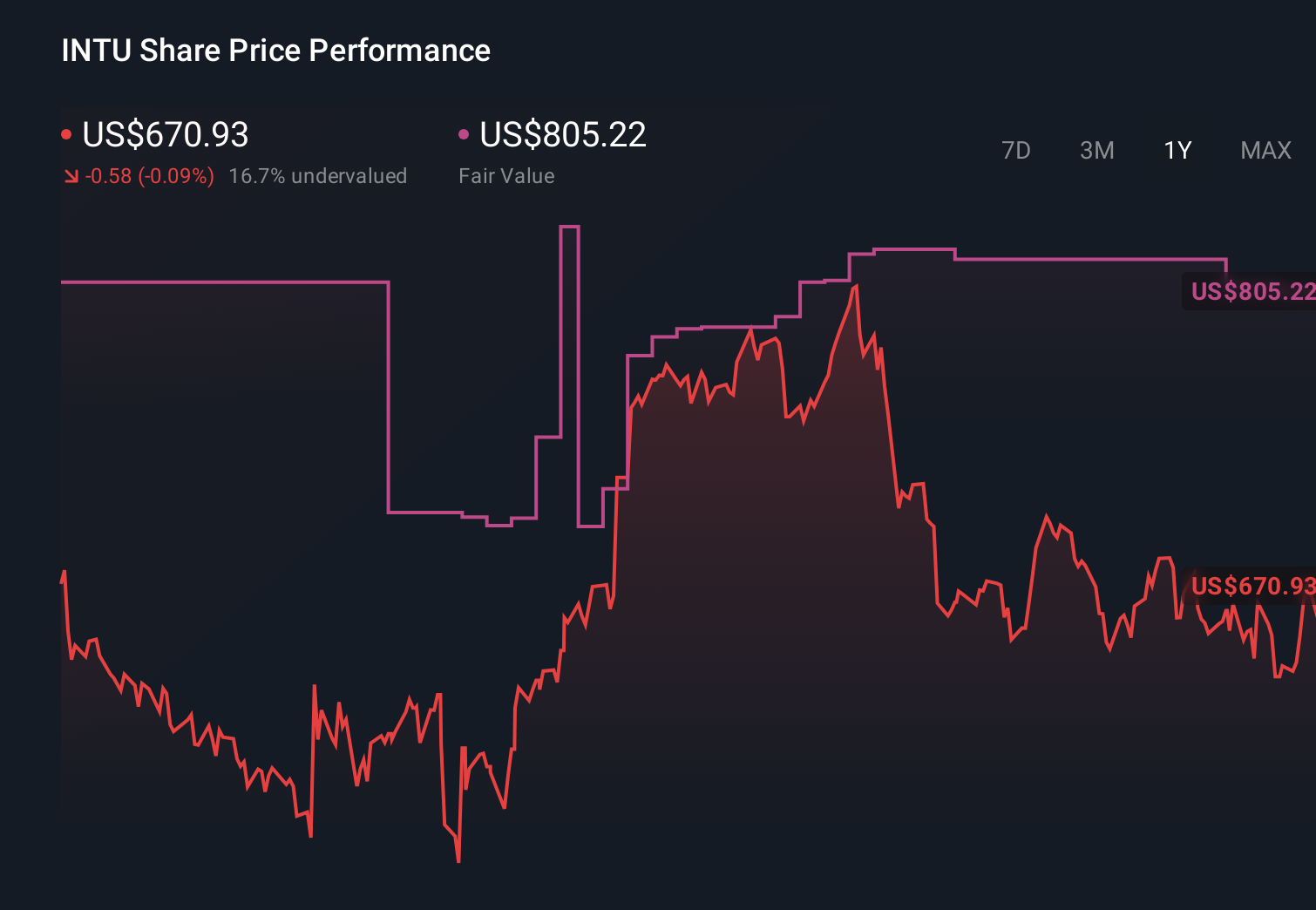
Before this sell off, the most pessimistic analysts were already assuming only about 11 percent annual revenue growth to roughly US$26.9 billion by 2029 and US$6.0 billion in earnings, so if you worry that AI adoption or mid market wins could lag those expectations, their cautious view on AI execution risk and Intuit’s heavier exposure to payments and credit products may feel closer to your own.
Explore 25 other fair value estimates on Intuit - why the stock might be worth just $406.78!
Reach Your Own Conclusion
Don't just follow the ticker - dig into the data and build a conviction that's truly your own.
- A great starting point for your Intuit research is our analysis highlighting 5 key rewards that could impact your investment decision.
- Our free Intuit research report provides a comprehensive fundamental analysis summarized in a single visual - the Snowflake - making it easy to evaluate Intuit's overall financial health at a glance.
Ready For A Different Approach?
Early movers are already taking notice. See the stocks they're targeting before they've flown the coop:
- Invest in the nuclear renaissance through our list of 88 elite nuclear energy infrastructure plays powering the global AI revolution.
- Find 48 companies with promising cash flow potential yet trading below their fair value.
- We've uncovered the 10 dividend fortresses yielding 5%+ that don't just survive market storms, but thrive in them.
This article by Simply Wall St is general in nature. We provide commentary based on historical data and analyst forecasts only using an unbiased methodology and our articles are not intended to be financial advice. It does not constitute a recommendation to buy or sell any stock, and does not take account of your objectives, or your financial situation. We aim to bring you long-term focused analysis driven by fundamental data. Note that our analysis may not factor in the latest price-sensitive company announcements or qualitative material. Simply Wall St has no position in any stocks mentioned.