
Investors Could Be Concerned With BinDawood Holding's (TADAWUL:4161) Returns On Capital
BINDAWOOD 4161.SA | 4.81 | +0.63% |
What financial metrics can indicate to us that a company is maturing or even in decline? When we see a declining return on capital employed (ROCE) in conjunction with a declining base of capital employed, that's often how a mature business shows signs of aging. Basically the company is earning less on its investments and it is also reducing its total assets. On that note, looking into BinDawood Holding (TADAWUL:4161), we weren't too upbeat about how things were going.
Return On Capital Employed (ROCE): What Is It?
Just to clarify if you're unsure, ROCE is a metric for evaluating how much pre-tax income (in percentage terms) a company earns on the capital invested in its business. The formula for this calculation on BinDawood Holding is:
Return on Capital Employed = Earnings Before Interest and Tax (EBIT) ÷ (Total Assets - Current Liabilities)
0.094 = ر.س379m ÷ (ر.س5.7b - ر.س1.7b) (Based on the trailing twelve months to September 2025).
Thus, BinDawood Holding has an ROCE of 9.4%. On its own, that's a low figure but it's around the 10% average generated by the Consumer Retailing industry.
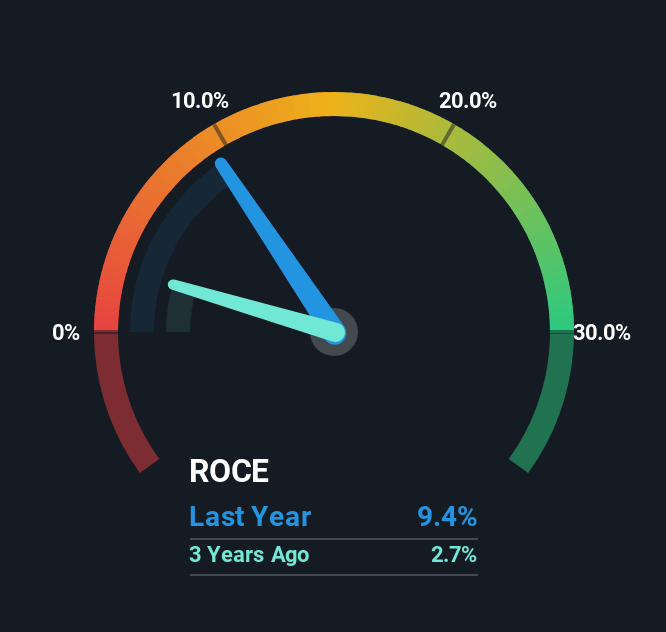
In the above chart we have measured BinDawood Holding's prior ROCE against its prior performance, but the future is arguably more important. If you'd like, you can check out the forecasts from the analysts covering BinDawood Holding for free.
What The Trend Of ROCE Can Tell Us
There is reason to be cautious about BinDawood Holding, given the returns are trending downwards. About five years ago, returns on capital were 16%, however they're now substantially lower than that as we saw above. On top of that, it's worth noting that the amount of capital employed within the business has remained relatively steady. Since returns are falling and the business has the same amount of assets employed, this can suggest it's a mature business that hasn't had much growth in the last five years. If these trends continue, we wouldn't expect BinDawood Holding to turn into a multi-bagger.
In Conclusion...
All in all, the lower returns from the same amount of capital employed aren't exactly signs of a compounding machine. It should come as no surprise then that the stock has fallen 52% over the last five years, so it looks like investors are recognizing these changes. Unless there is a shift to a more positive trajectory in these metrics, we would look elsewhere.
Like most companies, BinDawood Holding does come with some risks, and we've found 1 warning sign that you should be aware of.
This article by Simply Wall St is general in nature. We provide commentary based on historical data and analyst forecasts only using an unbiased methodology and our articles are not intended to be financial advice. It does not constitute a recommendation to buy or sell any stock, and does not take account of your objectives, or your financial situation. We aim to bring you long-term focused analysis driven by fundamental data. Note that our analysis may not factor in the latest price-sensitive company announcements or qualitative material. Simply Wall St has no position in any stocks mentioned.