

Investors Pour Into NASA ETF Ahead of Anticipated SpaceX IPO
Firefly Aerospace FLY | 0.00 | |
Intuitive Machines LUNR | 0.00 | |
Planet Labs PBC PL | 0.00 | |
Rocket Lab RKLB | 0.00 | |
Tema Space Innovators ETF NASA | 0.00 |
American investors are pouring into the newly launched Tema Space Innovators ETF (NYSE:NASA) as space-focused stocks surge ahead of the highly anticipated SpaceX IPO.
NASA ETF Inflows Jump As Stock Hits All-Time High
NASA, which was launched on March 30th, has accumulated over $1.4 billion in assets, making it the biggest space ETF in the world. It has had inflows in all weeks since its inception. Its stock soared by 55%, reaching an all-time high of $38. In contrast, the S&P 500 Index has jumped by 14% in this period.
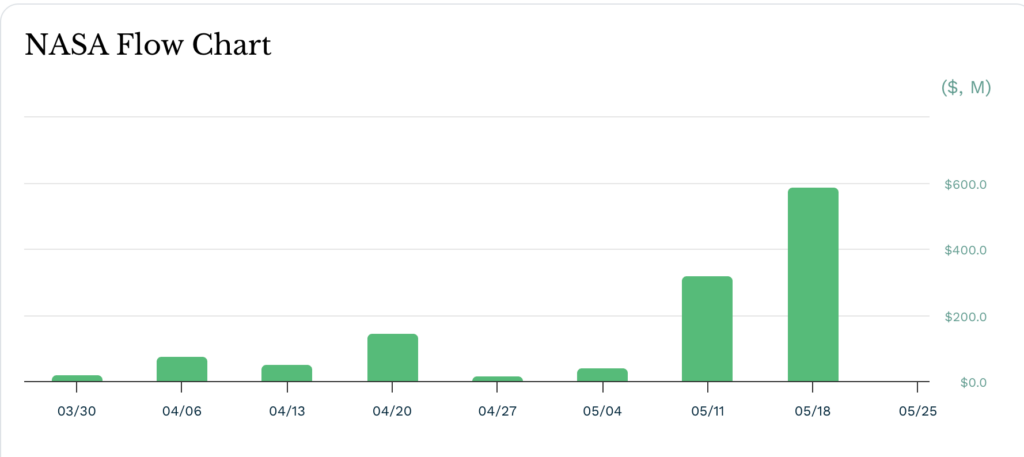
NASA ETF is made up of companies from the United States, Canada, Japan, the UK, and others. Its biggest holdings are companies like Rocket Lab (NASDAQ:RKLB), Planet Labs (NYSE:PL), Intuitive Machines (NASDAQ:LUNR), and Firefly Aerospace (NASDAQ:FLY).
Most of these space-related stocks have surged this year. Rocket Lab has soared 357% over the past 12 months, while Planet Labs has jumped 979% in the same period. LUNR has jumped by over 212%.
The main reason for the rally is that analysts believe that the space industry offers unlimited potential. A report by Grand View Research found that the industry was valued at $466 billion in 2024 and that it would reach $769 billion by 2030.
Still, the main challenge for the NASA ETF is that it is quite expensive. It has a gross expense ratio of 0.94% and a net one of 0.87%. These are huge numbers considering that popular funds like SCHD and SPYM have a 0.02% ratio.
SpaceX Revealed Strong Growth But High Losses
The most recently released SpaceX S1 showed that its business was doing well as launches jumped and Starlink demand jumped.
Its annual revenue jumped from $10.3 billion in 2023 to $18.67 billion last year. Its first-quarter revenue rose to $4.6 billion from the $4 billion it made in the same period last year.
Despite this revenue growth, the company also experienced some major losses. Its annual loss jumped to $4.59 billion last year from a $791 million profit a year earlier.
Other companies in the NASA ETF have also made substantial losses in the past few years as they continued to invest in growth. Rocket Lab's annual loss came in at $198 million, while Planet Lab lost over $246 million. Intuitive Machines' loss rose to over $83 million.
There are also concerns about their valuations. Intuitive Machines has a price-to-sales ratio of 14, while Rocket Lab and Planet Labs have 110 and 44, respectively.
Image: Shutterstock