
Is AI‑Driven Fintech Volatility Reframing Flywire’s (FLYW) Competitive Position Across Its Core Verticals?
Flywire Corp. FLYW | 11.56 11.56 | -1.28% 0.00% Pre |
- Earlier this week, payments software company Flywire came under pressure as broader technology markets reacted to geopolitical tensions and concerns about how autonomous AI systems could challenge existing payments platforms.
- The reaction highlighted how sentiment driven by high-profile short seller commentary and AI-related disruption fears can quickly spill over into perceptions of individual fintech operators like Flywire.
- We’ll now explore how this AI-related sector volatility interacts with Flywire’s existing growth narrative across education, healthcare, travel, and B2B payments.
Rare earth metals are an input to most high-tech devices, military and defence systems and electric vehicles. The global race is on to secure supply of these critical minerals. Beat the pack to uncover the 27 best rare earth metal stocks of the very few that mine this essential strategic resource.
Flywire Investment Narrative Recap
To own Flywire, you need to believe its software-led model can keep capturing cross border education, healthcare, travel and B2B payment flows even as competition and regulation intensify. This week’s AI driven sell off does not materially change the near term focus on sustaining client wins in education while managing margin pressure as newer verticals scale. The bigger risk right now is that geopolitical and policy shocks choke cross border volumes in key student markets.
Against this backdrop, Flywire’s appointment of Patrick Blanc as Chief Technology Officer in February 2026 looks especially relevant. His mandate to lead an AI first engineering approach directly intersects with concerns about autonomous AI disrupting legacy payment platforms, and will likely be watched closely as a proof point for Flywire’s ability to keep its technology differentiated enough to support future catalysts in education and B2B payments.
Yet beneath this growth story, investors should be aware of how rising AI and regulatory costs could pressure Flywire’s margins and competitive position if...
Flywire's narrative projects $985.9 million revenue and $112.9 million earnings by 2029. This requires 16.5% yearly revenue growth and an increase of about $99 million in earnings from $13.5 million today.
Uncover how Flywire's forecasts yield a $16.31 fair value, a 39% upside to its current price.
Exploring Other Perspectives
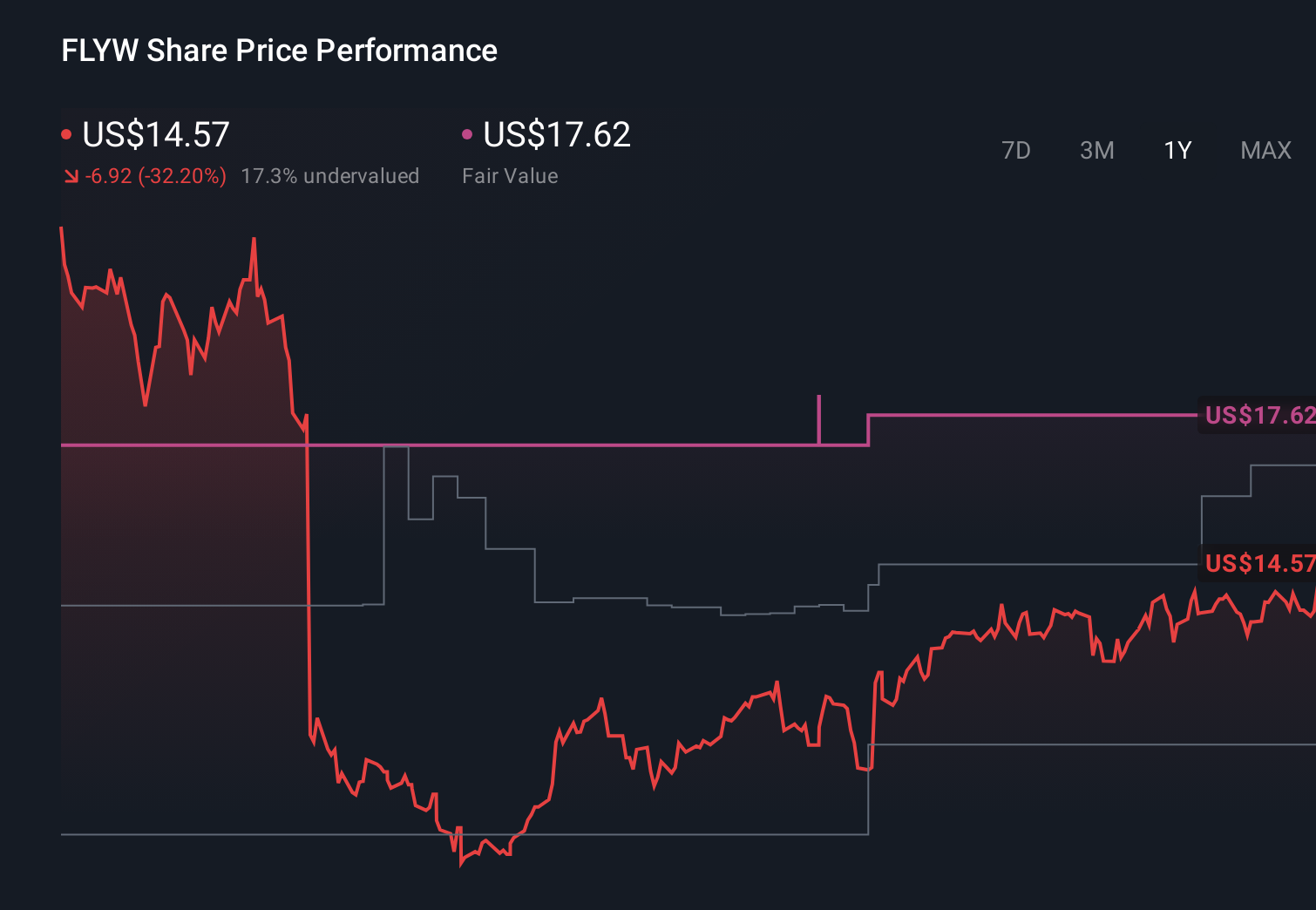
Some of the lowest ranked analysts took a far more cautious view, assuming revenue of about US$773.5 million and earnings of roughly US$51.8 million by 2028, and their concern about rising regulatory and technology costs could be sharpened by this latest AI driven scare, so it is worth comparing their more pessimistic assumptions with more optimistic views before deciding what you believe.
Explore 3 other fair value estimates on Flywire - why the stock might be worth just $16.31!
Decide For Yourself
Don't just follow the ticker - dig into the data and build a conviction that's truly your own.
- A great starting point for your Flywire research is our analysis highlighting 4 key rewards and 1 important warning sign that could impact your investment decision.
- Our free Flywire research report provides a comprehensive fundamental analysis summarized in a single visual - the Snowflake - making it easy to evaluate Flywire's overall financial health at a glance.
No Opportunity In Flywire?
Our daily scans reveal stocks with breakout potential. Don't miss this chance:
- We've uncovered the 11 dividend fortresses yielding 5%+ that don't just survive market storms, but thrive in them.
- Capitalize on the AI infrastructure supercycle with our selection of the 36 best 'picks and shovels' of the AI gold rush converting record-breaking demand into massive cash flow.
- The best AI stocks today may lie beyond giants like Nvidia and Microsoft. Find the next big opportunity with these 20 smaller AI-focused companies with strong growth potential through early-stage innovation in machine learning, automation, and data intelligence that could fund your retirement.
This article by Simply Wall St is general in nature. We provide commentary based on historical data and analyst forecasts only using an unbiased methodology and our articles are not intended to be financial advice. It does not constitute a recommendation to buy or sell any stock, and does not take account of your objectives, or your financial situation. We aim to bring you long-term focused analysis driven by fundamental data. Note that our analysis may not factor in the latest price-sensitive company announcements or qualitative material. Simply Wall St has no position in any stocks mentioned.