

Is American Airlines (AAL) Quietly Rewriting Its Cost Story With Leadership Changes And Cheaper Fuel?
American Airlines Group Inc. AAL | 0.00 |
- American Airlines Group Inc. recently announced that long-serving Vice Chair and Chief Strategy Officer Stephen L. Johnson plans to retire at the end of the year, after helping secure a new Citi agreement, reshape sales and distribution, and refocus the airline on customer experience.
- At the same time, easing jet-fuel costs, firm travel demand and upbeat earnings expectations for US airlines are reshaping how investors assess American’s cost structure and profit potential.
- We’ll now examine how lower jet-fuel prices, alongside these leadership changes, may influence American Airlines’ existing investment narrative and risk profile.
Rare earth metals are an input to most high-tech devices, military and defence systems and electric vehicles. The global race is on to secure supply of these critical minerals. Beat the pack to uncover the 29 best rare earth metal stocks of the very few that mine this essential strategic resource.
American Airlines Group Investment Narrative Recap
To own American Airlines today, you need to believe that easing fuel costs, resilient travel demand and its refocused commercial strategy can translate into healthier margins despite high debt and labor pressures. Johnson’s retirement looks more like succession timing than a shift in direction, so the biggest near term catalyst remains how effectively lower jet fuel flows through to earnings, while the key risk is still American’s leveraged balance sheet and its sensitivity to any demand or cost shock.
Against this backdrop, Johnson’s role in securing the new 10 year Citi co‑brand agreement stands out. That deal underpins a core part of American’s investment case: high margin loyalty and card income that is less volatile than ticket sales. As lower fuel costs improve near term profitability, this loyalty revenue stream could be especially important in supporting cash generation, offsetting some balance sheet strain and giving the airline more room to manage future industry or macro setbacks.
However, even if lower fuel prices help near term margins, investors should be aware that American’s sizeable debt load and interest burden could still...
American Airlines Group's narrative projects $67.8 billion revenue and $1.7 billion earnings by 2029.
Uncover how American Airlines Group's forecasts yield a $15.61 fair value, a 10% downside to its current price.
Exploring Other Perspectives
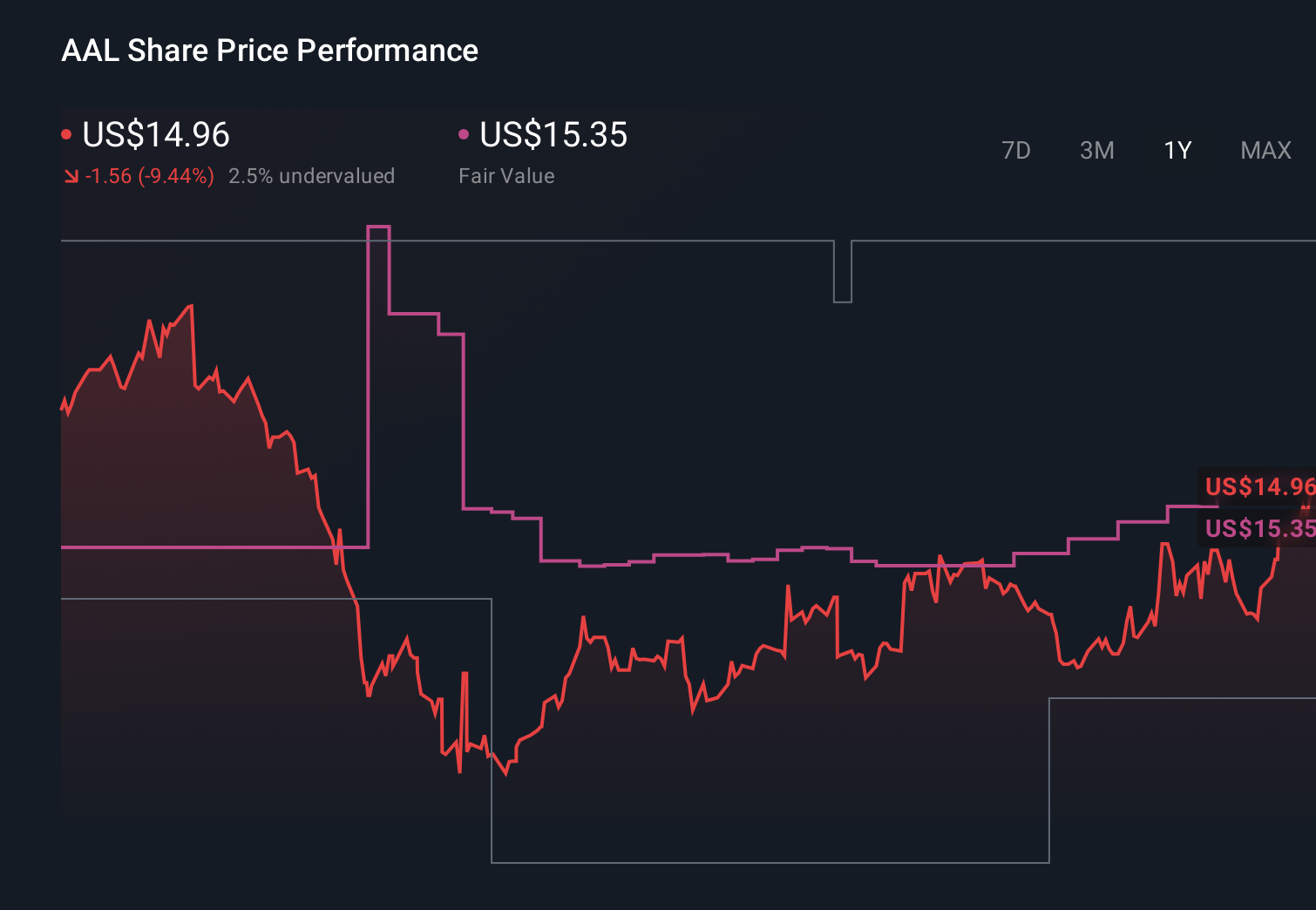
Some of the most optimistic analysts previously projected revenue near US$72.1 billion and earnings of US$2.4 billion, which is a far more upbeat view than consensus and could be tested by how fuel trends and cost pressures evolve from here.
Explore 9 other fair value estimates on American Airlines Group - why the stock might be worth over 4x more than the current price!
The Verdict Is Yours
Don't just follow the ticker - dig into the data and build a conviction that's truly your own.
- A great starting point for your American Airlines Group research is our analysis highlighting 2 key rewards and 4 important warning signs that could impact your investment decision.
- Our free American Airlines Group research report provides a comprehensive fundamental analysis summarized in a single visual - the Snowflake - making it easy to evaluate American Airlines Group's overall financial health at a glance.
Want Some Alternatives?
Every day counts. These free picks are already gaining attention. See them before the crowd does:
- Outshine the giants: these 14 early-stage AI stocks could fund your retirement.
- Uncover the next big thing with 21 elite penny stocks that balance risk and reward.
- Find 44 companies with promising cash flow potential yet trading below their fair value.
This article by Simply Wall St is general in nature. We provide commentary based on historical data and analyst forecasts only using an unbiased methodology and our articles are not intended to be financial advice. It does not constitute a recommendation to buy or sell any stock, and does not take account of your objectives, or your financial situation. We aim to bring you long-term focused analysis driven by fundamental data. Note that our analysis may not factor in the latest price-sensitive company announcements or qualitative material. Simply Wall St has no position in any stocks mentioned.