

Is Baidu (NasdaqGS:BIDU) A Bargain Or Already Fully Priced?
Baidu, Inc. Sponsored ADR Class A BIDU | 0.00 |
Baidu stock has fallen 30.2% year to date, which leaves investors weighing a weaker recent share price against valuation checks that do not yet paint it as a clear bargain.
- The 30.2% decline year to date raises the question of whether recent pessimism has pushed Baidu too far below where investors had been pricing its prospects.
- Progress in areas like autonomous driving, highlighted by recent London robotaxi approvals for competitors, can support sentiment around Baidu's own longer term technology efforts. At the same time, intense competition and regulatory scrutiny may still weigh on how much value the market is willing to assign to those projects.
- Baidu scores 2 out of 6 on Simply Wall St's broader valuation checks, which suggests the stock leans expensive on several measures rather than standing out as a straightforward bargain 2/6.
The stock's next move may depend on whether the recent share price weakness has already accounted for these risks or if Baidu still carries more optimism in the valuation than its fundamentals can support.
Is Baidu Still Cheap on Sales?
P/S is a useful lens for Baidu because investors often focus on its revenue base and platform reach rather than near term earnings.
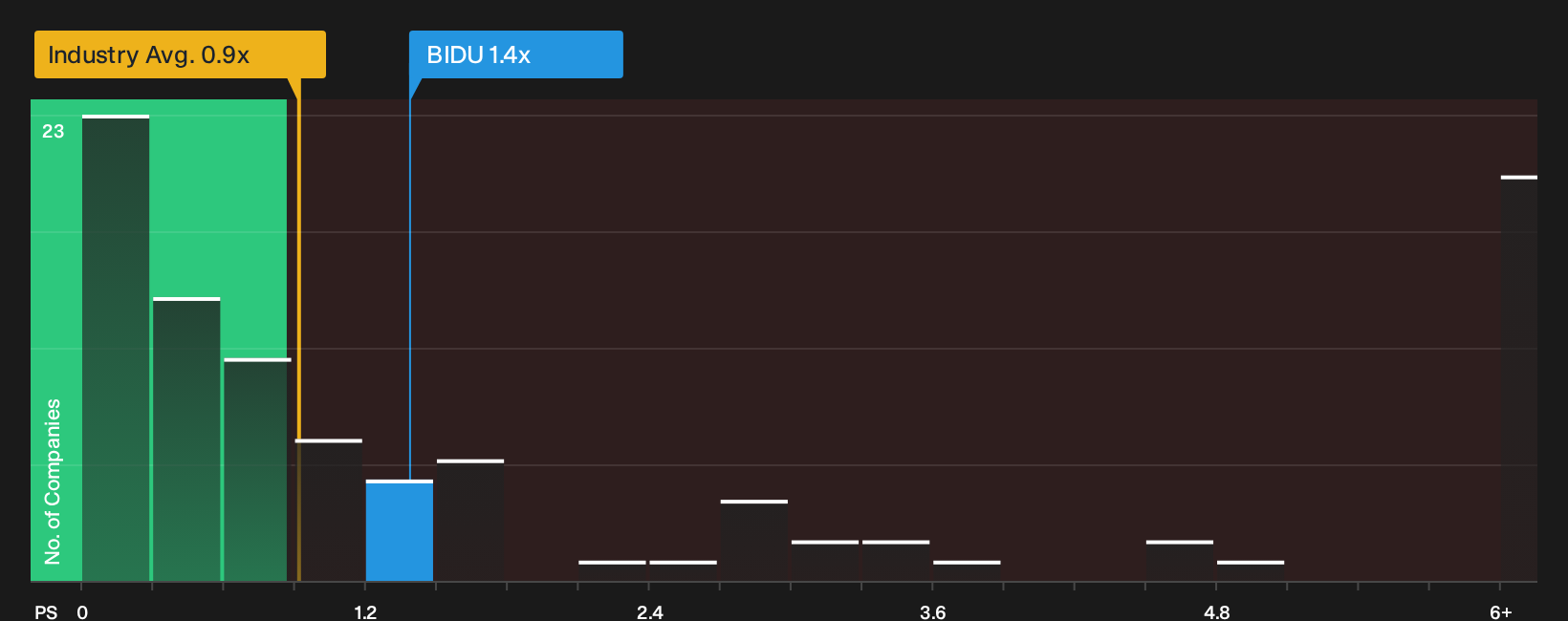
Baidu currently trades on a P/S multiple of 1.9x. This is above the Interactive Media and Services industry average of about 0.9x, yet below the peer group average of about 4.3x. On Simply Wall St’s fair P/S estimate of 2.3x, which reflects the company’s size, margins and risks, the stock sits at a discount to where that tailored benchmark would place it.
Despite recent attention on competitors winning London robotaxi permits, Baidu’s P/S multiple still prices the stock below that fair ratio, even after factoring in sector competition and regulatory questions. For investors who mainly look at sales based metrics, the current valuation appears cautious rather than exuberant.
On the P/S multiple, Baidu stock appears undervalued relative to the fair ratio implied by its fundamentals and risk profile.
The Baidu Narrative: What Would Justify Today's Price?
Simply Wall St Narratives for Baidu pick up where the valuation puzzle leaves off. They describe which paths for Baidu's growth, margins and earnings would need to hold for the stock to be worth materially more or less than today's price. Each one links its number to a specific view of how growth, profitability and risks could develop, and you can revisit these views as new data comes through on the Community page.
The Baidu community splits into two very different stories about where the value sits today.
Bull case: 58% undervalued
"Baidu is uniquely positioned to capitalize on the exponential proliferation of generative AI and automation across China's digital economy, especially as its comprehensive 4-layer AI stack and self-sufficient chip strategy allow it to absorb surging demand from an increasingly AI-centric business landscape..."
Bear case: roughly fairly valued
"Baidu's significant investments in next-generation AI search and generative AI are expected to weigh heavily on profitability for an extended period, as management admits these transformative products remain in early monetization stages with no clear timeline for scaled commercial success..."
Do you think there's more to the story for Baidu? Head over to our Community to see what others are saying!
The Bottom Line
Baidu screens as undervalued on its tailored P/S benchmark, yet the broader valuation checks still look weak. That mix suggests the market is reluctant to fully price in Baidu’s potential, given execution risk in areas like AI and autonomous driving and ongoing regulatory pressure. For you as an investor, the key question is whether Baidu can turn its technology investments into durable revenue and profit growth. The answer to that will decide whether the current discount on sales is an opportunity or an early sign of a value trap.
This article by Simply Wall St is general in nature. We provide commentary based on historical data and analyst forecasts only using an unbiased methodology and our articles are not intended to be financial advice. It does not constitute a recommendation to buy or sell any stock, and does not take account of your objectives, or your financial situation. We aim to bring you long-term focused analysis driven by fundamental data. Note that our analysis may not factor in the latest price-sensitive company announcements or qualitative material. Simply Wall St has no position in any stocks mentioned.