

Is Baidu’s Hong Kong Dual-Primary Shift Reshaping Governance And AI Strategy For BIDU?
Baidu, Inc. Sponsored ADR Class A BIDU | 0.00 |
- Baidu, Inc. recently moved to replace its existing Articles of Association with a new set to comply with Hong Kong Listing Rules Appendix A1, subject to shareholder approval at an extraordinary general meeting and accompanied by a circular outlining the proposed changes.
- Alongside this, Baidu has applied to convert its Hong Kong listing from secondary to dual-primary status, a governance and listing shift that may broaden its investor base and tighten alignment with Hong Kong regulatory standards.
- We’ll now examine how Baidu’s planned conversion to a dual-primary Hong Kong listing could influence its existing AI-focused investment narrative.
Invest in the nuclear renaissance through our list of 90 elite nuclear energy infrastructure plays powering the global AI revolution.
Baidu Investment Narrative Recap
Baidu’s story still hinges on whether its heavy AI investments can eventually offset pressure on its core search ads and improve margins. The move to a dual-primary Hong Kong listing and new Articles of Association looks more like a compliance and governance upgrade than a change to near term fundamentals, so it does not materially alter the key catalyst of AI monetization progress or the major risk of prolonged margin and free cash flow strain.
Among Baidu’s recent moves, the proposed dual-primary Hong Kong listing stands out here, as it sits alongside plans for new share issuance, repurchase mandates, and a fresh share incentive plan. These capital market tools intersect directly with the current catalyst and risk mix by potentially shaping how Baidu funds its AI push, manages dilution, and signals confidence at a time when earnings have been under pressure.
Yet behind the dual-primary listing, there is a less obvious risk investors should be aware of around Baidu’s negative free cash flow and...
Baidu's narrative projects CN¥153.1 billion revenue and CN¥20.8 billion earnings by 2029. This requires 5.9% yearly revenue growth and an earnings increase of about CN¥16.1 billion from CN¥4.7 billion today.
Uncover how Baidu's forecasts yield a $176.41 fair value, a 64% upside to its current price.
Exploring Other Perspectives
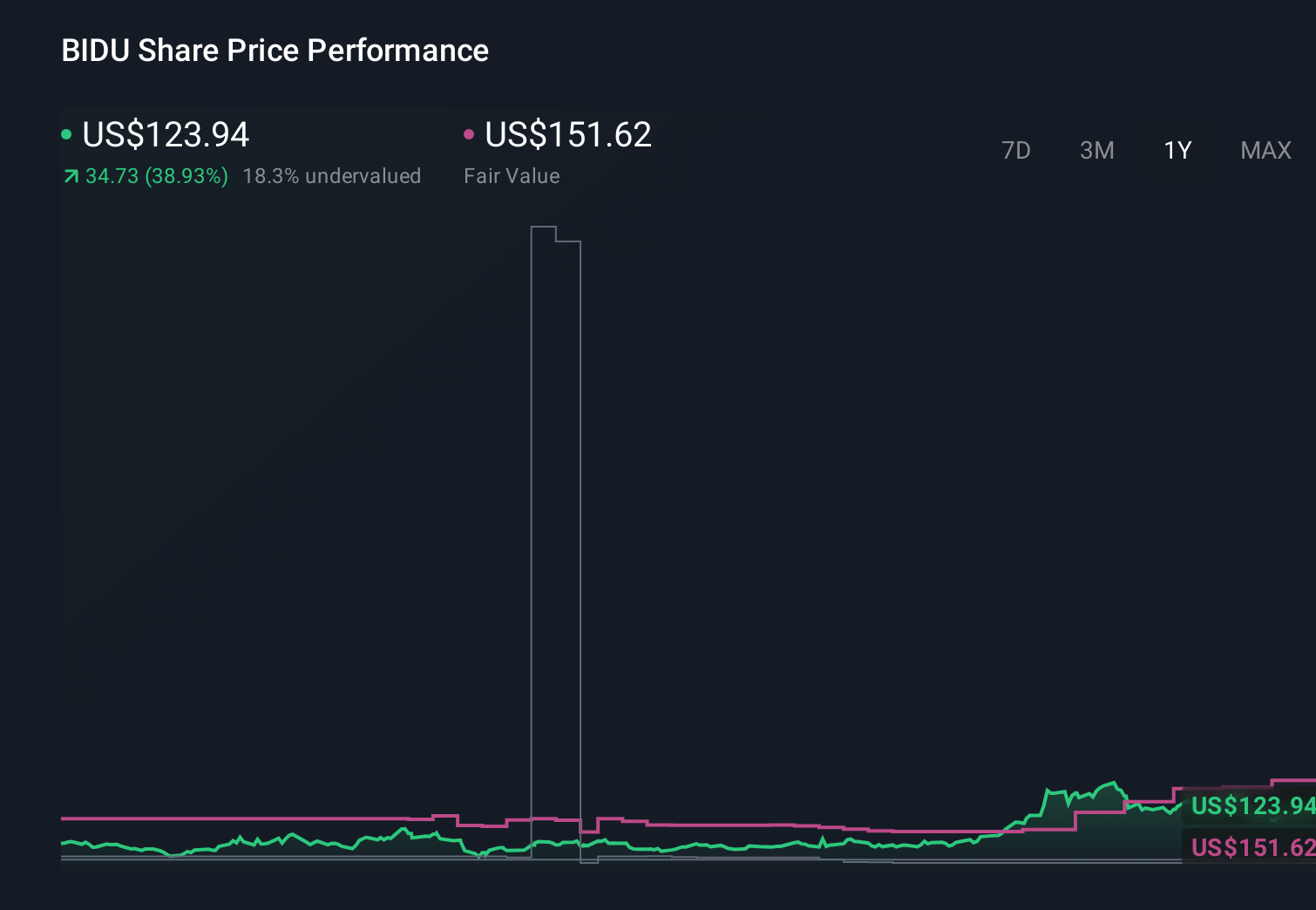
Some of the most optimistic analysts, who were assuming revenue could reach about CN¥218.1 billion and earnings CN¥39.5 billion, see Baidu’s AI stack as a powerful accelerator, in sharp contrast to the risk that costly AI initiatives and governance shifts like a dual-primary listing might extend today’s margin and cash flow pressures; as an investor, you can weigh these very different views and consider how this latest Hong Kong move might reshape both.
Explore 11 other fair value estimates on Baidu - why the stock might be worth over 2x more than the current price!
The Verdict Is Yours
Don't just follow the ticker - dig into the data and build a conviction that's truly your own.
- A great starting point for your Baidu research is our analysis highlighting 1 key reward and 2 important warning signs that could impact your investment decision.
- Our free Baidu research report provides a comprehensive fundamental analysis summarized in a single visual - the Snowflake - making it easy to evaluate Baidu's overall financial health at a glance.
No Opportunity In Baidu?
These stocks are moving-our analysis flagged them today. Act fast before the price catches up:
- The future of work is here. Discover the 33 top robotics and automation stocks leading the charge in AI-driven automation and industrial transformation.
- Capitalize on the AI infrastructure supercycle with our selection of the 54 best 'picks and shovels' of the AI gold rush converting record-breaking demand into massive cash flow.
- Uncover the next big thing with 21 elite penny stocks that balance risk and reward.
This article by Simply Wall St is general in nature. We provide commentary based on historical data and analyst forecasts only using an unbiased methodology and our articles are not intended to be financial advice. It does not constitute a recommendation to buy or sell any stock, and does not take account of your objectives, or your financial situation. We aim to bring you long-term focused analysis driven by fundamental data. Note that our analysis may not factor in the latest price-sensitive company announcements or qualitative material. Simply Wall St has no position in any stocks mentioned.