

Is Best Buy’s (BBY) AI Hardware Push Quietly Rewriting Its In-Store Experience Strategy?
Best Buy Co.,Inc. BBY | 0.00 |
- Earlier this month, GEEKOM announced that its Mini PCs are now available through Best Buy’s online marketplace and select U.S. stores, while Meta Platforms expanded its Meta Lab experiential spaces for AI glasses and VR headsets to more than 50 Best Buy locations.
- Together, these partnerships highlight Best Buy’s push to deepen its role as a hands-on destination for emerging AI-enabled hardware and compact computing solutions.
- Next, we’ll explore how Best Buy’s expanded AI wearables experiences and new Mini PC assortment may influence its existing investment narrative.
Explore 29 top quantum computing companies leading the revolution in next-gen technology and shaping the future with breakthroughs in quantum algorithms, superconducting qubits, and cutting-edge research.
Best Buy Investment Narrative Recap
To own Best Buy, you need to believe it can turn modest revenue growth into durable earnings and dividend power by pairing its stores with higher-margin services, marketplace partners and vendor-funded experiences. The GEEKOM Mini PC launch and Meta Lab expansion support this thesis by reinforcing Best Buy’s role as a discovery and education hub for AI hardware, but they do not fundamentally change the near-term catalyst around the computing upgrade cycle or the key risk of margin pressure from intense competition.
Among recent announcements, the continued roll out of Best Buy’s U.S. online marketplace is most relevant here, because GEEKOM’s presence flows directly through that platform. Together with experiential vendor spaces like Meta Lab, the marketplace is central to consensus expectations that Best Buy can grow assortment and retail media income without sacrificing profitability, even as it manages the risk that third-party brands and online channels reduce in-store traffic and pricing power.
Yet while these AI and marketplace initiatives are promising, investors still need to consider how exposed Best Buy remains if higher-margin categories underperform and...
Best Buy’s narrative projects $43.1 billion revenue and $1.5 billion earnings by 2029. This requires 1.1% yearly revenue growth and an earnings increase of about $0.4 billion from $1.1 billion today.
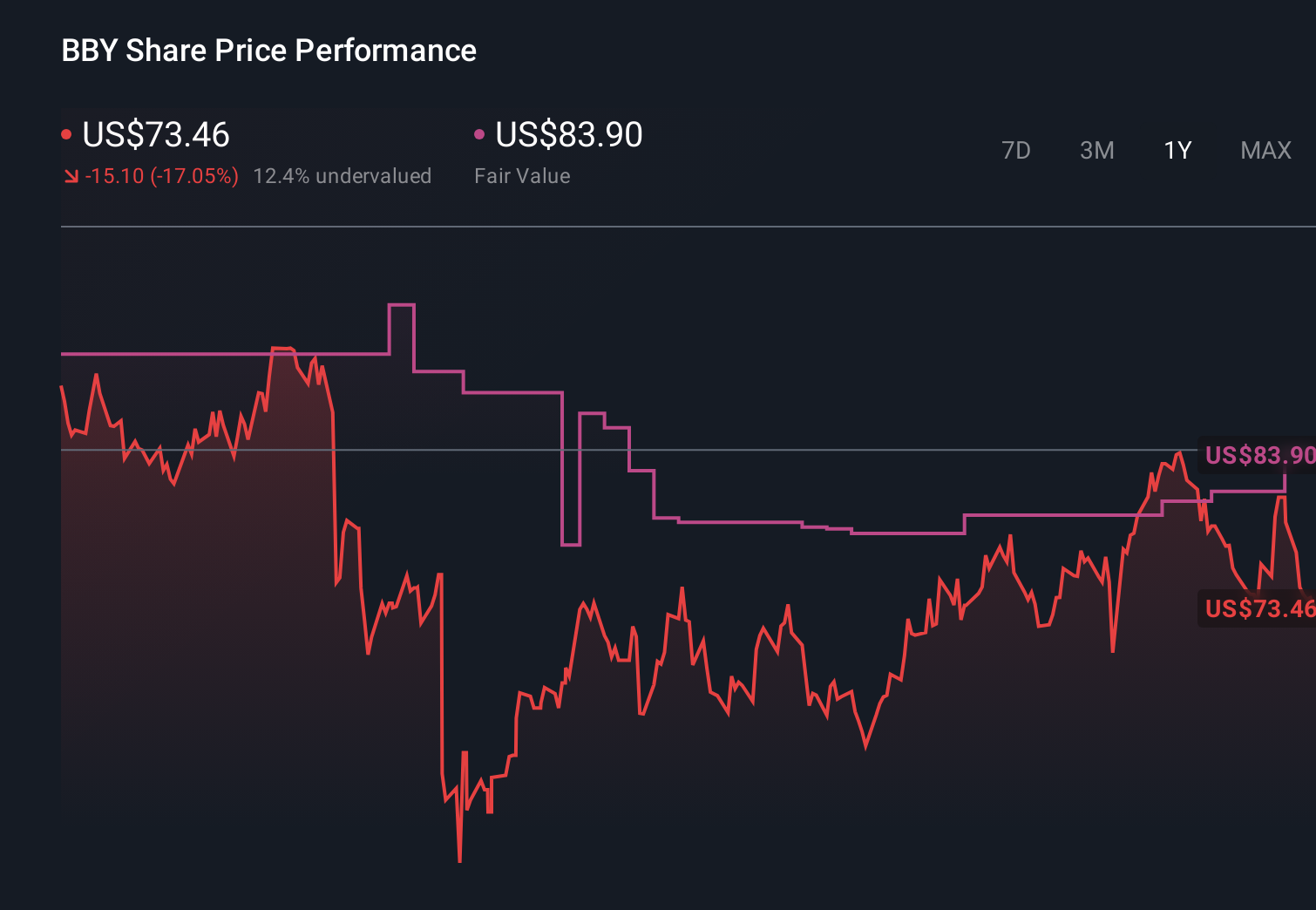
Uncover how Best Buy's forecasts yield a $72.50 fair value, in line with its current price.
Exploring Other Perspectives
Compared with consensus, the lowest analysts sound far more cautious, assuming revenue around US$42.6 billion and earnings near US$1.5 billion by 2029, so you should weigh these more pessimistic views against how initiatives like GEEKOM’s Mini PCs and Meta Lab could either support that cautious outlook or eventually nudge expectations higher.
Explore 6 other fair value estimates on Best Buy - why the stock might be worth just $72.50!
Form Your Own Verdict
Disagree with existing narratives? Extraordinary investment returns rarely come from following the herd, so go with your instincts.
- A great starting point for your Best Buy research is our analysis highlighting 5 key rewards and 1 important warning sign that could impact your investment decision.
- Our free Best Buy research report provides a comprehensive fundamental analysis summarized in a single visual - the Snowflake - making it easy to evaluate Best Buy's overall financial health at a glance.
Seeking Other Investments?
These stocks are moving-our analysis flagged them today. Act fast before the price catches up:
- We've uncovered the 9 dividend fortresses yielding 5%+ that don't just survive market storms, but thrive in them.
- Outshine the giants: these 14 early-stage AI stocks could fund your retirement.
- Invest in the nuclear renaissance through our list of 88 elite nuclear energy infrastructure plays powering the global AI revolution.
This article by Simply Wall St is general in nature. We provide commentary based on historical data and analyst forecasts only using an unbiased methodology and our articles are not intended to be financial advice. It does not constitute a recommendation to buy or sell any stock, and does not take account of your objectives, or your financial situation. We aim to bring you long-term focused analysis driven by fundamental data. Note that our analysis may not factor in the latest price-sensitive company announcements or qualitative material. Simply Wall St has no position in any stocks mentioned.