

Is Boeing (BA) Offering Value After Safety Concerns And A Mixed Valuation Picture?
Boeing Company BA | 0.00 |
- If you are wondering whether Boeing's current share price gives you good value, it helps to separate headline noise from what the numbers actually suggest about the stock.
- Boeing's stock most recently closed at US$231.03, with total returns of 0.9% over 7 days, 10.0% over 30 days, 1.4% year to date, 20.5% over 1 year, 14.5% over 3 years and 3.8% over 5 years.
- Recent attention on Boeing has focused on safety and quality issues across parts of its commercial aircraft business, with regulatory and customer scrutiny adding to the debate about the stock. At the same time, coverage has highlighted the ongoing importance of Boeing in global aerospace and defense supply chains, which frames how investors think about both risk and potential resilience.
- On Simply Wall St's 6 point valuation checklist, Boeing currently scores 2 out of 6. The rest of this article will unpack what that score means by comparing different valuation approaches, then finish with a broader way to think about what the stock might be worth.
Boeing scores just 2/6 on our valuation checks. See what other red flags we found in the full valuation breakdown.
Approach 1: Boeing Discounted Cash Flow (DCF) Analysis
A Discounted Cash Flow, or DCF, model estimates what a stock could be worth by projecting its future cash flows and discounting them back to today using a required rate of return.
For Boeing, the model used is a 2 Stage Free Cash Flow to Equity approach, based on cash flow projections in US$. The latest twelve month free cash flow (FCF) figure is a loss of about $477m, so the model leans heavily on future FCF expectations rather than current cash generation.
Analyst estimates and extrapolations point to FCF reaching $13.8b by 2030, with intermediate projections such as about $2.4b in 2026 and $6.5b in 2027, followed by higher figures in the subsequent years. Simply Wall St extrapolates beyond the analyst horizon to build a 10 year path of cash flows, then discounts each of those values back to today.
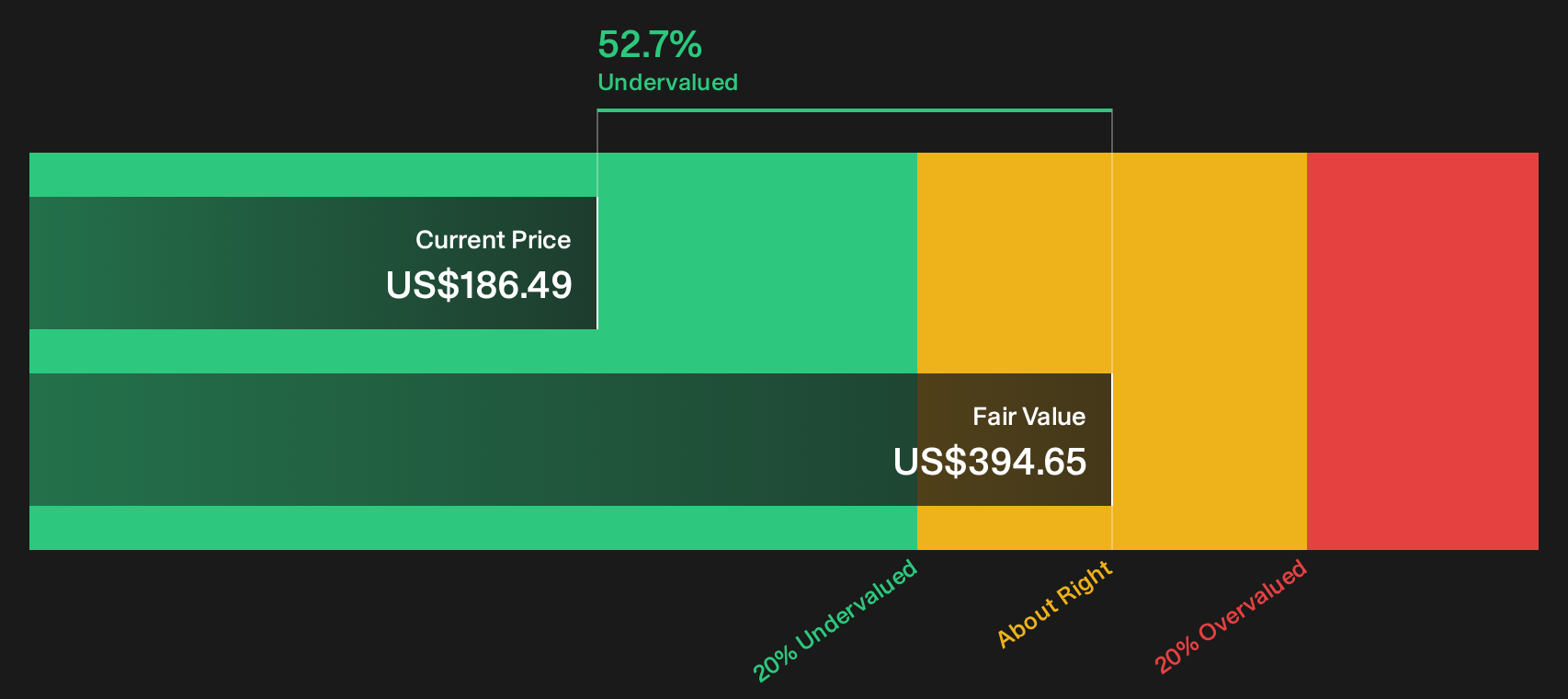
This cash flow stream results in an estimated intrinsic value of about $316.10 per share. Compared with the recent share price of $231.03, the DCF output implies the stock is 26.9% undervalued.
Result: UNDERVALUED
Our Discounted Cash Flow (DCF) analysis suggests Boeing is undervalued by 26.9%. Track this in your watchlist or portfolio, or discover 51 more high quality undervalued stocks.
Approach 2: Boeing Price vs Earnings
For companies that generate earnings, the P/E ratio is a familiar way to think about value, because it links what you pay for each share to the profit the company produces per share.
In general, higher growth expectations and lower perceived risk can support a higher P/E ratio, while slower growth expectations or higher risk tend to justify a lower, more conservative P/E as a "normal" range.
Boeing currently trades on a P/E of 94.76x. That compares with an Aerospace & Defense industry average P/E of about 36.92x and a peer group average of about 28.99x, so the stock sits well above these simple benchmarks.
Simply Wall St’s Fair Ratio for Boeing is 68.62x. This is a proprietary estimate of what Boeing’s P/E might be based on factors such as its earnings growth profile, industry, profit margins, market capitalization and company specific risks.
Because the Fair Ratio blends these company specific inputs, it can be more informative than a basic comparison with industry or peer averages, which treat very different businesses as if they all deserved the same multiple.
Comparing Boeing’s current P/E of 94.76x with the Fair Ratio of 68.62x suggests the stock is trading above what the model views as a fair level.
Result: OVERVALUED

P/E ratios tell one story, but what if the real opportunity lies elsewhere? Start investing in legacies, not executives. Discover our 18 top founder-led companies.
Upgrade Your Decision Making: Choose your Boeing Narrative
Earlier it was mentioned that there is an even better way to understand valuation, so Narratives are introduced here as a simple way for you to attach a clear story about Boeing to the numbers you see. This is done by spelling out your assumptions for fair value, future revenue, earnings and margins, and then linking that story to a financial forecast and a fair value estimate that you can compare with the current share price to decide whether it looks attractive or stretched.
On Simply Wall St’s Community page, Narratives are available as an accessible tool used by millions of investors. Each Narrative effectively says, “here is how Boeing’s business is expected to play out and here is the fair value that falls out of those assumptions.” When that fair value sits well above or below the live market price, it can signal whether a holder might review a position or a watcher might pay closer attention.
Narratives also update automatically as new information comes in, such as news about aircraft orders or earnings results. This means your Boeing view does not sit frozen in time but refreshes as the facts change, which helps keep any buy or sell decisions grounded in current data rather than outdated models.
For example, one investor’s Boeing Narrative on Simply Wall St might set a fair value close to the bullish US$300 scenario that relies on stronger revenue growth, higher profit margins and a P/E of about 28.8x. Another might sit nearer the more cautious US$206 to US$219 range that uses lower revenue growth and thinner margins. Yet both investors are using the same framework to connect their story about Boeing to a forecast and a fair value that can be directly compared with today’s price.
For Boeing, here are previews of two leading Boeing Narratives for easy comparison:
Fair value in this bullish narrative: US$300.00
Implied discount to this fair value versus the recent US$231.03 share price: about 23.0% undervalued
Revenue growth assumption used in this narrative: 14.77%
- Assumes Boeing grows revenue at a double digit rate and lifts profit margins into high single digits, supported by a US$522b commercial backlog and expanding defense, space and services contributions.
- Leans on analysts at the top end of the range, who see earnings reaching US$11.7b by around 2028 and support a 2028 P/E of about 28.8x.
- Frames a fair value of US$300 per share, while flagging quality control issues, debt levels and competition as key risks that could challenge this view.
Fair value in this more cautious narrative: US$206.79
Implied premium to this fair value versus the recent US$231.03 share price: about 11.7% overvalued
Revenue growth assumption used in this narrative: 15.00%
- Assumes solid revenue growth backed by order backlog and a recovery in commercial aviation, but expects only mid single digit net margins and highlights that earnings need to ramp meaningfully to justify higher prices.
- Values Boeing with a forward P/E framework that points to a mid case future price below the current share price once discounted back, suggesting the market already prices in a fair amount of recovery.
- Emphasizes execution, supply chain and regulatory risks, along with leverage and competition from Airbus and COMAC, as reasons to treat the stock as carrying meaningful downside if the turnaround underdelivers.
If you want to stress test your own expectations for Boeing against a range of financial outcomes, reviewing more Community Narratives can help you see how different assumptions about margins, growth and valuation translate into very different fair values.
To see how these results tie into long-term growth, risks, and valuation, check out the full range of community narratives for Boeing on Simply Wall St. Add the company to your watchlist or portfolio so you'll be alerted when the story evolves.
Do you think there's more to the story for Boeing? Head over to our Community to see what others are saying!

This article by Simply Wall St is general in nature. We provide commentary based on historical data and analyst forecasts only using an unbiased methodology and our articles are not intended to be financial advice. It does not constitute a recommendation to buy or sell any stock, and does not take account of your objectives, or your financial situation. We aim to bring you long-term focused analysis driven by fundamental data. Note that our analysis may not factor in the latest price-sensitive company announcements or qualitative material. Simply Wall St has no position in any stocks mentioned.