

Is Carvana’s $1.66 Billion Debt Recast Altering The Investment Case For Carvana (CVNA)?
Carvana CVNA | 0.00 |
- Earlier this month, Carvana entered into a US$1.66 billion senior secured Term Loan B maturing in 2033, using the proceeds to redeem its higher‑coupon 2030 secured notes and fund general corporate purposes.
- The refinancing replaces Carvana’s nearest secured maturity with longer-dated, lower-cost debt, trimming annual cash interest by about US$45 million over the next four years and adding flexibility through prepayment and incremental facility features.
- We’ll now examine how this lower-cost, longer-maturity debt reshapes Carvana’s investment narrative around balance sheet strength and future growth.
The best AI stocks today may lie beyond giants like Nvidia and Microsoft. Find the next big opportunity with these 18 smaller AI-focused companies with strong growth potential through early-stage innovation in machine learning, automation, and data intelligence that could fund your retirement.
Carvana Investment Narrative Recap
To own Carvana today, you need to believe its online model can keep scaling profitably while its balance sheet stays resilient. The new US$1.66 billion Term Loan B lowers near term secured refinancing pressure and interest costs, which supports the key short term catalyst of continued profitable growth, but it does not remove execution risks in reconditioning, logistics and marketing efficiency that could still weigh on margins.
The most relevant recent announcement here is Carvana’s Q2 2026 result, with US$7,376 million in revenue and US$310 million in net income. That profitability context matters when assessing the new debt: a lighter interest burden can reinforce already positive earnings, but if unit growth or ADESA integration were to stumble, higher fixed obligations could again become a focus for the market.
Yet behind this stronger balance sheet, investors still need to watch the risk that elevated debt could limit flexibility if operating trends suddenly shift and...
Carvana's narrative projects $47.3 billion revenue and $2.2 billion earnings by 2029. This requires 23.6% yearly revenue growth and about a $0.6 billion earnings increase from $1.6 billion today.
Uncover how Carvana's forecasts yield a $82.82 fair value, a 12% upside to its current price.
Exploring Other Perspectives
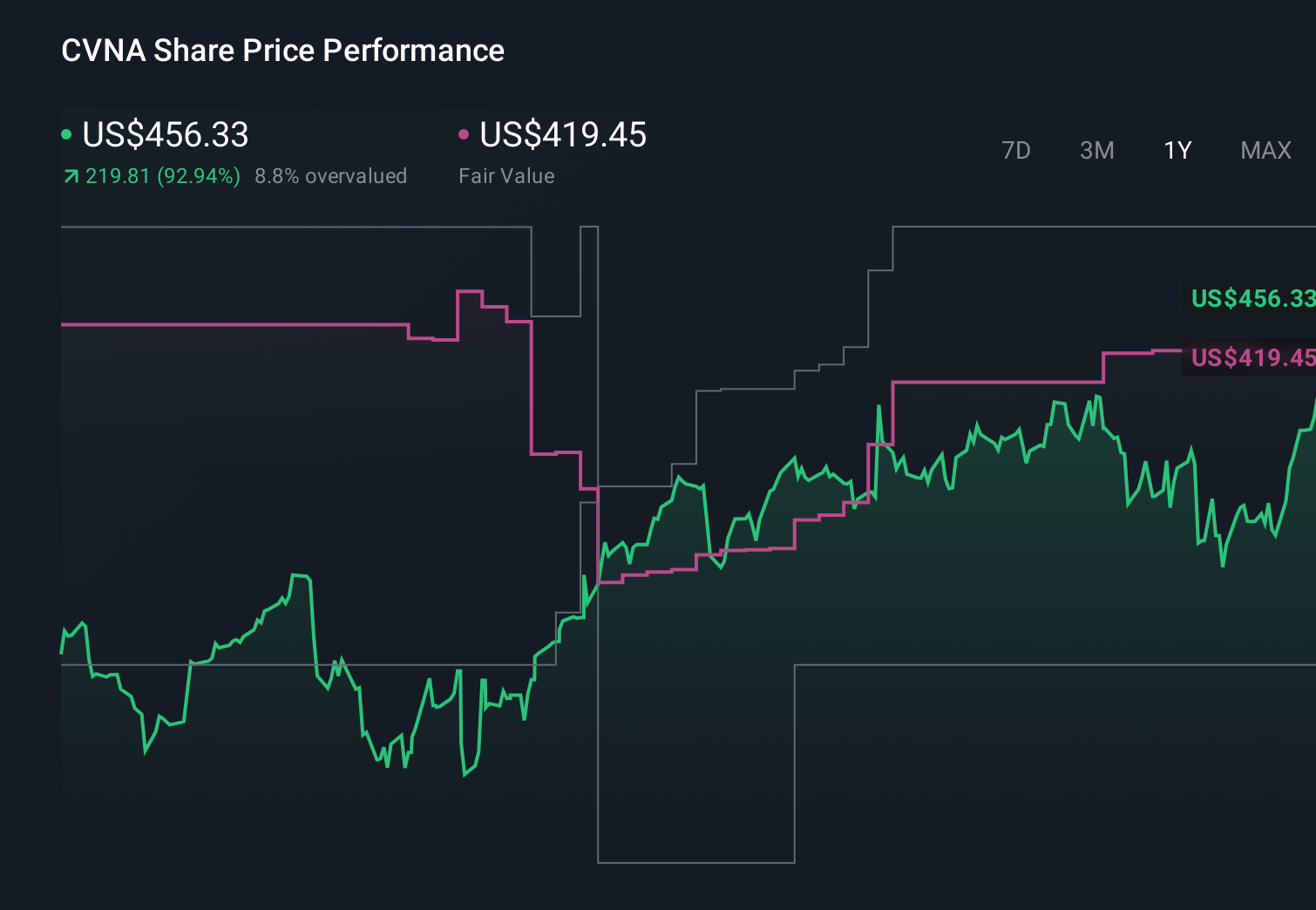
Some of the most optimistic analysts were assuming Carvana could reach about US$50 billion in revenue and US$3.7 billion in earnings by 2029, which is a far more bullish view than consensus and sits in tension with concerns about long term leverage risks that the new loan only partly addresses.
Explore 6 other fair value estimates on Carvana - why the stock might be worth over 4x more than the current price!
Reach Your Own Conclusion
Don't just follow the ticker - dig into the data and build a conviction that's truly your own.
- A great starting point for your Carvana research is our analysis highlighting 2 key rewards and 1 important warning sign that could impact your investment decision.
- Our free Carvana research report provides a comprehensive fundamental analysis summarized in a single visual - the Snowflake - making it easy to evaluate Carvana's overall financial health at a glance.
Contemplating Other Strategies?
Early movers are already taking notice. See the stocks they're targeting before they've flown the coop:
- This technology could replace computers: discover 24 stocks that are working to make quantum computing a reality.
- Rare earth metals are an input to most high-tech devices, military and defence systems and electric vehicles. The global race is on to secure supply of these critical minerals. Beat the pack to uncover the 31 best rare earth metal stocks of the very few that mine this essential strategic resource.
- The future of work is here. Discover the 38 top robotics and automation stocks leading the charge in AI-driven automation and industrial transformation.
This article by Simply Wall St is general in nature. We provide commentary based on historical data and analyst forecasts only using an unbiased methodology and our articles are not intended to be financial advice. It does not constitute a recommendation to buy or sell any stock, and does not take account of your objectives, or your financial situation. We aim to bring you long-term focused analysis driven by fundamental data. Note that our analysis may not factor in the latest price-sensitive company announcements or qualitative material. Simply Wall St has no position in any stocks mentioned.