
Is Chubb (CB) Offering Value After Recent Share Price Pullback And Mixed Growth Outlook?
Chubb Limited CB | 328.33 | +0.36% |
- If you are wondering whether Chubb's current share price reflects its true worth, you are not alone. Many investors are asking if the recent price level still offers value.
- Chubb shares last closed at US$322.76, with returns of 4.1% year to date and 15.2% over the past year, while the stock shows a 3.4% decline over 7 days and a 1.0% decline over 30 days that may have caught your eye.
- Recent headlines around Chubb have focused on its position in the insurance space and how investors are thinking about risk, capital strength and growth opportunities for large insurers. These themes help frame why the stock has moved the way it has and why valuation is such a key focus right now.
- On our checks, Chubb currently has a valuation score of 3 out of 6, which means it screens as undervalued on half of the valuation tests we apply. Next we will walk through the main valuation approaches investors commonly use and then finish with a way to look at value that can give an even clearer picture.
Approach 1: Chubb Excess Returns Analysis
The Excess Returns model looks at how much profit Chubb is expected to generate over and above the return required by its shareholders, then capitalises those excess profits into an intrinsic value per share.
For Chubb, the starting point is a Book Value of US$188.59 per share and a Stable EPS estimate of US$30.40 per share, based on weighted future Return on Equity estimates from 15 analysts. The Average Return on Equity used in the model is 13.28%, while the Cost of Equity is US$15.56 per share. The difference between what Chubb is expected to earn and what investors require is captured in an Excess Return of US$14.85 per share.
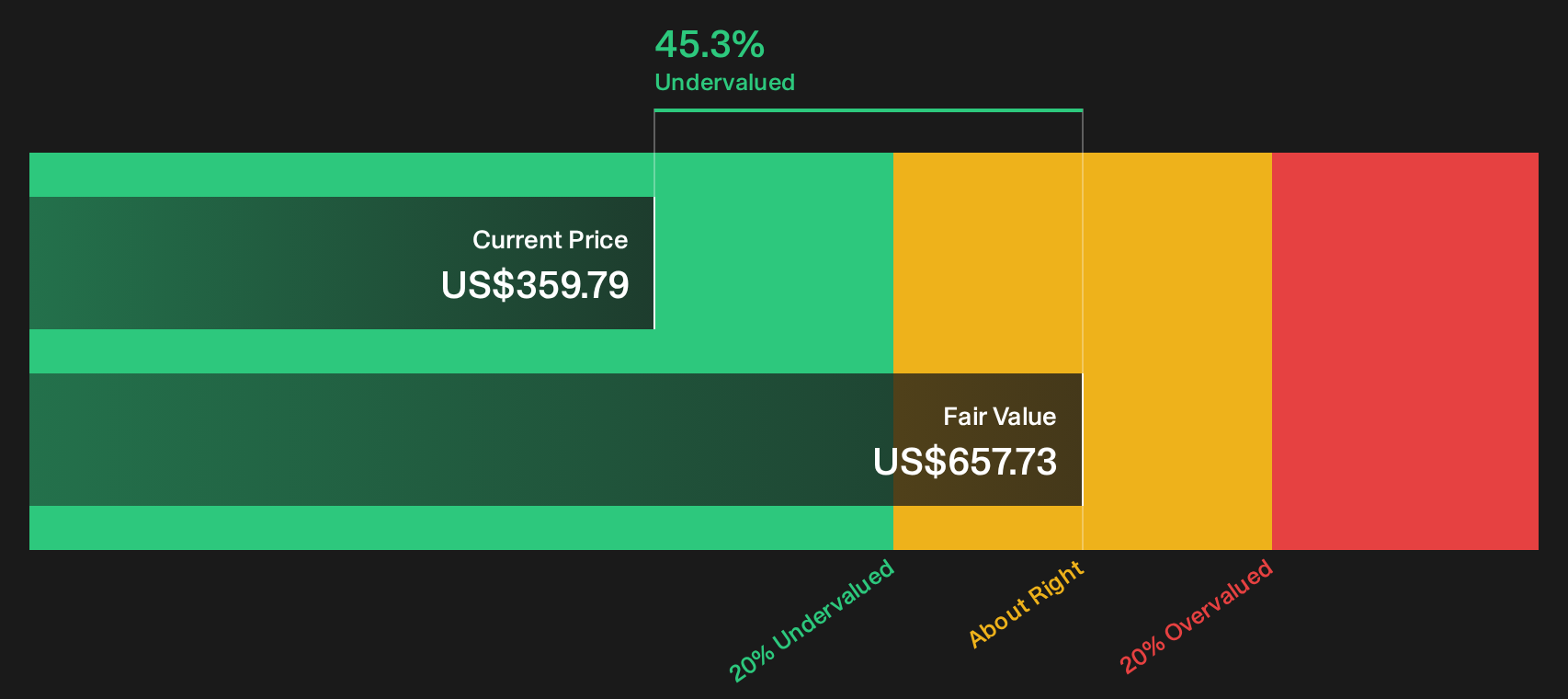
The model also incorporates a Stable Book Value of US$228.96 per share, drawn from weighted future Book Value estimates from 13 analysts. Putting all of this together, the Excess Returns framework produces an intrinsic value estimate of about US$667.67 per share, compared with the recent share price of US$322.76. That gap implies the stock is around 51.7% undervalued based on this approach.
Result: UNDERVALUED
Our Excess Returns analysis suggests Chubb is undervalued by 51.7%. Track this in your watchlist or portfolio, or discover 50 more high quality undervalued stocks.
Approach 2: Chubb Price vs Earnings
For a profitable insurer like Chubb, the P/E ratio is a useful way to think about value because it directly links what you pay today to the earnings the business is already generating. In general, higher growth expectations and lower perceived risk tend to support a higher, or more generous, P/E, while slower expected growth and higher risk usually point to a lower, more conservative P/E.
Chubb currently trades on a P/E of 12.21x. That sits above the Insurance industry average of about 11.43x and also above the peer average of 8.95x. To go a step further, Simply Wall St calculates a proprietary “Fair Ratio” of 12.69x for Chubb. This Fair Ratio reflects factors such as the company’s earnings profile, profit margins, risk characteristics, industry and market cap, rather than just a simple comparison with peers or the wider industry.
Because this Fair Ratio is tailored to Chubb’s fundamentals, it can give you a more company specific view than raw peer or sector averages. With Chubb’s actual P/E of 12.21x sitting below the Fair Ratio of 12.69x, the shares may appear undervalued on this multiple based approach.
Result: UNDERVALUED

P/E ratios tell one story, but what if the real opportunity lies elsewhere? Start investing in legacies, not executives. Discover our 20 top founder-led companies.
Upgrade Your Decision Making: Choose your Chubb Narrative
Earlier we mentioned that there is an even better way to understand valuation, so let us introduce Narratives, which are simply your own story about a company linked directly to a financial forecast and a Fair Value that you can compare with the current price.
On Simply Wall St’s Community page, used by millions of investors, a Narrative lets you set out your view on Chubb’s future revenue, earnings and margins, then connect those assumptions to a Fair Value that updates automatically as new information such as news or earnings is added.
That makes Narratives a practical tool to help you decide whether Chubb looks cheap or expensive at today’s price, because you can constantly compare your Fair Value to the live market price instead of relying only on static multiples or one off models.
For example, one Chubb Narrative currently anchors on a Fair Value of about US$247.08 per share while another sits closer to US$337.70, showing how two investors can look at the same company, plug in different expectations and reach very different conclusions about whether the current price makes sense.
For Chubb, however, we’ll make it really easy for you with previews of two leading Chubb Narratives:
First up is an analyst-style view that sees the stock as broadly in line with its underlying value, with dividends and buybacks playing a key role in the story.
🐂 Chubb Bull CaseFair Value: US$337.70
Difference vs last close of US$322.76: about 4.4% below this fair value estimate
Revenue growth assumption: 6.46% annual decline
- Focuses on international expansion, digital distribution and specialized insurance lines as key drivers for diversified revenue and earnings.
- Highlights dividends, buybacks and a strong capital position as important supports for earnings per share and flexibility in returning cash to shareholders.
- Flags competition, loss cost inflation, catastrophe exposure, emerging market volatility and regulatory pressure as important risks to margins and revenue.
On the other side, an independent community-style Narrative takes a more cautious line and lands on a lower fair value for the shares.
🐻 Chubb Bear CaseFair Value: US$247.08
Difference vs last close of US$322.76: about 30.6% above this fair value estimate
Revenue growth assumption: 2.55% annually
- Emphasizes that Chubb already operates at scale across commercial, personal and specialty insurance, with strong underwriting and risk management built in.
- Frames the insurance industry as highly competitive, with large global peers and insurtechs all pushing on technology, customer service and product breadth.
- Points to a wide set of risks, including catastrophe events, market moves, regulatory complexity, competition and climate-related pressures, as reasons for a more conservative value.
Taken together, these two Narratives give you a quick sense of the current debate. One view sees the current price not far from a steady fair value supported by capital returns. The other applies a lower fair value and leans more heavily on industry competition and risk. The next step is to decide which assumptions feel closer to your own and adjust the inputs to build a Chubb Narrative that matches your expectations.
Do you think there's more to the story for Chubb? Head over to our Community to see what others are saying!

This article by Simply Wall St is general in nature. We provide commentary based on historical data and analyst forecasts only using an unbiased methodology and our articles are not intended to be financial advice. It does not constitute a recommendation to buy or sell any stock, and does not take account of your objectives, or your financial situation. We aim to bring you long-term focused analysis driven by fundamental data. Note that our analysis may not factor in the latest price-sensitive company announcements or qualitative material. Simply Wall St has no position in any stocks mentioned.