

Is Copart’s (CPRT) Salvage Auction Model More Sensitive to Insurance Cycles Than Investors Assume?
Copart, Inc. CPRT | 0.00 |
- Renaissance Investment Management has already exited its Copart holding, citing deteriorating fundamentals as higher auto insurance costs lead some drivers to drop collision coverage and reduce the flow of damaged vehicles to Copart’s salvage auctions.
- This shift in insurance coverage patterns directly affects Copart’s core supply engine, raising questions about how resilient its auction and service model is when total-loss volumes face pressure.
- We’ll now examine how the prospect of fewer insured total-loss vehicles affects Copart’s investment narrative built around volume growth.
The future of work is here. Discover the 32 top robotics and automation stocks leading the charge in AI-driven automation and industrial transformation.
Copart Investment Narrative Recap
To own Copart, you need to believe its global salvage marketplace remains central to how insurers and other partners dispose of damaged vehicles, with auction volumes and fee revenue tied closely to insured total-loss activity. The Renaissance exit highlights a key near term risk: rising auto insurance costs that may shrink collision coverage and unit flow. That directly touches Copart’s biggest present vulnerability, but the recent earnings trend suggests the immediate financial impact has not yet been dramatic.
The most relevant recent announcement is Copart’s Q3 2026 result, which showed revenue of US$1,237.07 million and net income of US$402.4 million. These numbers came alongside commentary about a challenging operating backdrop, giving investors a current snapshot of how insurance volume headwinds are feeding through to the income statement while Copart continues to run its auctions at scale.
Yet this sits uncomfortably against the risk that a structural rise in underinsurance quietly reshapes the flow of total loss vehicles that investors should be aware of...
Copart's narrative projects $5.8 billion revenue and $1.8 billion earnings by 2029. This requires 7.4% yearly revenue growth and an earnings increase of about $0.2 billion from $1.6 billion today.
Uncover how Copart's forecasts yield a $41.44 fair value, a 40% upside to its current price.
Exploring Other Perspectives
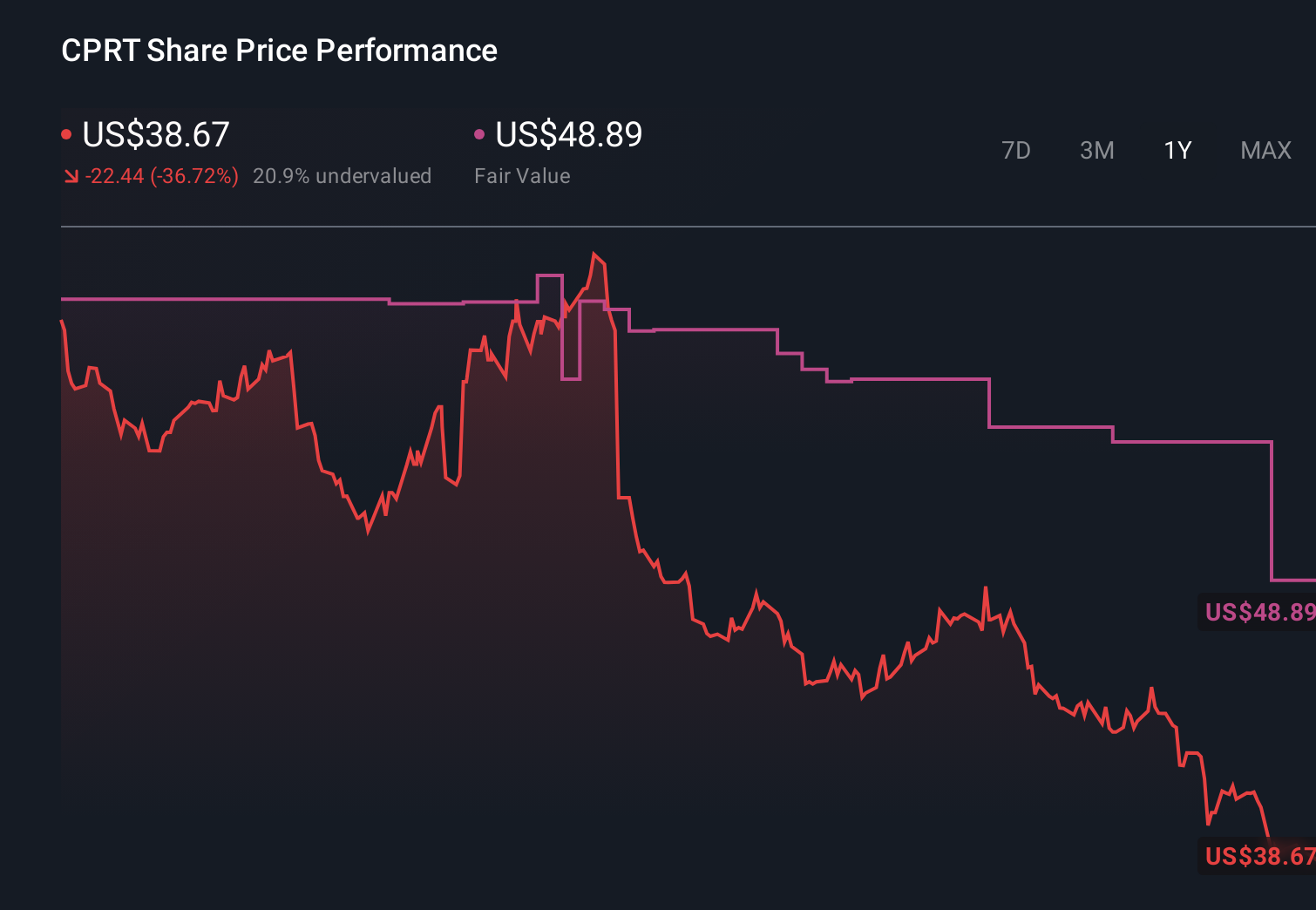
Before this insurance shock, the most optimistic analysts were assuming Copart could reach about US$6.0 billion of revenue and US$1.9 billion of earnings by 2028, which is a very different, far more upbeat story than the current worries about shrinking insured volumes and shows how widely opinions on Copart’s future can differ.
Explore 11 other fair value estimates on Copart - why the stock might be worth just $30.00!
Reach Your Own Conclusion
Don't just follow the ticker - dig into the data and build a conviction that's truly your own.
- A great starting point for your Copart research is our analysis highlighting 4 key rewards that could impact your investment decision.
- Our free Copart research report provides a comprehensive fundamental analysis summarized in a single visual - the Snowflake - making it easy to evaluate Copart's overall financial health at a glance.
Curious About Other Options?
Early movers are already taking notice. See the stocks they're targeting before they've flown the coop:
- Rare earth metals are an input to most high-tech devices, military and defence systems and electric vehicles. The global race is on to secure supply of these critical minerals. Beat the pack to uncover the 31 best rare earth metal stocks of the very few that mine this essential strategic resource.
- Find 48 companies with promising cash flow potential yet trading below their fair value.
- The best AI stocks today may lie beyond giants like Nvidia and Microsoft. Find the next big opportunity with these 14 smaller AI-focused companies with strong growth potential through early-stage innovation in machine learning, automation, and data intelligence that could fund your retirement.
This article by Simply Wall St is general in nature. We provide commentary based on historical data and analyst forecasts only using an unbiased methodology and our articles are not intended to be financial advice. It does not constitute a recommendation to buy or sell any stock, and does not take account of your objectives, or your financial situation. We aim to bring you long-term focused analysis driven by fundamental data. Note that our analysis may not factor in the latest price-sensitive company announcements or qualitative material. Simply Wall St has no position in any stocks mentioned.