
Is Daqo New Energy (DQ) Pricing Reflect Its Recent Volatility And Conflicting Valuation Signals
Daqo New Energy Corp Sponsored ADR DQ | 21.11 | -1.31% |
- If you are wondering whether Daqo New Energy is priced attractively today, the key question is how its current share price lines up with its underlying business value.
- The stock last closed at US$23.11, with returns of 4.3% over 7 days, a 10.5% decline over 30 days, a 22.1% decline year to date, and a 21.2% gain over 1 year that sits against much weaker 3 year and 5 year returns of 49.4% and 70.8% declines.
- Recent price moves have been shaped by ongoing sector wide discussion around solar materials producers and changing sentiment on future capacity and supply trends. Investors have been weighing this context as they reassess how much they are willing to pay for Daqo New Energy shares today.
- Our valuation checks give Daqo New Energy a score of 4 out of 6, which points to several areas where the stock screens as undervalued compared to common yardsticks. Next we look at what different valuation approaches say about that number, along with an additional way to think about valuation at the end of the article.
Approach 1: Daqo New Energy Discounted Cash Flow (DCF) Analysis
A Discounted Cash Flow, or DCF, model estimates what a company could be worth today by projecting its future cash flows and then discounting those back to a present value.
For Daqo New Energy, the model used is a 2 Stage Free Cash Flow to Equity approach based on cash flow projections. The company’s latest twelve month free cash flow is a loss of $239.24 million. Analysts provide explicit free cash flow estimates up to 2028, with Simply Wall St extrapolating further out. Within those projections, free cash flow for 2026 is forecast at $33.90 million, rising to $134.40 million by 2028. By 2035, the extrapolated free cash flow figure in the model reaches $287.92 million.
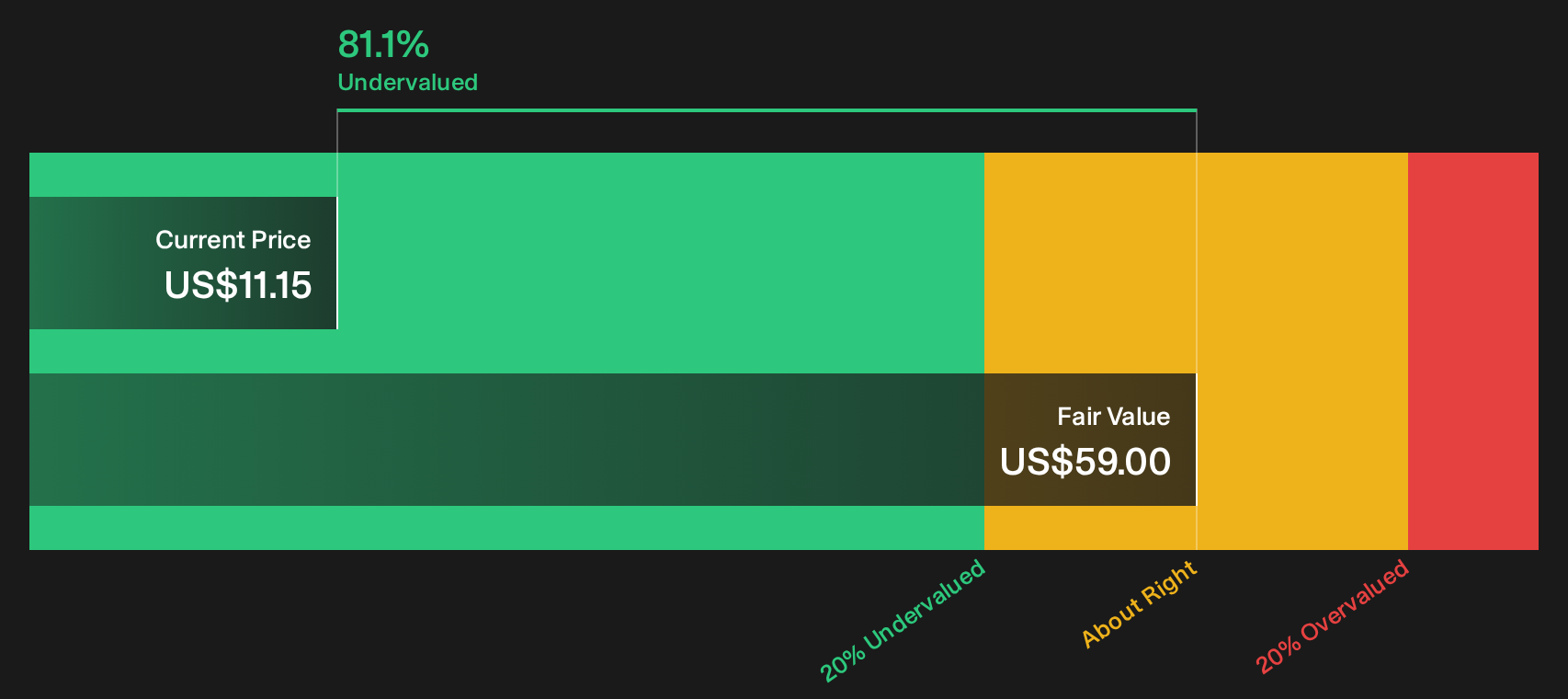
When all these projected cash flows are discounted back, the DCF model arrives at an estimated intrinsic value of about $31.29 per share. Compared with the recent share price of $23.11, this implies the stock is 26.1% undervalued based on this approach.
Result: UNDERVALUED
Our Discounted Cash Flow (DCF) analysis suggests Daqo New Energy is undervalued by 26.1%. Track this in your watchlist or portfolio, or discover 48 more high quality undervalued stocks.
Approach 2: Daqo New Energy Price vs Sales
For companies where earnings can be volatile, the P/S ratio is often a useful cross check because it compares the share price to the revenue the business generates, rather than profits that can swing from year to year.
What counts as a “normal” P/S ratio usually reflects how investors see a company’s growth potential and risk. Higher growth expectations or more resilient revenue can support a higher multiple, while higher risk or weaker growth prospects tend to justify a lower one.
Daqo New Energy is currently trading on a P/S ratio of 2.33x. This sits below the Semiconductor industry average of 5.58x and also below the peer group average of 6.69x. On the face of it, the stock trades at a discount to both its sector and closer peers.
Simply Wall St’s Fair Ratio is a proprietary estimate of what a “reasonable” P/S might be for Daqo New Energy, given factors such as its growth profile, industry, profit margins, market capitalization and company specific risks. Because it adjusts for these company level traits, the Fair Ratio can be more tailored than a simple comparison against broad industry or peer averages.
For Daqo New Energy, the Fair Ratio is 1.14x, which is below the current P/S of 2.33x. On this basis, the shares look more expensive than the Fair Ratio would suggest.
Result: OVERVALUED

P/S ratios tell one story, but what if the real opportunity lies elsewhere? Start investing in legacies, not executives. Discover our 18 top founder-led companies.
Upgrade Your Decision Making: Choose your Daqo New Energy Narrative
Earlier we mentioned that there is an even better way to think about valuation. That is through Narratives, which let you set out your own story for Daqo New Energy by linking your assumptions about future revenue, earnings and margins to a financial forecast, a Fair Value and then a clear comparison with the current price, all within an easy tool on Simply Wall St's Community page that millions of investors use.
Each Narrative ties your view of the business to numbers. You might align with a more optimistic fair value of US$39.00 per share, or a more cautious fair value closer to US$15.60, and the platform then shows you how that stacks up against the latest share price to help you decide whether the stock looks attractive or stretched on your terms.
Because Narratives on Simply Wall St update automatically when fresh information such as earnings, production guidance or news is added, you can keep your Daqo New Energy view current without rebuilding your analysis from scratch. You can also see in one place how your story, the forecast and the implied Fair Value change over time.
For Daqo New Energy, however, we will make it really easy for you with previews of two leading Daqo New Energy Narratives:
These sit at opposite ends of current analyst thinking, so you can quickly see what needs to be true for either a higher or lower fair value to make sense for you.
Fair value in this bullish narrative: US$39.00 per share
Implied price gap to that fair value at the last close of US$23.11: around 40.7% below the narrative fair value
Assumed annual revenue growth: 41.00%
- Analysts on the optimistic side anchor around a US$39.00 fair value, with the model using a discount rate of 11.43%, higher future P/E assumptions and net profit margins of 15.29%.
- This view leans on higher growth expectations for Daqo New Energy’s polysilicon business, with revenue growth assumptions of 41.00% a year and a belief that the company can support a higher earnings multiple over time.
- Supporters of this narrative place weight on the idea that if execution on revenue, margins and cash generation remains in line with these assumptions, the current share price could sit below what they regard as a reasonable long term value anchor.
Fair value in this bearish narrative: US$15.60 per share
Implied price gap to that fair value at the last close of US$23.11: around 48.1% above the narrative fair value
Assumed annual revenue growth: 30.46%
- The cautious narrative works off a US$15.60 fair value, using a discount rate of 11.39% and profit margins of 14.71%, and assumes that current market expectations may be too optimistic relative to long run pricing and utilization for polysilicon.
- This view uses revenue growth of 30.46% a year but pairs it with concerns about overcapacity, the risk of long periods of low realized prices, heavy reinvestment and potential pressure on returns.
- Analysts aligned with this fair value would argue you need to be comfortable with the idea that even if earnings improve, the share price today could already reflect more generous assumptions than they see as reasonable.
Taken together, these two Narratives frame a clear valuation range around Daqo New Energy, from roughly US$15.60 to US$39.00 based on different sets of analyst assumptions about growth, margins, discount rates and future P/E levels. They offer a starting point for you to decide which story about the company’s prospects, risks and fair value feels closer to your own view of the stock.
If you want to move beyond the previews and test your own assumptions, you can build your own Narrative or see how the community has already mapped out their views for Daqo New Energy, including both bullish and bearish cases, all in one place. Curious how numbers become stories that shape markets? Explore Community Narratives
Do you think there's more to the story for Daqo New Energy? Head over to our Community to see what others are saying!

This article by Simply Wall St is general in nature. We provide commentary based on historical data and analyst forecasts only using an unbiased methodology and our articles are not intended to be financial advice. It does not constitute a recommendation to buy or sell any stock, and does not take account of your objectives, or your financial situation. We aim to bring you long-term focused analysis driven by fundamental data. Note that our analysis may not factor in the latest price-sensitive company announcements or qualitative material. Simply Wall St has no position in any stocks mentioned.