
Is Duke Energy (DUK) Pricing Reflect Long Term Utility Demand And Income Focus
Duke Energy Corporation DUK | 132.22 | +1.01% |
- If you are wondering whether Duke Energy's current share price lines up with its underlying worth, this article will walk through what the available data can and cannot tell you about value.
- Duke Energy's stock last closed at US$121.67, with returns of 1.1% over 7 days, 3.6% over 30 days, 3.6% year to date, 12.1% over 1 year, 35.9% over 3 years and 58.6% over 5 years. This provides useful context before looking at valuation.
- Recent news flow around Duke Energy has focused on ongoing interest in regulated utilities and how investors are weighing income, stability and sensitivity to interest rates. For long term holders and new investors alike, this backdrop helps frame how the market is currently thinking about the stock.
- Duke Energy currently scores 3 out of 6 on our valuation checks. We will break down what that means across different valuation approaches and then finish by looking at one more way to think about whether the current price makes sense for you.
Approach 1: Duke Energy Dividend Discount Model (DDM) Analysis
The Dividend Discount Model estimates what a stock could be worth by projecting future dividends and discounting them back to today, based on how fast those dividends might grow and the return investors require.
For Duke Energy, the model uses an annual dividend per share of US$4.65, a return on equity of 8.80% and a payout ratio of about 101.89%. Plugging these into the standard DDM formula results in an implied dividend growth rate of roughly 0.17% decline each year, based on the calculation source, Calculated (1 - Payout Ratio) x ROE, (1 - 101.89%) x 8.80%). That very high payout ratio suggests most earnings are being returned to shareholders, with limited retained earnings to support dividend growth.
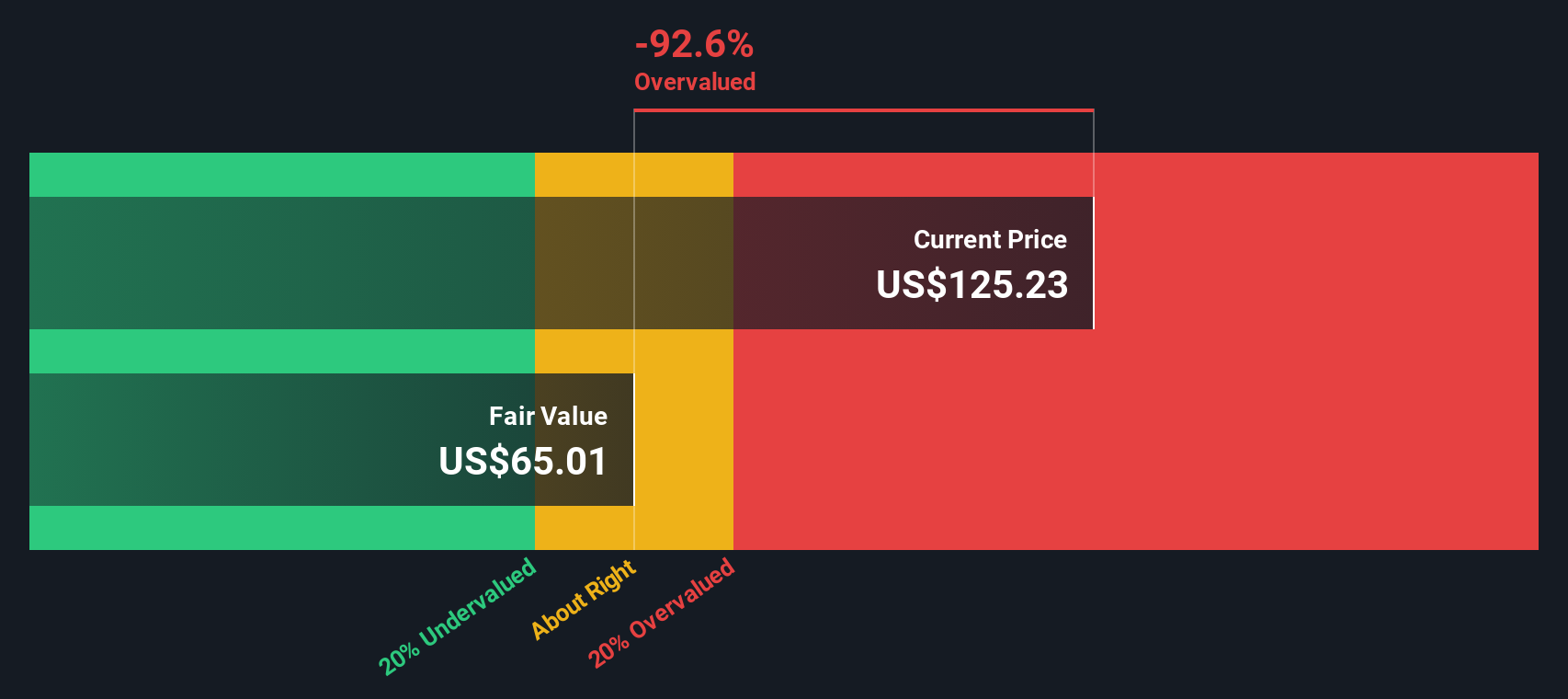
On these inputs, the DDM output points to an intrinsic value of about US$65.25 per share. Compared with the recent share price of US$121.67, the DDM implies the stock is about 86.5% overvalued using this lens.
Result: OVERVALUED
Our Dividend Discount Model (DDM) analysis suggests Duke Energy may be overvalued by 86.5%. Discover 878 undervalued stocks or create your own screener to find better value opportunities.
Approach 2: Duke Energy Price vs Earnings
P/E is a common way to value profitable companies because it links what you pay directly to the earnings the business is generating today. Investors usually accept a higher or lower P/E depending on what they expect for future earnings growth and how much risk they see in those earnings.
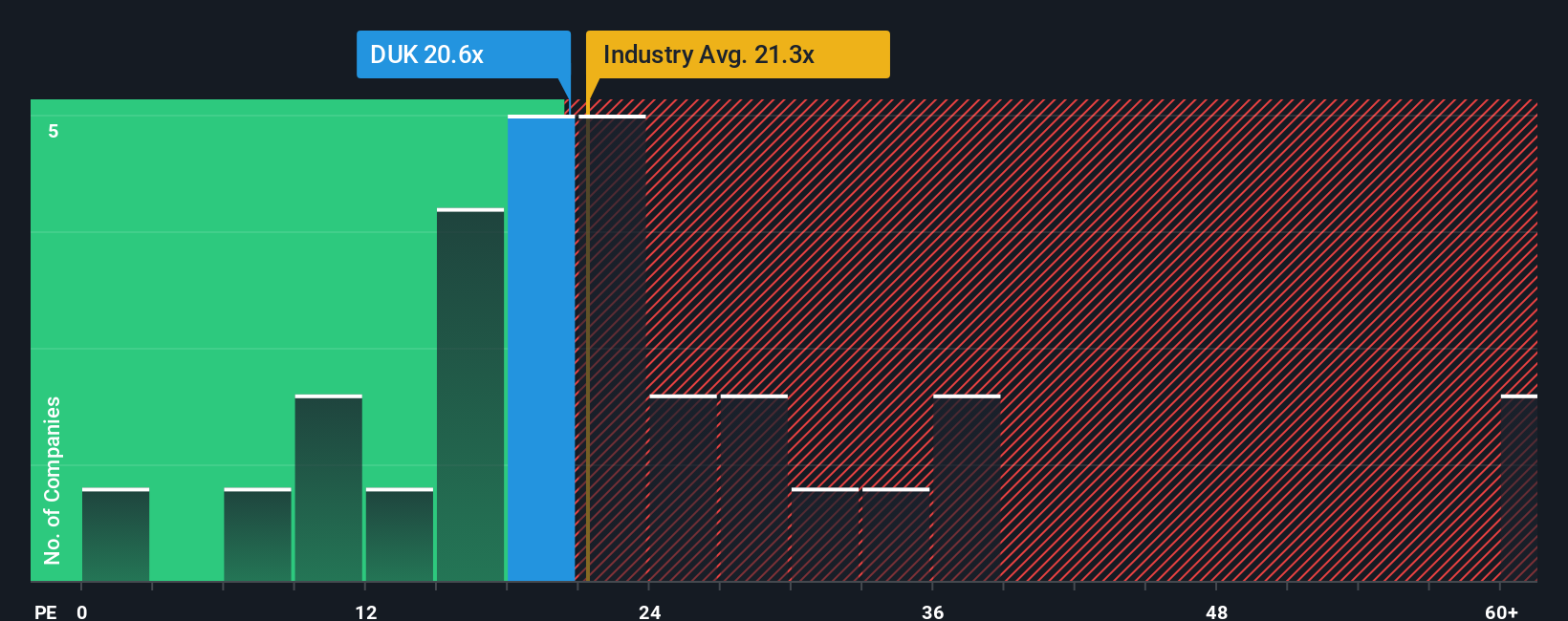
Duke Energy currently trades on a P/E of 19.23x. That sits slightly below the Electric Utilities industry average P/E of 20.52x and below the peer group average of 25.61x, which gives you a first pass sense of how the market is currently pricing the stock against similar businesses.
Simply Wall St’s Fair Ratio for Duke Energy is 24.30x. This is a proprietary estimate of what the P/E might be based on factors such as the company’s earnings growth profile, industry, profit margins, market capitalization and specific risks. Because it blends these company level drivers with sector context, the Fair Ratio can be more tailored than a simple comparison with industry or peer averages alone.
Comparing the current P/E of 19.23x with the Fair Ratio of 24.30x suggests the shares are trading below that Fair Ratio estimate.
Result: UNDERVALUED
P/E ratios tell one story, but what if the real opportunity lies elsewhere? Discover 1425 companies where insiders are betting big on explosive growth.
Upgrade Your Decision Making: Choose your Duke Energy Narrative
Earlier we mentioned that there is an even better way to think about valuation, so let us introduce you to Narratives, which are simply your story about a company linked directly to its numbers, like your view of fair value and your expectations for future revenue, earnings and margins.
On Simply Wall St’s Community page, used by millions of investors, you can set up a Narrative that connects how you see Duke Energy’s business to a financial forecast, then to a fair value that you can compare with the current share price to help decide whether you might want to buy, hold or sell.
Because Narratives on the platform update when new information such as news or earnings is added, your fair value view can adjust automatically instead of relying on a once off spreadsheet.
For example, one Duke Energy Narrative might assume a relatively low fair value while another might assume a higher fair value based on different expectations for future earnings and profit margins. This shows how two investors can look at the same stock and reach different yet clearly explained conclusions.
Do you think there's more to the story for Duke Energy? Head over to our Community to see what others are saying!

This article by Simply Wall St is general in nature. We provide commentary based on historical data and analyst forecasts only using an unbiased methodology and our articles are not intended to be financial advice. It does not constitute a recommendation to buy or sell any stock, and does not take account of your objectives, or your financial situation. We aim to bring you long-term focused analysis driven by fundamental data. Note that our analysis may not factor in the latest price-sensitive company announcements or qualitative material. Simply Wall St has no position in any stocks mentioned.