

Is Fannie Mae’s Executive Shake-Up And Holding-Company Idea Altering The Investment Case For FNMA?
FEDERAL NATIONAL MORTGAGE ASSOC FNMA | 0.00 |
- In recent days, Fannie Mae has seen another wave of senior executive departures and cut about a dozen top leaders, while a white paper from Oksenholt Capital Management proposed a new public holding company that would sit above both Fannie Mae and Freddie Mac to capture operational and technology synergies.
- These management changes and structural proposals raise fresh questions about executive stability, multifamily financing capacity, and how Fannie Mae’s federal charter might be positioned within a broader holding-company framework.
- We’ll now examine how the senior leadership shake-up and holding-company proposal could reshape Fannie Mae’s existing investment narrative.
Capitalize on the AI infrastructure supercycle with our selection of the 55 best 'picks and shovels' of the AI gold rush converting record-breaking demand into massive cash flow.
Federal National Mortgage Association Investment Narrative Recap
To own Fannie Mae, you generally need to believe its US$4.1 trillion guaranty book and fee income can keep supporting earnings, even as capital demands and housing uncertainty ebb and flow. The latest senior leadership cuts and the proposed public holding company raise governance and structural questions, but they do not yet clearly alter the near term focus on credit costs in multifamily and the risk that higher required capital limits balance sheet flexibility.
The most relevant recent announcement is the reduction of about a dozen top executives, which lands just as multifamily borrowers lean more on agency lending amid tighter capital markets. For many shareholders, this links directly to the risk of elevated multifamily stress and credit provisions, at a time when analysts were already watching serious delinquencies, net charge offs, and capital requirements as key swing factors for the earnings profile.
Yet behind the apparent opportunity in Fannie Mae’s scale, investors should be aware of how persistent multifamily weakness could...
Federal National Mortgage Association's narrative projects $32.1 billion revenue and $169.4 thousand earnings by 2029. This requires 5.7% yearly revenue growth and a $67.8 million earnings decrease from $68.0 million today.
Uncover how Federal National Mortgage Association's forecasts yield a $10.50 fair value, a 67% upside to its current price.
Exploring Other Perspectives
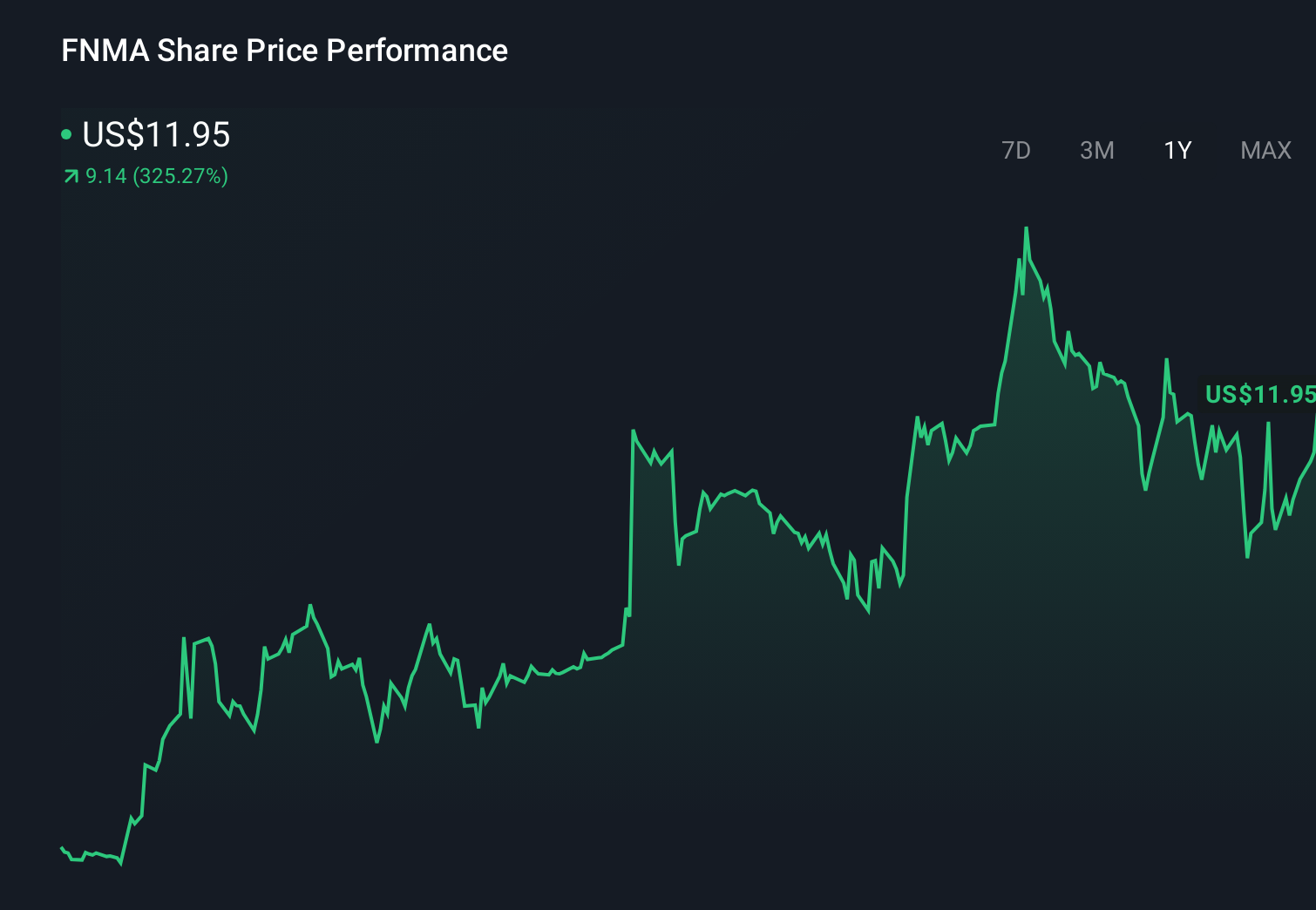
Some of the lowest ranked analysts were already cautious, assuming only 4.9 percent annual revenue growth and US$29.4 billion in 2029 earnings, and the latest leadership turmoil could either reinforce or soften that pessimism depending on how you interpret the added multifamily and capital uncertainty.
Explore 9 other fair value estimates on Federal National Mortgage Association - why the stock might be worth just $9.59!
Form Your Own Verdict
Disagree with existing narratives? Extraordinary investment returns rarely come from following the herd, so go with your instincts.
- A great starting point for your Federal National Mortgage Association research is our analysis highlighting 3 key rewards and 2 important warning signs that could impact your investment decision.
- Our free Federal National Mortgage Association research report provides a comprehensive fundamental analysis summarized in a single visual - the Snowflake - making it easy to evaluate Federal National Mortgage Association's overall financial health at a glance.
Seeking Other Investments?
Right now could be the best entry point. These picks are fresh from our daily scans. Don't delay:
- Uncover the next big thing with 22 elite penny stocks that balance risk and reward.
- Explore 24 top quantum computing companies leading the revolution in next-gen technology and shaping the future with breakthroughs in quantum algorithms, superconducting qubits, and cutting-edge research.
- We've uncovered the 12 dividend fortresses yielding 5%+ that don't just survive market storms, but thrive in them.
This article by Simply Wall St is general in nature. We provide commentary based on historical data and analyst forecasts only using an unbiased methodology and our articles are not intended to be financial advice. It does not constitute a recommendation to buy or sell any stock, and does not take account of your objectives, or your financial situation. We aim to bring you long-term focused analysis driven by fundamental data. Note that our analysis may not factor in the latest price-sensitive company announcements or qualitative material. Simply Wall St has no position in any stocks mentioned.