

Is FedEx’s (FDX) Freight Spin-Off a Clearer Focus or a Fragmented Network Strategy?
FedEx Corporation FDX | 0.00 |
- Earlier this month, FedEx completed the spin-off of its FedEx Freight division into an independent, publicly traded company, reshaping its portfolio around express and ground parcel operations while Freight focuses on stand-alone less-than-truckload services.
- The separation is intended to simplify FedEx’s cost-reduction and Network 2.0 efforts, support greater use of automation and AI, and free up capital to reduce long-term debt and sharpen each entity’s operational priorities.
- Next, we’ll examine how the FedEx Freight spin-off may alter FedEx’s cost-saving plans, Network 2.0 rollout, and overall investment narrative.
Rare earth metals are an input to most high-tech devices, military and defence systems and electric vehicles. The global race is on to secure supply of these critical minerals. Beat the pack to uncover the 27 best rare earth metal stocks of the very few that mine this essential strategic resource.
FedEx Investment Narrative Recap
To own FedEx after the Freight spin off, you now have to believe in a leaner, parcel focused network that can turn cost programs like DRIVE and Network 2.0 into better margins while managing debt and capital intensity. The separation directly affects the biggest near term catalyst, execution on Network 2.0, by simplifying the network, but it also shifts the key risk toward whether FedEx can offset Freight’s previous profit contribution amid industrial softness and international pricing pressure.
Among recent developments, FedEx’s plan to use Freight share sale proceeds to redeem its €354.878 million 1.300% notes and reduce long term debt ties closely to this new story. A less leveraged balance sheet can support continued investment in automation, Tricolor, and Europe while giving the company more room to absorb restructuring costs and potential earnings volatility as the stand alone Express and Ground network proves out its cost saving targets.
Yet, even as management leans into cost cuts and network simplification, investors should also be aware that...
FedEx's narrative projects $105.3 billion revenue and $5.8 billion earnings by 2029.
Uncover how FedEx's forecasts yield a $401.89 fair value, a 21% upside to its current price.
Exploring Other Perspectives
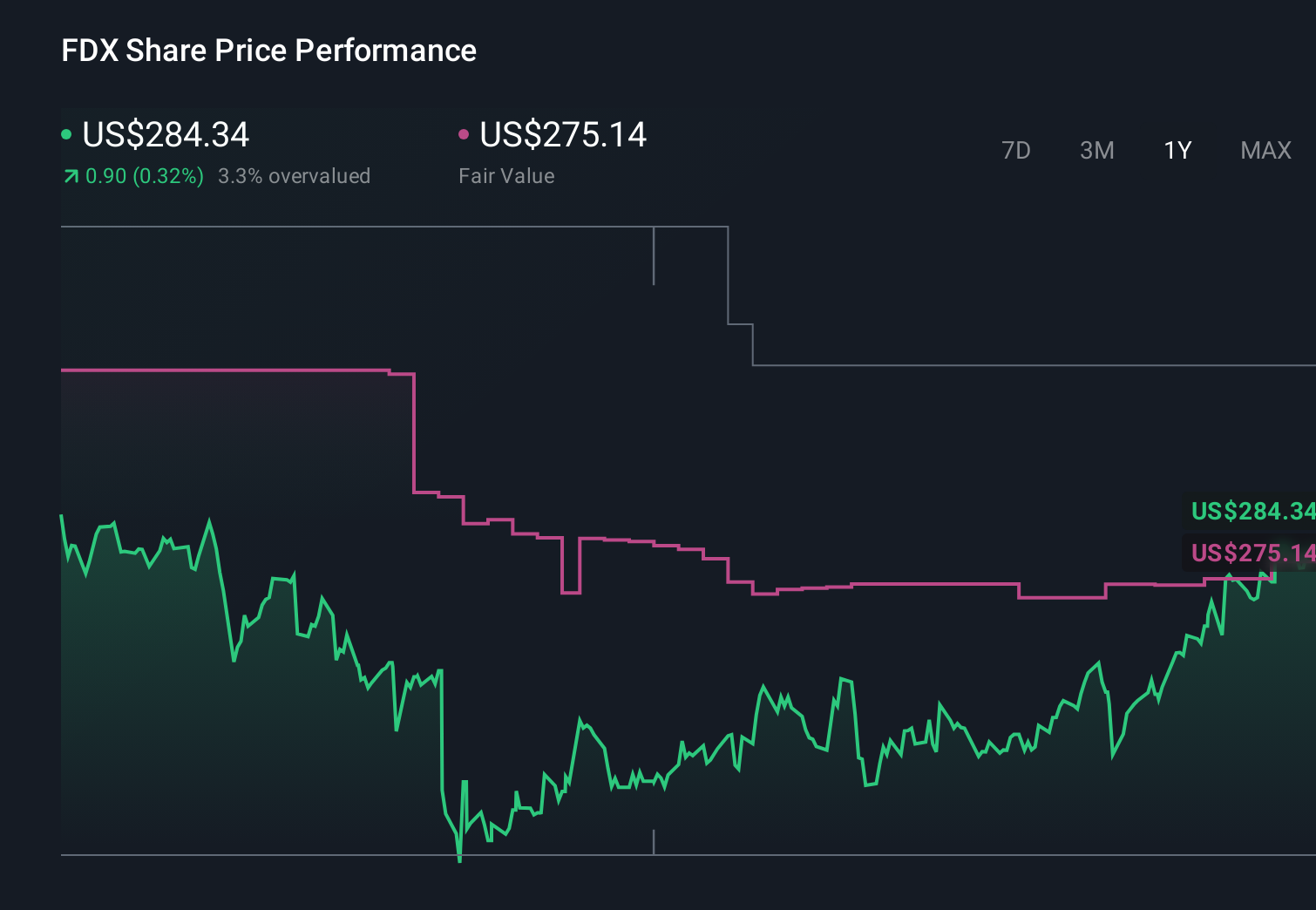
While the baseline view focuses on cost savings and network gains, the most pessimistic analysts saw only about 1.2% annual revenue growth and US$5.3 billion of earnings by 2029, reminding you that opinions on FedEx’s post spin future can differ sharply and that both bullish and bearish narratives may need to be revisited after this Freight separation.
Explore 4 other fair value estimates on FedEx - why the stock might be worth just $401.89!
The Verdict Is Yours
Disagree with existing narratives? Extraordinary investment returns rarely come from following the herd, so go with your instincts.
- A great starting point for your FedEx research is our analysis highlighting 4 key rewards and 2 important warning signs that could impact your investment decision.
- Our free FedEx research report provides a comprehensive fundamental analysis summarized in a single visual - the Snowflake - making it easy to evaluate FedEx's overall financial health at a glance.
Seeking Other Investments?
Markets shift fast. These stocks won't stay hidden for long. Get the list while it matters:
- Invest in the nuclear renaissance through our list of 88 elite nuclear energy infrastructure plays powering the global AI revolution.
- Uncover the next big thing with 24 elite penny stocks that balance risk and reward.
- Explore 30 top quantum computing companies leading the revolution in next-gen technology and shaping the future with breakthroughs in quantum algorithms, superconducting qubits, and cutting-edge research.
This article by Simply Wall St is general in nature. We provide commentary based on historical data and analyst forecasts only using an unbiased methodology and our articles are not intended to be financial advice. It does not constitute a recommendation to buy or sell any stock, and does not take account of your objectives, or your financial situation. We aim to bring you long-term focused analysis driven by fundamental data. Note that our analysis may not factor in the latest price-sensitive company announcements or qualitative material. Simply Wall St has no position in any stocks mentioned.