

Is Fiserv (FISV) Using agentOS To Quietly Redefine Its Fintech Platform Advantage?
Fiserv, Inc. FISV | 0.00 |
- Earlier this week, Fiserv, Inc. launched agentOS, an agentic AI operating system built with OpenAI and AWS to help banks and credit unions deploy, govern, and scale AI agents across core banking, payments, issuer processing, and servicing workflows, with wide availability targeted for August 2026.
- The inclusion of a banking-native agent marketplace, featuring Fiserv-built and third-party agents for functions like risk management, regulatory reporting, and back-office reconciliation, signals a push to turn AI into a configurable infrastructure layer across financial institutions’ existing Fiserv platforms.
- Next, we’ll examine how agentOS’s bank-specific AI marketplace and deep integration across Fiserv platforms could reshape the company’s investment narrative.
Uncover the next big thing with 27 elite penny stocks that balance risk and reward.
Fiserv Investment Narrative Recap
To own Fiserv, you need to believe its broad payments and banking platforms can convert heavy product investment into steadier earnings after a difficult year. The launch of agentOS looks directionally helpful for addressing concerns about slow adoption of next generation platforms, but it does not change that the most immediate catalyst is management’s ability to stabilize margins after recent compression, while the biggest current risk remains execution delays on new products and integrations.
Among the recent news, the planned joint venture with Bridgeport Partners around ATM Managed Services, Cash & Logistics, and MoneyPass stands out as most relevant. It highlights how Fiserv is reshaping its portfolio while it simultaneously pushes deeper into AI powered infrastructure like agentOS, a combination that could influence both near term profitability trends and longer term perceptions of where the company’s core earnings power really sits.
Yet, even as agentOS and portfolio changes signal progress, investors should be aware that persistent execution risk around complex, multi platform product rollouts could...
Fiserv's narrative projects $24.7 billion revenue and $5.9 billion earnings by 2028.
Uncover how Fiserv's forecasts yield a $84.75 fair value, a 59% upside to its current price.
Exploring Other Perspectives
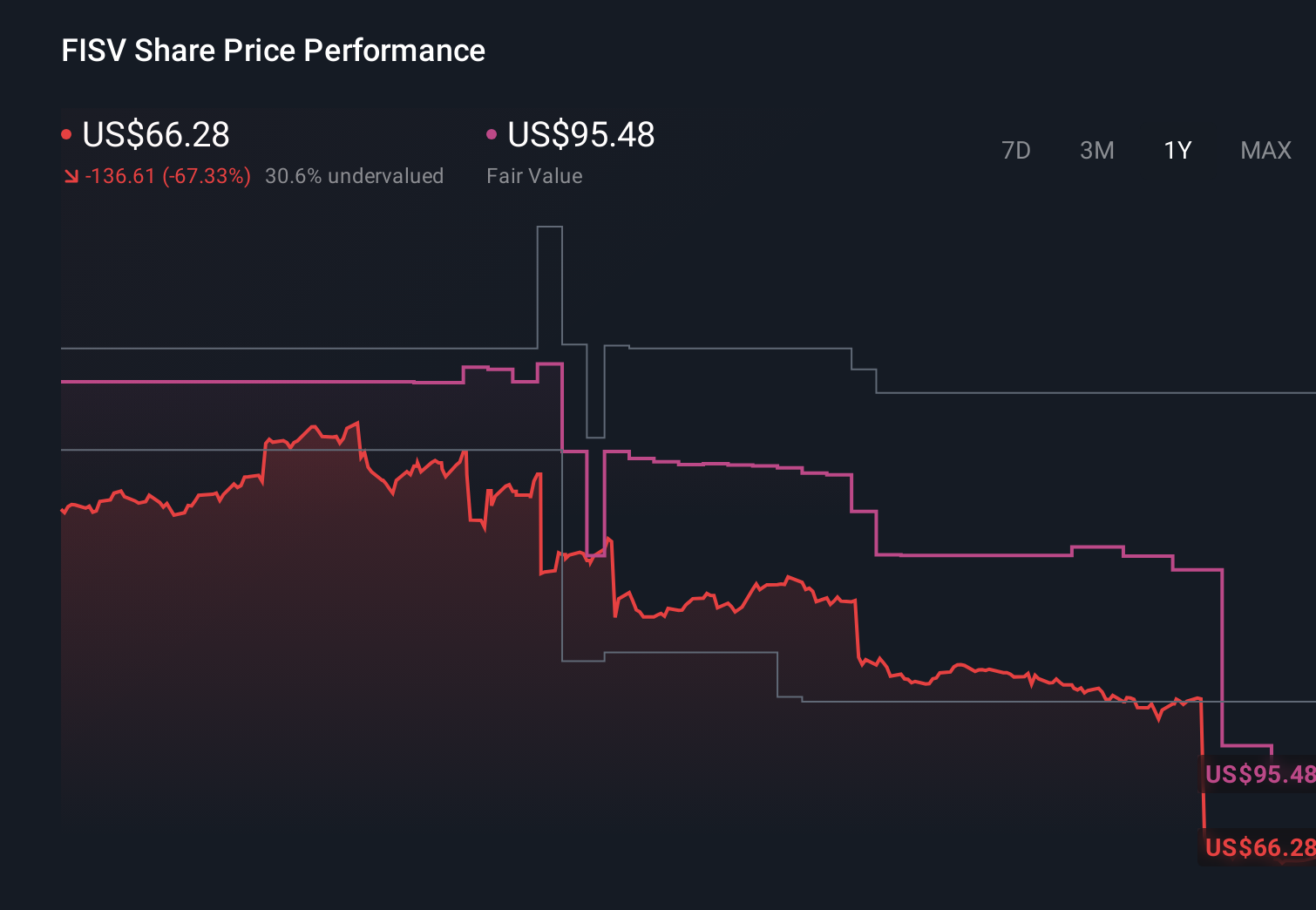
Some analysts are far more optimistic, assuming revenue of about US$23.7 billion and earnings of roughly US$4.3 billion by 2029, but if you worry that Fiserv’s push into complex “business operating systems” could amplify technology and adoption risks, this bullish view may feel very different from your own and the agentOS launch could eventually tilt expectations in either direction.
Explore 17 other fair value estimates on Fiserv - why the stock might be worth over 2x more than the current price!
Reach Your Own Conclusion
Don't just follow the ticker - dig into the data and build a conviction that's truly your own.
- A great starting point for your Fiserv research is our analysis highlighting 3 key rewards and 1 important warning sign that could impact your investment decision.
- Our free Fiserv research report provides a comprehensive fundamental analysis summarized in a single visual - the Snowflake - making it easy to evaluate Fiserv's overall financial health at a glance.
Curious About Other Options?
Opportunities like this don't last. These are today's most promising picks. Check them out now:
- The best AI stocks today may lie beyond giants like Nvidia and Microsoft. Find the next big opportunity with these 15 smaller AI-focused companies with strong growth potential through early-stage innovation in machine learning, automation, and data intelligence that could fund your retirement.
- Invest in the nuclear renaissance through our list of 87 elite nuclear energy infrastructure plays powering the global AI revolution.
- We've uncovered the 13 dividend fortresses yielding 5%+ that don't just survive market storms, but thrive in them.
This article by Simply Wall St is general in nature. We provide commentary based on historical data and analyst forecasts only using an unbiased methodology and our articles are not intended to be financial advice. It does not constitute a recommendation to buy or sell any stock, and does not take account of your objectives, or your financial situation. We aim to bring you long-term focused analysis driven by fundamental data. Note that our analysis may not factor in the latest price-sensitive company announcements or qualitative material. Simply Wall St has no position in any stocks mentioned.