

Is FIS’s Extended Barclays Deal a Quiet Turning Point in Its Core Banking Strategy (FIS)?
Fidelity National Information Services, Inc. FIS | 0.00 |
- In April 2026, Barclays US Consumer Bank and Fidelity National Information Services extended their multi-year core banking partnership, with Barclays adopting FIS’s cloud-ready Profile platform to support retail deposit growth and digital modernization.
- This renewed agreement, alongside FIS’s recent top ranking among global core banking technology providers, underscores its role as a key infrastructure partner to large financial institutions modernizing at scale.
- We’ll now explore how this extended Barclays partnership, centered on FIS’s Profile core platform, may influence the company’s broader investment narrative.
We've uncovered the 12 dividend fortresses yielding 5%+ that don't just survive market storms, but thrive in them.
Fidelity National Information Services Investment Narrative Recap
To own FIS, you really need to believe in its role as core infrastructure for banks that are upgrading deposits, payments and digital channels. The extended Barclays US Consumer Bank agreement reinforces that story, but it does not remove the near term risk around high debt levels and thin margins after recent one off items. The most important short term catalyst remains whether FIS can translate its product wins into cleaner earnings and stronger free cash flow.
The Barclays renewal connects directly to FIS’s wider push into cloud and AI enabled banking platforms, echoed by its recent number one ranking from Everest Group among global core banking providers. That recognition, covering more than 500 core banking clients and roughly 200 million accounts, lines up with the same modernization trend that underpins the Barclays decision and speaks to why many investors focus on FIS’s ability to deepen and expand these large bank relationships over time.
Yet even with these wins, investors should be aware that...
Fidelity National Information Services' narrative projects $15.0 billion revenue and $2.4 billion earnings by 2029. This requires 12.1% yearly revenue growth and about a $2.0 billion earnings increase from $382.0 million today.
Uncover how Fidelity National Information Services' forecasts yield a $66.33 fair value, a 37% upside to its current price.
Exploring Other Perspectives
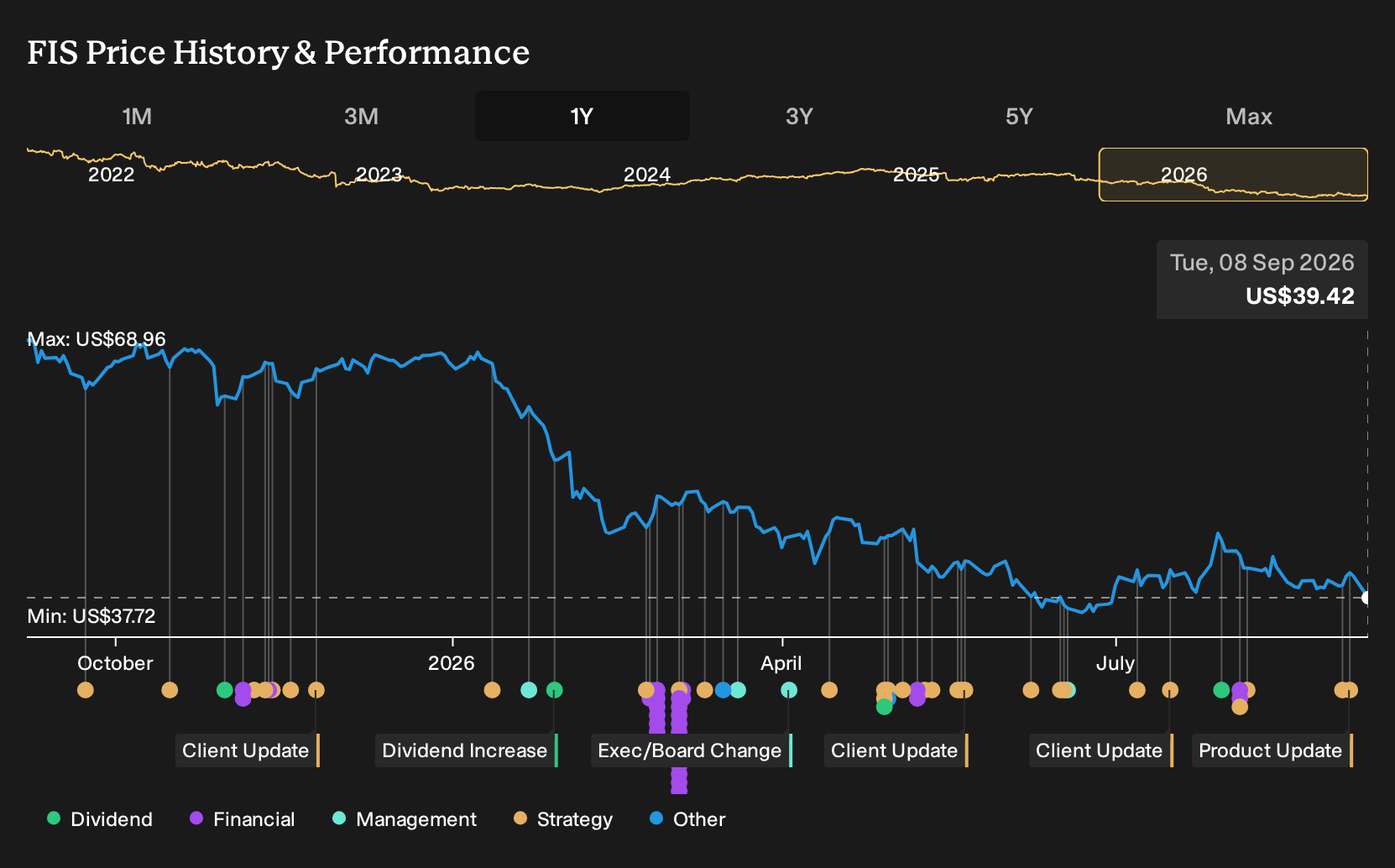
Before this Barclays news, the most pessimistic analysts were already assuming revenue of about US$14.7 billion and earnings near US$2.6 billion by 2029, yet they still worried that heavy AI and data investments might not pay off quickly, reminding you that reasonable people can look at the same FIS story and reach very different conclusions.
Explore 3 other fair value estimates on Fidelity National Information Services - why the stock might be worth just $58.60!
Reach Your Own Conclusion
Disagree with existing narratives? Extraordinary investment returns rarely come from following the herd, so go with your instincts.
- A great starting point for your Fidelity National Information Services research is our analysis highlighting 2 key rewards and 4 important warning signs that could impact your investment decision.
- Our free Fidelity National Information Services research report provides a comprehensive fundamental analysis summarized in a single visual - the Snowflake - making it easy to evaluate Fidelity National Information Services' overall financial health at a glance.
Want Some Alternatives?
Don't miss your shot at the next 10-bagger. Our latest stock picks just dropped:
- The latest GPUs need a type of rare earth metal called Neodymium and there are only 31 companies in the world exploring or producing it. Find the list for free.
- Outshine the giants: these 19 early-stage AI stocks could fund your retirement.
- AI is about to change healthcare. These 36 stocks are working on everything from early diagnostics to drug discovery. The best part - they are all under $10b in market cap - there's still time to get in early.
This article by Simply Wall St is general in nature. We provide commentary based on historical data and analyst forecasts only using an unbiased methodology and our articles are not intended to be financial advice. It does not constitute a recommendation to buy or sell any stock, and does not take account of your objectives, or your financial situation. We aim to bring you long-term focused analysis driven by fundamental data. Note that our analysis may not factor in the latest price-sensitive company announcements or qualitative material. Simply Wall St has no position in any stocks mentioned.