

Is General Motors (GM) Still Attractive After 67% One-Year Surge And EV Progress?
General Motors Company GM | 0.00 |
If you are wondering whether General Motors stock at around US$78.41 really offers value today, the key is understanding how its current price lines up with what the business might reasonably be worth.
Over the last week the stock returned 2.0%, over the last month it returned 7.8%, year to date it shows a 3.2% decline, and over the last year it returned 67.3%, while the three and five year returns are 144.3% and 49.2% respectively.
Recent headlines have focused on General Motors' progress in electric vehicles and its plans around autonomous and software driven offerings, which help explain why investors have been rethinking the long term potential embedded in the stock price. There has also been attention on capital allocation, including investments in new technologies and shareholder return policies, giving extra context to how the market is framing both opportunity and risk.
On Simply Wall St's 6 point valuation framework, General Motors currently scores a 4 out of 6. The next sections will compare what different valuation methods suggest the stock might be worth and then look at one more powerful way to connect valuation with the broader investment story.
Approach 1: General Motors Discounted Cash Flow (DCF) Analysis
A Discounted Cash Flow model takes estimates of the cash a company may generate in the future and discounts those projected amounts back to today, aiming to arrive at an estimate of what the whole business could be worth now.
For General Motors, Simply Wall St uses a 2 Stage Free Cash Flow to Equity model based on cash flow projections. The latest twelve month free cash flow is about $13.59b. Analyst estimates and subsequent extrapolations suggest annual free cash flow figures between roughly $10.16b in 2026 and $13.74b by 2035, with projections out to 10 years based on a mix of analyst inputs and modelled growth assumptions.
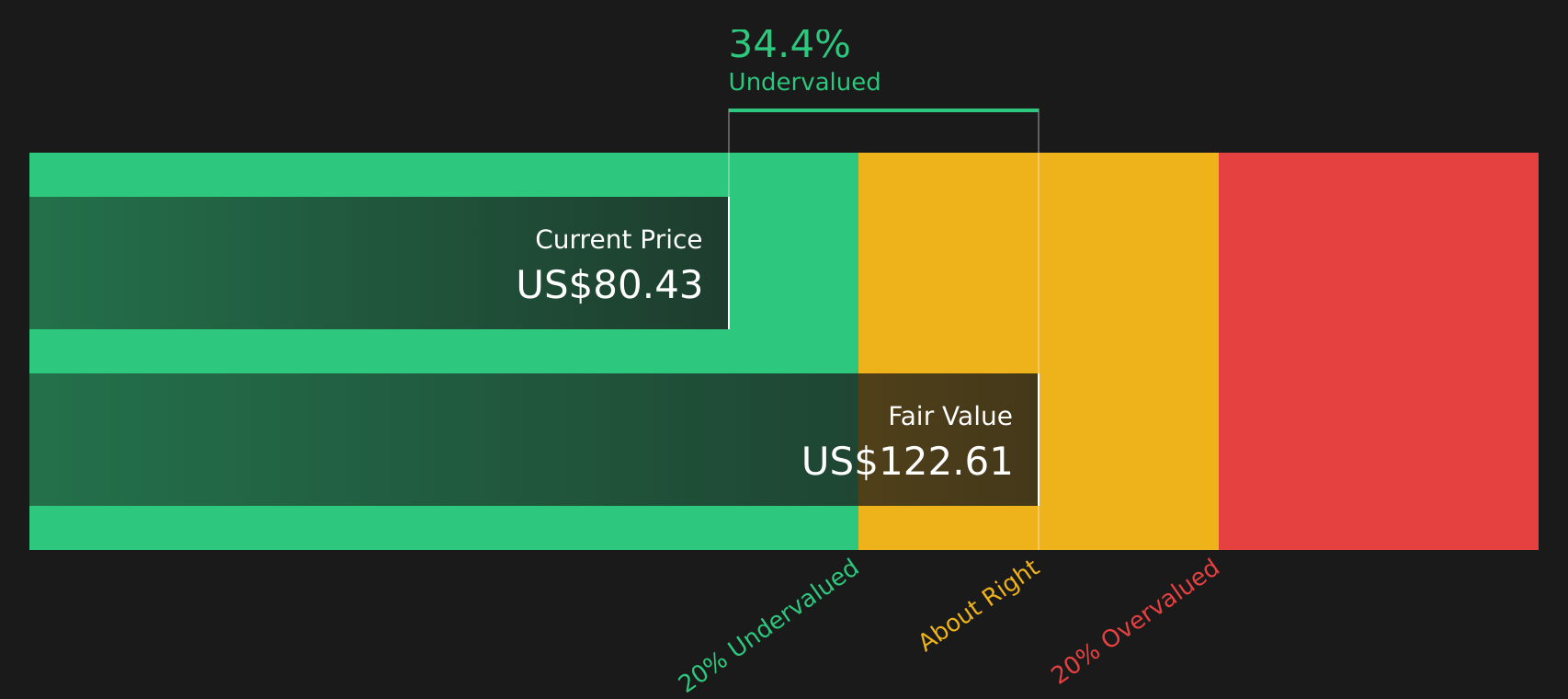
On this basis, the DCF model points to an estimated intrinsic value of about $127.99 per share. Compared with the recent share price of around $78.41, this implies the stock is trading at a 38.7% discount to that modelled value, so the DCF view suggests the stock is undervalued on current cash flow assumptions.
Result: UNDERVALUED
Our Discounted Cash Flow (DCF) analysis suggests General Motors is undervalued by 38.7%. Track this in your watchlist or portfolio, or discover 51 more high quality undervalued stocks.
Approach 2: General Motors Price vs Earnings
For profitable companies, the P/E ratio is a useful way to relate what you are paying per share to the earnings the business is generating. This helps you gauge how the market is valuing those earnings today.
What counts as a normal or fair P/E ratio often reflects how the market views a company’s earnings growth prospects and risk. Higher growth or lower perceived risk is often linked to higher multiples, and the opposite is also true.
General Motors currently trades on a P/E of 29.1x. That sits above the auto industry average of about 18.9x, yet below the broader peer group average of 45.8x. This shows that investors are applying a middle-of-the-road earnings multiple compared with different reference points.
Simply Wall St’s Fair Ratio for General Motors is 31.8x. This is its estimate of an appropriate P/E once factors like earnings growth, industry, profit margin, market cap and key risks are taken into account. This type of Fair Ratio can be more informative than a simple peer or industry comparison because it aims to align the multiple with the company’s specific fundamentals rather than broad group averages alone.
With General Motors trading on 29.1x compared with a Fair Ratio of 31.8x, the stock screens as slightly undervalued on this preferred multiple view.
Result: UNDERVALUED

P/E ratios tell one story, but what if the real opportunity lies elsewhere? Start investing in legacies, not executives. Discover our 18 top founder-led companies.
Upgrade Your Decision Making: Choose Your General Motors Narrative
Earlier it was mentioned that there is an even better way to understand valuation, so Narratives are introduced here as your way of attaching a clear story about General Motors to the numbers you care about. This links your view on its future revenue, earnings and margins to a Fair Value that can be compared directly with the current share price.
On Simply Wall St’s Community page, Narratives are an easy tool used by millions of investors to set out their assumptions, see the Fair Value that results from those forecasts, and then quickly check whether they see the stock as above or below that figure. This can help them decide if they want to wait, add, or trim.
Because Narratives are connected to live data, they refresh automatically when new earnings, news or analyst revisions arrive. As a result, your Fair Value view keeps updating without you rebuilding every input from scratch.
For General Motors, for example, one published Narrative on the platform applies a Fair Value of about US$41.79 per share while another applies about US$119.99 per share. That spread illustrates how two investors can look at the same stock, plug in very different expectations for trucks, EV execution and margins, and end up with very different but clearly articulated stories and valuation anchors.
For General Motors however, we will make it really easy for you with previews of two leading General Motors Narratives:
Fair value: US$79.46 per share
Difference to this narrative fair value: about 1.3% below the narrative estimate at the recent price of US$78.41
Revenue growth assumption: about 1.2%
- Sees EV expansion, U.S. manufacturing investment, software monetisation and cost controls as key drivers for market share and margin strength.
- Builds in modest revenue change, slightly higher profit margins and lower future P/E than the wider U.S. auto group, with ongoing buybacks reducing the share count.
- Flags tariff headwinds, quality and warranty risks, EV incentive changes, heavy capital spending and intense global competition as important threats to this outlook.
Fair value: US$41.79 per share
Difference to this narrative fair value: about 87.7% above the narrative estimate at the recent price of US$78.41
Revenue growth assumption: about 1.6%
- Argues that GM faces uncertain conditions around manufacturing, operations and product mix, with management attention pulled toward stability instead of growth.
- Views EV investments as important but slow to translate into meaningful returns because of policy and cost pressures, with GM expected to trail parts of the sector on P/E and sentiment.
- Assumes overall revenue could hold up, but profit margins compress in the near term, which keeps this narrative’s fair value well below the current share price.
If you want to see how other investors are joining the dots between these stories, you can review the wider range of community views on GM and see which assumptions line up with your own. You can then decide how closely you want to track the stock against your chosen fair value anchor. See what the community is saying about General Motors
Do you think there's more to the story for General Motors? Head over to our Community to see what others are saying!

This article by Simply Wall St is general in nature. We provide commentary based on historical data and analyst forecasts only using an unbiased methodology and our articles are not intended to be financial advice. It does not constitute a recommendation to buy or sell any stock, and does not take account of your objectives, or your financial situation. We aim to bring you long-term focused analysis driven by fundamental data. Note that our analysis may not factor in the latest price-sensitive company announcements or qualitative material. Simply Wall St has no position in any stocks mentioned.