

Is It Time To Reassess AES (AES) After Its Mixed Share Price Performance?
AES Corporation AES | 0.00 |
- Wondering if AES at around US$14.47 offers good value today? This article walks through what the current price might be implying about the stock.
- The share price is up 1.0% over the past week, flat over the past month, down 2.4% year to date, and up 24.6% over the past year, which can leave the current risk and reward trade off feeling unclear.
- That mixed return profile sits against ongoing investor interest in utilities and renewables, where sentiment can shift quickly as capital flows in and out of the sector. While this piece is not tied to a specific headline, it aims to give you context for those moves by focusing squarely on what the current price might say about value.
- AES currently scores 5 on Simply Wall St’s 6 point valuation checklist. You can see that scorecard in detail at 5 out of 6. Next you will see how different valuation approaches line up on AES, with an additional way to think about valuation at the end of the article.
Approach 1: AES Discounted Cash Flow (DCF) Analysis
A Discounted Cash Flow, or DCF, model looks at the cash the company is expected to generate in the future, then discounts those cash flows back into today’s dollars to estimate what the stock could be worth now.
For AES, the model used is a 2 Stage Free Cash Flow to Equity approach. The latest twelve month free cash flow is a loss of $2.19b. Looking ahead, analyst input and Simply Wall St extrapolations suggest free cash flow of $1.28b in 2026, rising to a projected $1.38b in 2028 and about $1.69b in 2035, all in $ terms. These future cash flows are discounted back and summed to reach an estimated intrinsic value of $19.65 per share.
Against a recent share price of about $14.47, this DCF output implies AES trades at roughly a 26.4% discount to that intrinsic value. On this model alone, the stock appears to be trading below the estimated intrinsic value.
Result: UNDERVALUED
Our Discounted Cash Flow (DCF) analysis suggests AES is undervalued by 26.4%. Track this in your watchlist or portfolio, or discover 51 more high quality undervalued stocks.
Approach 2: AES Price vs Earnings
For profitable companies, the P/E ratio is a useful shorthand because it links what you pay for the stock directly to the earnings it is currently generating. It gives you a quick sense of how many dollars investors are willing to pay today for each dollar of earnings.
What counts as a "normal" P/E really depends on how the market views a company’s growth prospects and risk profile. Higher expected growth or lower perceived risk can support a higher P/E, while slower growth or higher risk tends to line up with a lower P/E.
AES currently trades on a P/E of about 7.48x. That sits below both the Renewable Energy industry average of 16.38x and a peer group average of 35.77x. Simply Wall St’s Fair Ratio for AES is 25.20x, which is a proprietary estimate of what the P/E might be given factors such as earnings growth, profit margins, industry, market cap and specific risks.
The Fair Ratio can be more informative than a simple industry or peer comparison because it is tailored to AES rather than using broad averages. With the current P/E of 7.48x sitting well below the Fair Ratio of 25.20x, the multiple comparison points to AES trading on a lower earnings multiple than that model implies.
Result: UNDERVALUED

P/E ratios tell one story, but what if the real opportunity lies elsewhere? Start investing in legacies, not executives. Discover our 19 top founder-led companies.
Upgrade Your Decision Making: Choose your AES Narrative
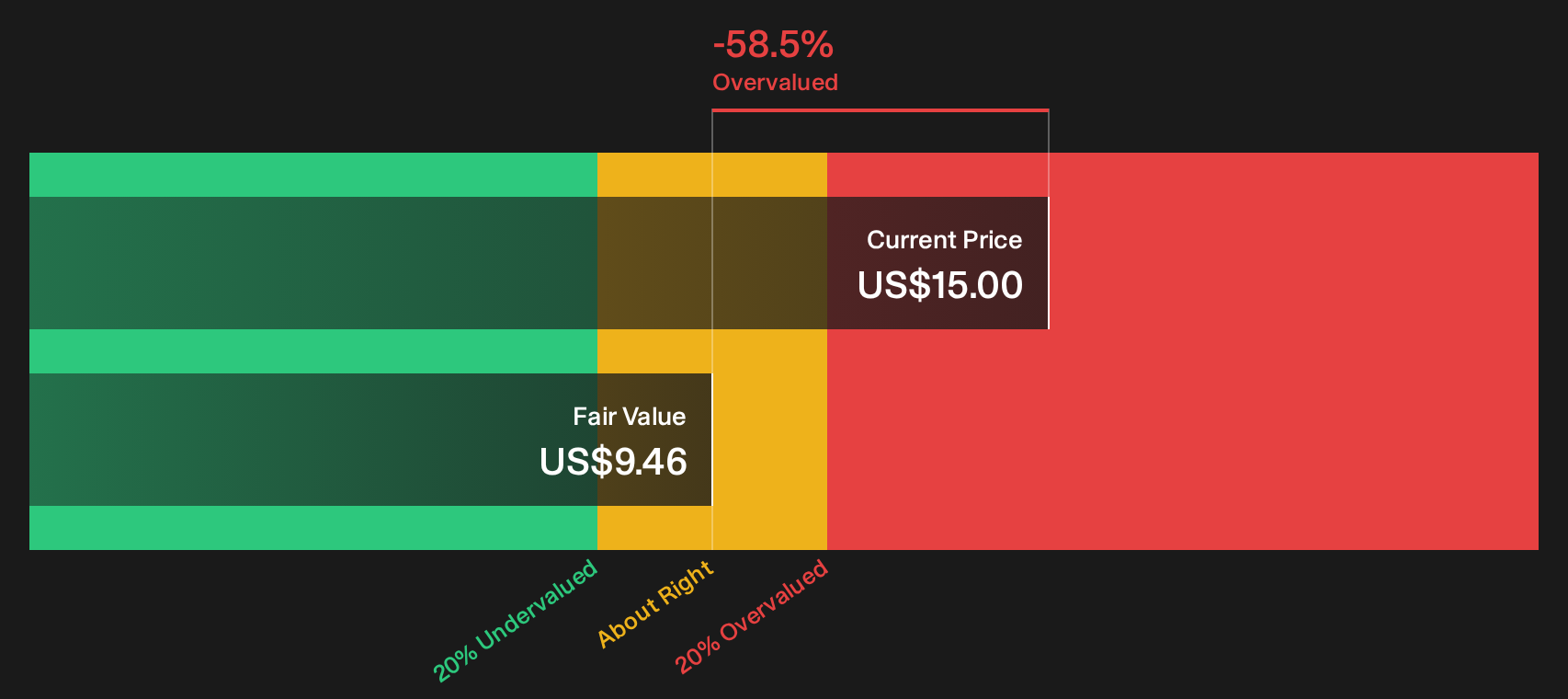
Earlier it was mentioned that there is an even better way to understand valuation. Narratives on Simply Wall St let you attach a clear story to your numbers by linking your view of AES, your forecast for revenue, earnings and margins, and your own fair value estimate. You can then compare that fair value to the current price to help guide buy or sell decisions, all inside an easy tool on the Community page that automatically refreshes when new data comes in. This is why one AES Narrative on the optimistic side can point to a fair value around US$15.74, while a more cautious view lands closer to US$7.17, and another around US$15.00. This gives you a concrete sense of how different assumptions create very different conclusions even for the same stock.
For AES however, we will make it really easy for you with previews of two leading AES Narratives:
On Simply Wall St, each narrative ties together a view on earnings, margins, valuation, and risks, then compares that view to the current share price of about US$14.47. That is why the fair values below are different from each other and from the DCF and P/E work earlier in the article.
Fair value in this bullish narrative: about US$15.74 per share.
At a recent price of about US$14.47, this narrative implies AES trades at roughly a 8.1% discount to that fair value.
Revenue growth assumption in this narrative: about 12.32% a year.
- Assumes AES grows revenue at a double digit rate while lifting profit margins from about 7.7% to about 11.7%, with earnings modeled at about US$2.0b by 2029.
- Leans on themes such as data center power demand, energy storage, and grid digitization to support higher earnings visibility and a fair value near US$15.74.
- Highlights risks around interest costs, regulation, and international exposure, and stresses that the bullish case only holds if those headwinds stay manageable and the take private process plays out as analysts expect.
Fair value in this more cautious narrative: about US$7.17 per share.
At a recent price of about US$14.47, this narrative implies AES trades at roughly a 50.5% premium to that fair value.
Revenue growth assumption in this narrative: about 4.05% a year.
- Frames AES as a mature utility and power producer that already reflects many positives in the current price, with fair value anchored closer to US$7.17.
- Draws on data such as dividend yield, institutional ownership and external ratings, but pairs those with a more modest revenue growth assumption of about 4.05% a year.
- Suggests that if growth, margins, or market multiples fall short of bullish expectations, the current share price could sit well above what this cautious earnings path might support.
Taken together, these two narratives show how different assumptions on earnings growth, margins, valuation multiples, and deal outcomes can pull fair value estimates for AES in very different directions. Your next step is to decide which set of assumptions feels closer to your own view on the company and how that lines up with your risk tolerance and time horizon.
To see how these results tie into long-term growth, risks, and valuation, check out the full range of community narratives for AES on Simply Wall St. Add the company to your watchlist or portfolio so you'll be alerted when the story evolves.
Do you think there's more to the story for AES? Head over to our Community to see what others are saying!

This article by Simply Wall St is general in nature. We provide commentary based on historical data and analyst forecasts only using an unbiased methodology and our articles are not intended to be financial advice. It does not constitute a recommendation to buy or sell any stock, and does not take account of your objectives, or your financial situation. We aim to bring you long-term focused analysis driven by fundamental data. Note that our analysis may not factor in the latest price-sensitive company announcements or qualitative material. Simply Wall St has no position in any stocks mentioned.