

Is It Time To Reassess Baidu (BIDU) After A Choppy Share Price Performance?
Baidu, Inc. Sponsored ADR Class A BIDU | 0.00 |
- If you are wondering whether Baidu's current share price really reflects what you are getting for your money, this article breaks down what the numbers say about value so you can judge for yourself.
- Baidu's stock has been choppy recently, with the share price down about 8.5% over the last week, up 6.2% over the last month, and still down 12.7% year to date, even after a 56.0% gain over the past year and a 10.5% gain over three years.
- These moves come as Baidu stays in focus for its role in Chinese search and online services, and the stock continues to reflect shifting expectations around its position in the broader tech sector. While daily headlines can move the share price, the more useful question is how those headlines stack up against the stock's underlying value.
- Right now, Baidu scores 2 out of 6 on Simply Wall St's valuation checks, which you can see in detail on its valuation score. The rest of this article will walk through what different valuation approaches imply, and then finish with a way to tie all of those methods together into a clearer picture of value.
Baidu scores just 2/6 on our valuation checks. See what other red flags we found in the full valuation breakdown.
Approach 1: Baidu Discounted Cash Flow (DCF) Analysis
A Discounted Cash Flow, or DCF, model takes estimates of the cash a company could generate in the future and discounts those cash flows back to today, to arrive at an estimate of what the business might be worth now.
For Baidu, Simply Wall St uses a 2 Stage Free Cash Flow to Equity model based on cash flow projections in CN¥. The latest twelve month free cash flow figure is a loss of about CN¥6.5b. From there, analysts and extrapolated estimates point to projected free cash flow of around CN¥8.8b in 2026 and roughly CN¥23.0b by 2035, with values in between based on a mix of analyst inputs and modelled growth.
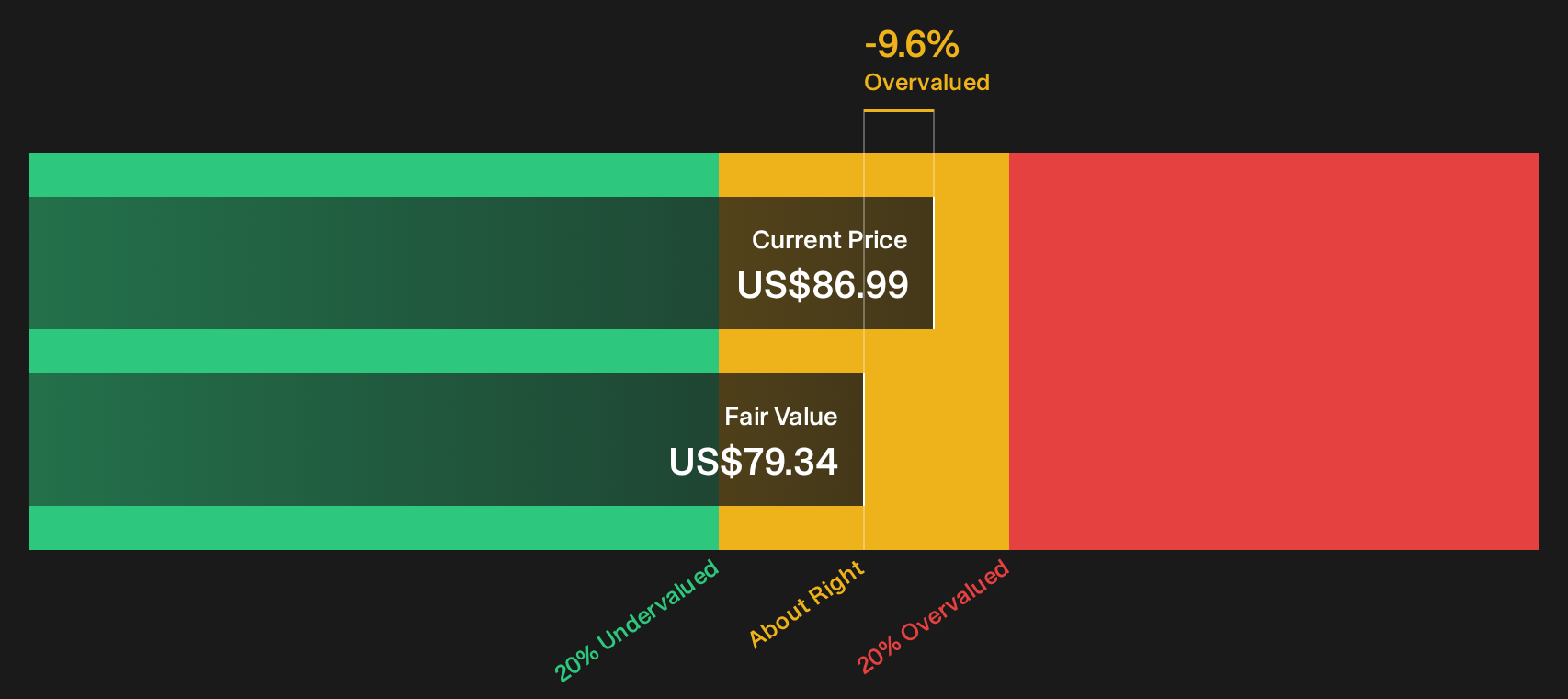
After discounting these projected cash flows back to today, the model arrives at an estimated intrinsic value of US$105.21 per share. Compared with the current share price, the DCF output suggests Baidu is about 24.7% overvalued on this basis.
Result: OVERVALUED
Our Discounted Cash Flow (DCF) analysis suggests Baidu may be overvalued by 24.7%. Discover 53 high quality undervalued stocks or create your own screener to find better value opportunities.
Approach 2: Baidu Price vs Sales
For companies where earnings can be volatile, the P/S ratio is often a useful cross check because it compares the stock price with the revenue the business generates, which tends to be more stable than profits.
In general, investors may accept a higher P/S ratio if they expect stronger revenue growth or see lower risk, and a lower P/S if growth expectations are more modest or perceived risk is higher. That is why comparing P/S in isolation can be misleading.
Baidu currently trades on a P/S ratio of 2.36x. This is above the Interactive Media and Services industry average of 1.06x, but below the peer group average of 4.50x. To refine this further, Simply Wall St calculates a Fair Ratio of 2.53x for Baidu. This proprietary metric estimates what P/S might be reasonable after considering factors such as earnings growth expectations, industry, profit margins, market cap and company specific risks.
Because the Fair Ratio incorporates these fundamentals, it can be more informative than a simple comparison with peers or the broad industry. Baidu's current 2.36x P/S is slightly below the 2.53x Fair Ratio, which indicates the stock may be mildly undervalued on this measure.
Result: UNDERVALUED

P/S ratios tell one story, but what if the real opportunity lies elsewhere? Start investing in legacies, not executives. Discover our 20 top founder-led companies.
Upgrade Your Decision Making: Choose your Baidu Narrative
Earlier it was mentioned that there is an even better way to think about value than any single ratio or DCF. On Simply Wall St this takes the form of Narratives, which let you attach a clear story about Baidu to the numbers you believe in, such as your own fair value, revenue, earnings and margin paths.
A Narrative is essentially your Baidu thesis written in numbers. It links what you think about its AI, cloud, search and robotaxi businesses to a forecast and then to a fair value that you can compare with today’s price to decide whether the stock looks expensive or cheap to you.
On the Simply Wall St Community page, Narratives are set up so you can quickly choose or adjust assumptions rather than build a full model yourself. They update automatically when new data, news or earnings are added, so your view stays in sync with fresh information without extra work.
For Baidu, one investor might align with a more bullish Narrative that points to a fair value around US$241.22 based on stronger revenue growth and higher profit margins. Another might prefer a more cautious Narrative closer to US$71.17. Seeing those side by side can make it easier for you to decide which story feels closest to your own expectations and risk tolerance.
For Baidu however we will make it really easy for you with previews of two leading Baidu Narratives:
Start with a bullish Narrative that leans into AI, cloud and autonomous driving, then contrast it with a more cautious take that keeps economic and competitive risks front and center. Seeing both helps you decide which set of assumptions feels closer to your own view.
Fair value in this bullish Narrative: US$176.41
Implied discount to this fair value from the latest close of US$131.18: around 26% below the Narrative fair value.
Revenue growth used in this Narrative: 5.86% a year.
- Assumes Baidu leans into AI, cloud and autonomous driving to widen its earnings base, with analysts using revenue growth of 5.86% and profit margins stepping up from 3.6% to 13.6% over three years.
- Takes the view that AI search, AI cloud and Apollo Go can be scaled so that higher margin, subscription and project work supports a higher earnings run rate by 2029.
- Anchors on a consensus fair value of US$176.41, backed by expectations for CN¥153.1b of revenue, CN¥20.8b of earnings and a 25.8x P/E in 2029 using a 10.1% discount rate, while flagging that analyst opinions vary and should be checked against your own assumptions.
Fair value in this more cautious Narrative: US$74.22
Implied premium to this fair value from the latest close of US$131.18: around 77% above the Narrative fair value.
Revenue growth used in this Narrative: 5.25% a year.
- Highlights that Baidu remains heavily exposed to China’s advertising market, with competition from platforms like ByteDance, Alibaba and Tencent, while also facing global rivals in cloud, AI and autonomous driving.
- Stresses execution risk around turning large AI, cloud and autonomous driving investments into consistent, profitable revenue, especially against a backdrop of economic uncertainty and geopolitical tension.
- Frames Baidu as a complex stock where AI and cloud potential sits alongside pressure on the core business, mixed analyst sentiment and a valuation that, in this Narrative, looks demanding compared with an estimated fair value of US$74.22.
If you want to move beyond previews and see how different assumptions on growth, margins and valuation multiple change the picture, you can review the full set of community Narratives for Baidu and stress test them against your own expectations using To see how these results tie into long-term growth, risks, and valuation, check out the full range of community narratives for Baidu on Simply Wall St. Add the company to your watchlist or portfolio so you'll be alerted when the story evolves.
Do you think there's more to the story for Baidu? Head over to our Community to see what others are saying!

This article by Simply Wall St is general in nature. We provide commentary based on historical data and analyst forecasts only using an unbiased methodology and our articles are not intended to be financial advice. It does not constitute a recommendation to buy or sell any stock, and does not take account of your objectives, or your financial situation. We aim to bring you long-term focused analysis driven by fundamental data. Note that our analysis may not factor in the latest price-sensitive company announcements or qualitative material. Simply Wall St has no position in any stocks mentioned.