

Is It Time To Reassess Delta Air Lines (DAL) After Its Strong Multi Year Share Price Run
Delta Air Lines, Inc. DAL | 0.00 |
- If you are wondering whether Delta Air Lines stock still offers value after a strong run, the next sections walk through what the current price may be implying and how that stacks up against different valuation checks.
- The stock last closed at US$70.23, with returns of 39.6% over the past year and 103.9% over three years, even though it is down 4.2% over the past week and 2.1% over the past month.
- Recent headlines around the aviation sector have focused on capacity shifts, route expansion and ongoing operational adjustments, which all shape how investors think about airlines as a group. These themes provide important context for Delta Air Lines because they can influence how the market weighs its long term prospects against near term risks.
- Simply Wall St currently assigns Delta Air Lines a value score of 4/6. The rest of this article will unpack what that means across different valuation methods before finishing with a broader way to think about what "fair value" really looks like for this stock.
Approach 1: Delta Air Lines Discounted Cash Flow (DCF) Analysis
A Discounted Cash Flow, or DCF, model projects a company’s future cash flows and then discounts them back to today using a required rate of return, aiming to estimate what the business could be worth right now.
For Delta Air Lines, the model used is a 2 Stage Free Cash Flow to Equity approach built on cash flow projections. The latest twelve‑month free cash flow is about $3.09b. Analyst estimates feed into the earlier years of the forecast, then Simply Wall St extrapolates further out, with projected free cash flow of $4.60b in 2029 and a set of estimates run through 2035 in the $4.5b to $4.9b range on an undiscounted basis.
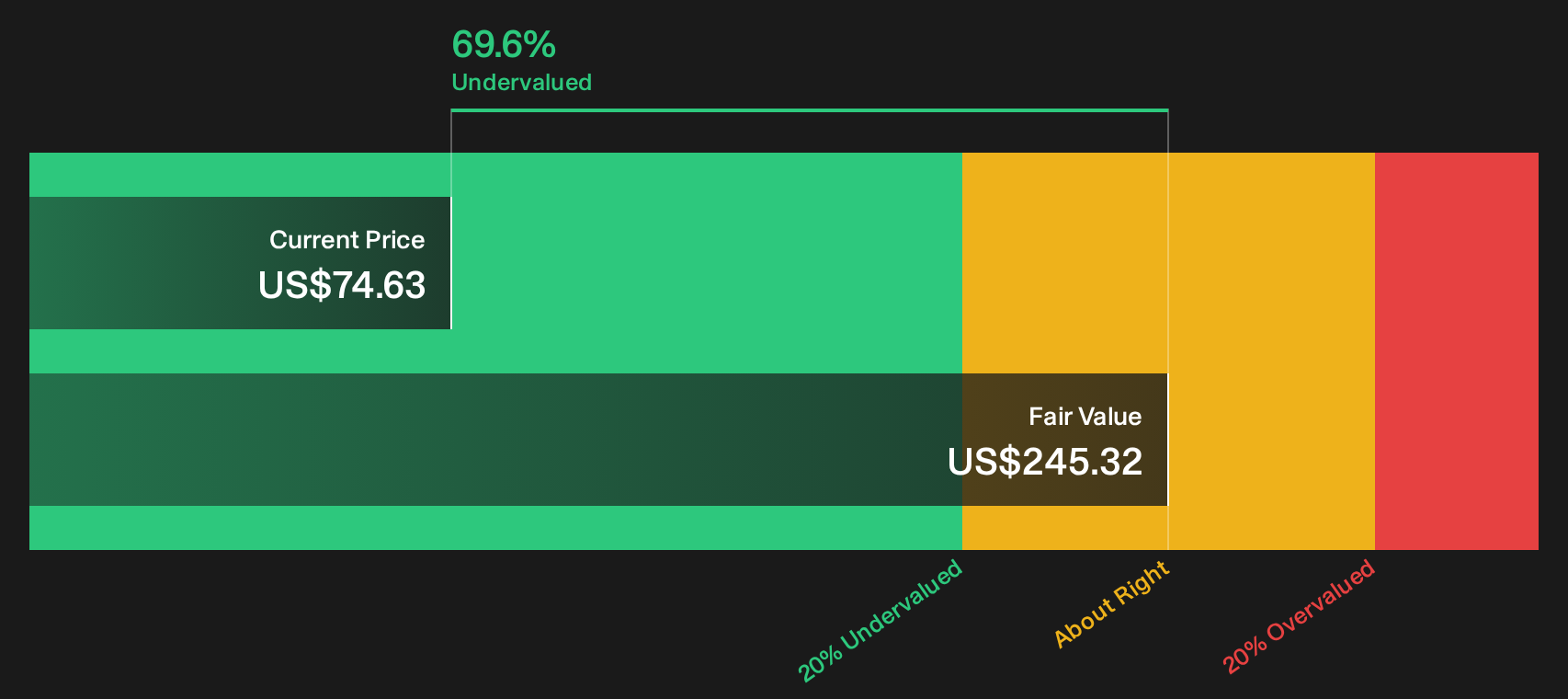
When those future cash flows are discounted back into today’s dollars, the DCF suggests an intrinsic value of about $106.11 per share. Compared with the recent share price of $70.23, this output implies the stock trades at roughly a 33.8% discount to that modelled value.
Result: UNDERVALUED
Our Discounted Cash Flow (DCF) analysis suggests Delta Air Lines is undervalued by 33.8%. Track this in your watchlist or portfolio, or discover 51 more high quality undervalued stocks.
Approach 2: Delta Air Lines Price vs Earnings
For profitable companies, the P/E ratio is a useful shorthand because it links what you pay for the stock to the earnings the business is already generating. It gives you a quick sense of how many dollars investors are currently willing to pay for each dollar of earnings.
What counts as a "normal" or "fair" P/E depends on how the market views a company’s growth potential and risk profile. Higher expected growth or lower perceived risk can support a higher P/E, while lower growth or higher risk usually lines up with a lower P/E.
Delta Air Lines currently trades on a P/E of 10.25x. That sits above the Airlines industry average of about 8.41x, but below the broader peer group average of 19.79x. Simply Wall St also calculates a proprietary “Fair Ratio” of 18.02x for Delta Air Lines. This Fair Ratio incorporates factors such as earnings growth expectations, profit margins, industry, market cap and company specific risks, so it can offer a more tailored benchmark than simple comparisons with industry or peer averages.
Because Delta Air Lines' actual P/E of 10.25x is below the Fair Ratio of 18.02x, the stock screens as undervalued on this earnings based check.
Result: UNDERVALUED

P/E ratios tell one story, but what if the real opportunity lies elsewhere? Start investing in legacies, not executives. Discover our 19 top founder-led companies.
Upgrade Your Decision Making: Choose your Delta Air Lines Narrative
Earlier it was mentioned that there is an even better way to understand valuation. Narratives are introduced here as a simple way for you to attach your own story about Delta Air Lines to the numbers, linking what you believe about its routes, premium demand or fuel risks to a clear forecast for future revenue, earnings and margins, and then to a Fair Value that you can compare with the current share price.
On Simply Wall St’s Community page, Narratives are available as an accessible tool used by millions of investors. They allow you to pick or adjust assumptions and instantly see how your view translates into a Fair Value that updates when new earnings, news or guidance are added.
For example, one Delta Air Lines Narrative on the bullish side assumes revenue growth of about 8.0% a year, profit margins of roughly 7.3%, a future P/E of about 13.6x and a Fair Value of US$95.00. A more cautious Narrative uses roughly flat revenue, margins of about 7.8%, a future P/E of about 10.7x and a Fair Value of about US$64.40, giving you a clear range of stories to compare with your own expectations.
For Delta Air Lines, we will make it really easy for you with previews of two leading Delta Air Lines Narratives:
Fair value in this bullish Narrative: US$79.89
Implied discount to this fair value at the last close of US$70.23: about 12.1% undervalued
Revenue growth assumption: 4.79% a year
- Analysts expect steady revenue growth with only a small shift lower in profit margins, supported by premium, loyalty and international segments that are seen as relatively resilient.
- The Narrative focuses on cost control, including flat capacity growth, maintenance savings and aircraft retirements, as a way to support margins and free cash flow.
- Risks in this view center on weaker main cabin demand, higher capital and fuel related costs and pressure from low cost carriers that could squeeze pricing if conditions soften.
Fair value in this more cautious Narrative: US$63.21
Implied premium to this fair value at the last close of US$70.23: about 11.1% overvalued
Revenue growth assumption: 3.5% a year
- This Narrative credits Delta with strong unit economics and cost discipline, including profitable seat mile economics even in seasonally softer quarters.
- It suggests that the current share price already reflects much of the good news, with slower assumed revenue growth, a lower future P/E and limited room for further valuation expansion.
- Key risks highlighted are a stretched balance sheet and sensitivity to external shocks, along with potential pressure on travel demand from tariff related headwinds and broader economic weakness.
Once you have seen how these Narratives turn different assumptions about demand, margins and valuation into two very different fair values, you can decide which set of numbers feels closer to your own view of Delta Air Lines or whether your story sits somewhere in between.
To see how these results tie into long-term growth, risks, and valuation, check out the full range of community narratives for Delta Air Lines on Simply Wall St. Add the company to your watchlist or portfolio so you'll be alerted when the story evolves.
Do you think there's more to the story for Delta Air Lines? Head over to our Community to see what others are saying!

This article by Simply Wall St is general in nature. We provide commentary based on historical data and analyst forecasts only using an unbiased methodology and our articles are not intended to be financial advice. It does not constitute a recommendation to buy or sell any stock, and does not take account of your objectives, or your financial situation. We aim to bring you long-term focused analysis driven by fundamental data. Note that our analysis may not factor in the latest price-sensitive company announcements or qualitative material. Simply Wall St has no position in any stocks mentioned.