

Is It Time To Revisit Intuit (INTU) After Its 35% One Year Share Price Decline?
Intuit Inc. INTU | 0.00 |
- This article examines whether Intuit, trading at around US$406.99, is currently priced for opportunity or already reflects its strengths, and explains what the current valuation may be indicating.
- The stock has returned 4.4% over the last 7 days, while the 1-year return shows a 35.1% decline, which can influence how investors think about both upside potential and risk.
- Recent coverage has focused on how Intuit is positioning its core software platforms and product ecosystem, providing useful context for the share price pullback. Commentary has also highlighted investor interest in large, established software companies, which can affect how quickly sentiment shifts around the stock.
- Simply Wall St currently gives Intuit a valuation score of 5 out of 6. Next, you will see how different methods such as DCF and multiples assess the stock, followed by a final section that explores a broader way to think about valuation beyond the headline numbers.
Approach 1: Intuit Discounted Cash Flow (DCF) Analysis
A Discounted Cash Flow model estimates what a stock could be worth by projecting future cash flows and discounting them back to today, using a required rate of return. It focuses on the cash the company is expected to generate for shareholders rather than short term market moves.
For Intuit, the latest twelve month Free Cash Flow stands at about $6.76b. Simply Wall St uses a 2 Stage Free Cash Flow to Equity model, which blends analyst forecasts and longer term estimates. For example, projected Free Cash Flow in 2030 is $11.75b, with interim yearly projections between 2026 and 2035 ranging from about $7.47b to $16.22b before discounting. Analysts typically contribute up to five years of estimates, and the remaining years are extrapolated by Simply Wall St.
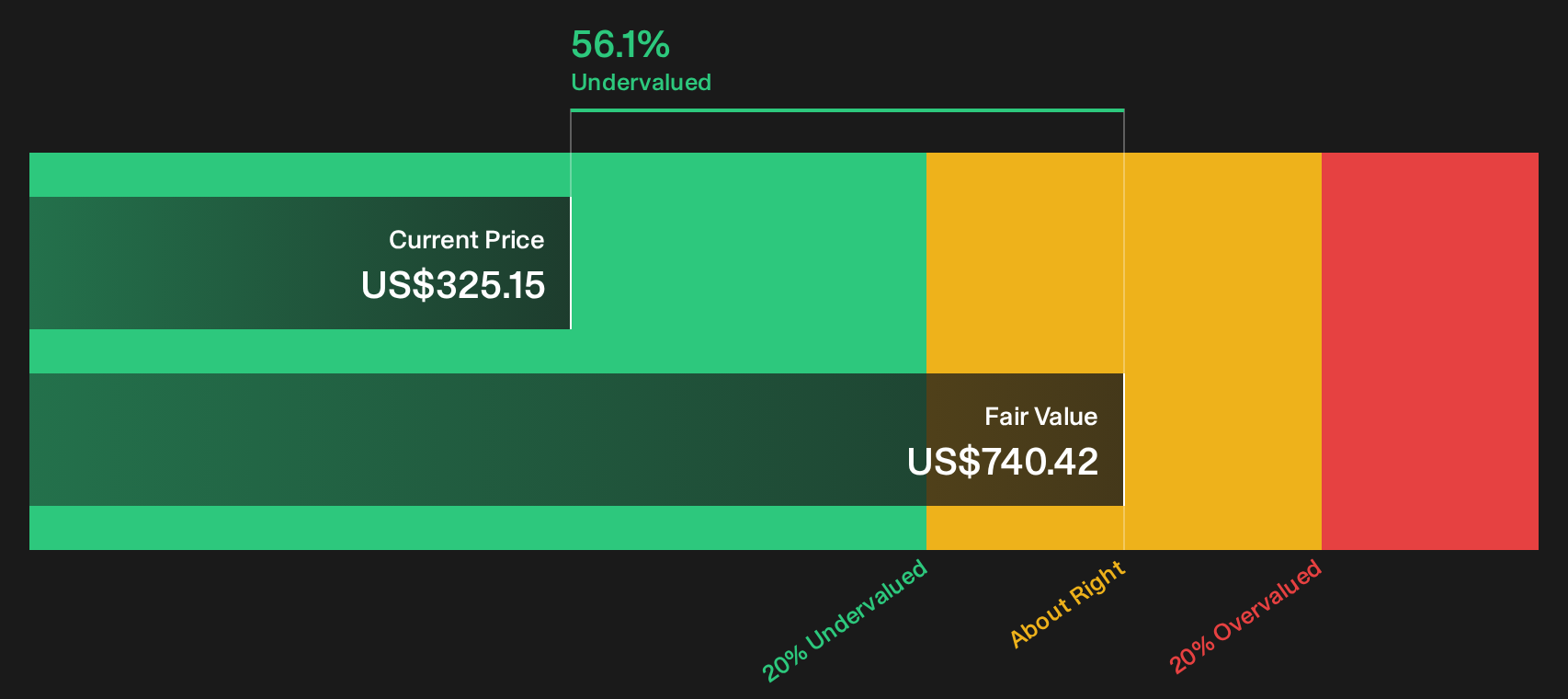
On this basis, the model arrives at an estimated intrinsic value of $772.56 per share. Compared with the recent share price of about $406.99, the DCF output suggests the stock is 47.3% undervalued according to this set of assumptions.
Result: UNDERVALUED
Our Discounted Cash Flow (DCF) analysis suggests Intuit is undervalued by 47.3%. Track this in your watchlist or portfolio, or discover 48 more high quality undervalued stocks.
Approach 2: Intuit Price vs Earnings (P/E)
For profitable companies like Intuit, the P/E ratio is a useful shorthand for how much investors are paying for each dollar of earnings. Higher P/E ratios usually reflect higher growth expectations or lower perceived risk, while lower P/E ratios can point to more modest growth assumptions or higher uncertainty.
Intuit currently trades on a P/E of 25.93x. That sits below both the Software industry average of 31.62x and the broader peer group average of 50.78x. On the surface, that might suggest a discount, but simple comparisons to peers or the sector do not account for differences in earnings growth, profitability, risk profile or company size.
To address this, Simply Wall St calculates a Fair Ratio, which is the P/E level that would be expected for Intuit given factors such as its earnings growth, industry, profit margins, market cap and identified risks. This tailored Fair Ratio for Intuit is 33.94x, which is above the current P/E of 25.93x. On this basis, the P/E approach indicates that Intuit’s shares are trading below the level suggested by these fundamentals.
Result: UNDERVALUED

P/E ratios tell one story, but what if the real opportunity lies elsewhere? Start investing in legacies, not executives. Discover our 17 top founder-led companies.
Upgrade Your Decision Making: Choose your Intuit Narrative
Earlier it was mentioned that there is an even better way to understand valuation, so Narratives are introduced here as simple stories that you create about Intuit, linking your view of its products, AI push and mid market expansion to specific forecasts for revenue, earnings and margins, which then roll up into a Fair Value that can be set against the current price.
On Simply Wall St, Narratives sit inside the Community page and are used by millions of investors as an accessible tool that ties a company’s story to a model, then keeps updating when fresh information like news or earnings arrives, so your view of Intuit is not static.
In practice, that means you can see how a more cautious Narrative that aligns with a Fair Value around US$425 and a more optimistic Narrative that aligns with a Fair Value around US$916 can both be grounded in the same company. You can then use that spread to judge whether the current price feels closer to your own Fair Value or far enough away to consider action.
Do you think there's more to the story for Intuit? Head over to our Community to see what others are saying!

This article by Simply Wall St is general in nature. We provide commentary based on historical data and analyst forecasts only using an unbiased methodology and our articles are not intended to be financial advice. It does not constitute a recommendation to buy or sell any stock, and does not take account of your objectives, or your financial situation. We aim to bring you long-term focused analysis driven by fundamental data. Note that our analysis may not factor in the latest price-sensitive company announcements or qualitative material. Simply Wall St has no position in any stocks mentioned.