

Is It Too Late To Consider AES (AES) After A 54.5% One Year Rally?
The Aes AES | 0.00 |
- Wondering if AES at around US$14.68 is still offering value after a strong run, or if you are late to the story.
- The stock has inched up 1.0% over the past week and 1.3% over the last month, while the 1 year return sits at 54.5% despite a small decline of 0.9% year to date and weaker outcomes over 3 and 5 years.
- Recent coverage has focused on AES as a utility and power company with a significant footprint in electricity generation and related services, along with ongoing attention to its capital structure and project pipeline. This mix of operational updates and balance sheet focus helps explain why the market has been reassessing the stock over the past year.
- AES currently has a value score of 5 out of 6 based on a set of valuation checks. The next sections will break down what that means using different methods, then turn to a broader way of thinking about valuation that can help you put all these numbers into context.
Approach 1: AES Discounted Cash Flow (DCF) Analysis
A Discounted Cash Flow model takes projections of a company’s future cash flows and discounts them back to today using a required rate of return, to estimate what the business might be worth now.
For AES, the latest twelve month free cash flow is a loss of about $2.19b, so the story here is about what future cash flows could look like rather than current cash generation. The model used is a 2 Stage Free Cash Flow to Equity approach, with analyst input up to 2028 and further projections extrapolated. For example, projected free cash flow for 2028 is $1.38b, and the ten year path includes figures such as $1.28b in 2026 and $1.69b in 2035, all in $ and then discounted back to today.
Pulling these cash flow projections together, the DCF model points to an estimated intrinsic value of about $19.65 per share. Compared with the recent share price around $14.68, this implies AES trades at roughly a 25.3% discount. On this basis, the stock appears undervalued according to this model.
Result: UNDERVALUED
Our Discounted Cash Flow (DCF) analysis suggests AES is undervalued by 25.3%. Track this in your watchlist or portfolio, or discover 48 more high quality undervalued stocks.
Approach 2: AES Price vs Earnings
For profitable companies, the P/E ratio is a useful way to see how much you are paying for each dollar of earnings. It ties directly to what the business currently earns, which many investors find easier to relate to than long range cash flow forecasts.
What counts as a normal or fair P/E ratio depends on how fast earnings are expected to grow and how risky those earnings are. Higher expected growth or lower perceived risk can justify a higher P/E, while slower growth or higher risk often leads to a lower P/E.
AES currently trades on a P/E of about 7.6x. That compares with an average of 16.2x for the Renewable Energy industry and a peer group average of 36.6x. Simply Wall St also calculates a Fair Ratio of 24.8x for AES. This Fair Ratio is designed to be more tailored than simple peer or industry comparisons because it incorporates factors such as earnings growth, profit margin, industry, market cap and identified risks.
Comparing the current P/E of 7.6x with the Fair Ratio of 24.8x suggests the stock is trading below the level implied by those fundamentals.
Result: UNDERVALUED

P/E ratios tell one story, but what if the real opportunity lies elsewhere? Start investing in legacies, not executives. Discover our 20 top founder-led companies.
Upgrade Your Decision Making: Choose your AES Narrative
Earlier it was mentioned that there is an even better way to understand valuation, so Narratives are introduced here as a simple way for you to write the story behind your numbers by linking your view on AES's future revenue, earnings and margins to a forecast and then to a fair value that you can compare with the current share price.
On Simply Wall St's Community page, Narratives are available as an easy tool that lets you set assumptions, see the implied fair value, and then quickly spot whether your story suggests AES is priced above or below what you think it is worth, with those fair values updating automatically when new data such as earnings, news or deal terms arrive.
For AES, one investor on the platform might build a bullish Narrative with a fair value around US$15.74 based on assumptions about stronger revenue growth and profit margins, while another might use more cautious inputs and arrive closer to US$7.17. Seeing those side by side can help you decide which story feels closer to your own view before you act.
For AES however we will make it really easy for you with previews of two leading AES Narratives:
Fair value in this bullish Narrative: US$15.74 per share
Implied discount to that fair value at the recent US$14.68 price: about 6.7% below the Narrative fair value
Revenue growth assumption used in this Narrative: 12.32% per year
- Views AES as well placed in data center partnerships, supply chain planning, and digital grid solutions. These areas are expected to support higher recurring revenue and margins compared with peers.
- Assumes stronger renewables EBITDA and load growth from electrification, along with potential benefits from energy storage, coal to gas transitions, and selected acquisitions of distressed or subscale assets.
- Flags key risks such as higher interest costs, possible pressure on renewable power purchase agreement pricing, regulatory and political uncertainty, and rising maintenance and technology related spending.
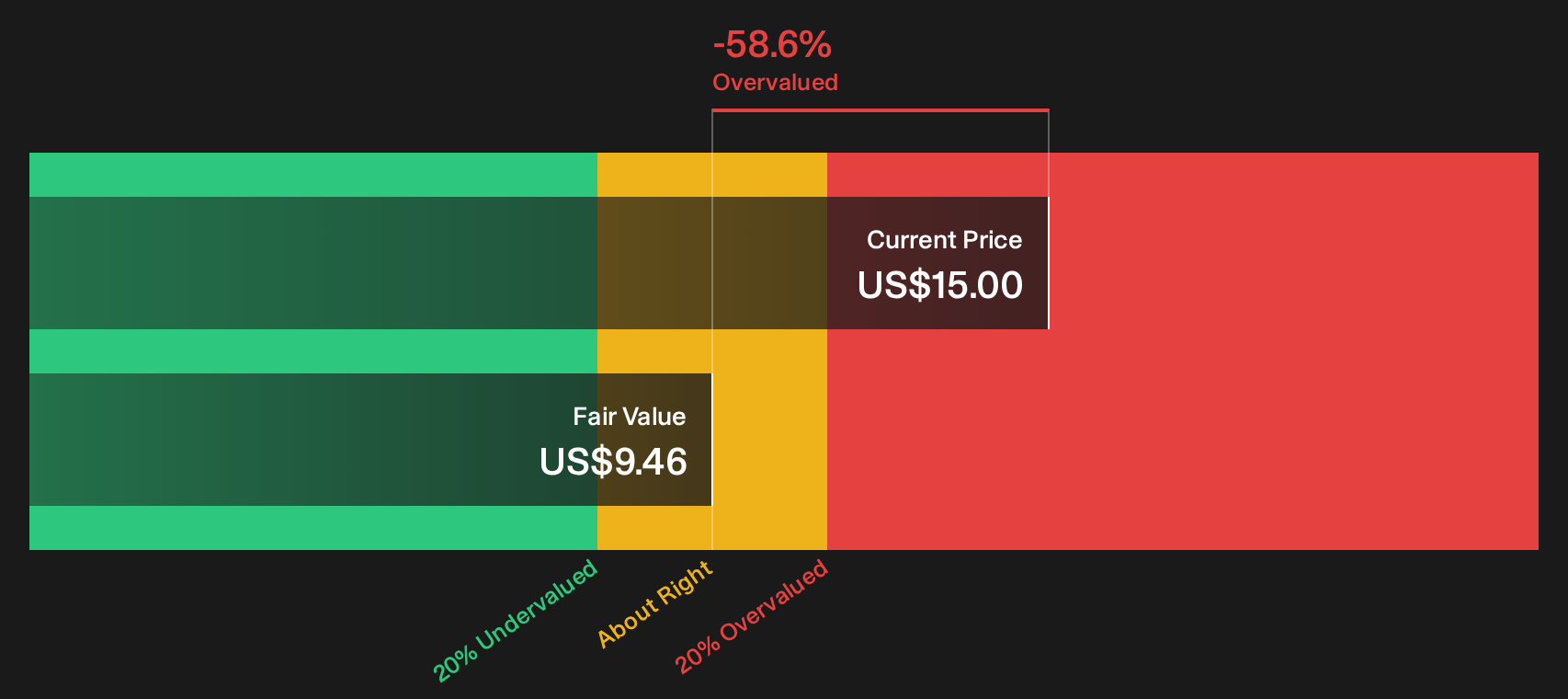
Fair value in this more cautious Narrative: US$7.17 per share
Implied premium to that fair value at the recent US$14.68 price: about 104.7% above the Narrative fair value
Revenue growth assumption used in this Narrative: 4.05% per year
- Treats AES primarily as an established utility and independent power producer with a long history, broad generation mix, and a focus on dividends and institutional ownership.
- Highlights third party commentary about earnings growth expectations, dividend yield, and prior fair value estimates, but anchors a much lower fair value of US$7.17 despite those references.
- Suggests that even with earnings growth forecasts and previous views of the stock as undervalued, a more conservative stance points to a lower justified value than where the stock has recently traded.
If you want to test which of these Narratives aligns closer with your view on AES, you can adjust the assumptions yourself and see how the implied fair value changes using the full Narrative tools on Simply Wall St, starting with See what the community is saying about AES.
Do you think there's more to the story for AES? Head over to our Community to see what others are saying!

This article by Simply Wall St is general in nature. We provide commentary based on historical data and analyst forecasts only using an unbiased methodology and our articles are not intended to be financial advice. It does not constitute a recommendation to buy or sell any stock, and does not take account of your objectives, or your financial situation. We aim to bring you long-term focused analysis driven by fundamental data. Note that our analysis may not factor in the latest price-sensitive company announcements or qualitative material. Simply Wall St has no position in any stocks mentioned.