
Is It Too Late To Consider Intel (INTC) After A 154% One Year Surge?
Intel Corporation INTC | 50.38 | +4.89% |
- For investors wondering whether Intel at US$50.24 is still reasonably priced or if most of the easy gains are already behind it, this article walks through what the current numbers are really saying about the stock.
- Over the short term, Intel has returned 2.9% over the last 7 days and 10.3% over the last 30 days. Its year to date return is 27.6% and its 1-year return is 154.1%, compared to 80.3% over 3 years and a 10.6% decline over 5 years.
- These mixed return figures sit against a backdrop of ongoing interest in large US semiconductor names and continued debate about how much optimism is already reflected in their share prices. For investors, that makes it even more important to separate sentiment from what the underlying valuation suggests Intel may reasonably be worth.
- On our checks, Intel scores a 3 out of 6 valuation score, which means it screens as undervalued on half of the pricing tests we run. Next, we will walk through the main valuation methods and then finish with a way to put those numbers into a broader context.
Approach 1: Intel Discounted Cash Flow (DCF) Analysis
A Discounted Cash Flow model looks at the cash Intel is expected to generate in the future, then discounts those projected cash flows back to today to estimate what the business might be worth per share.
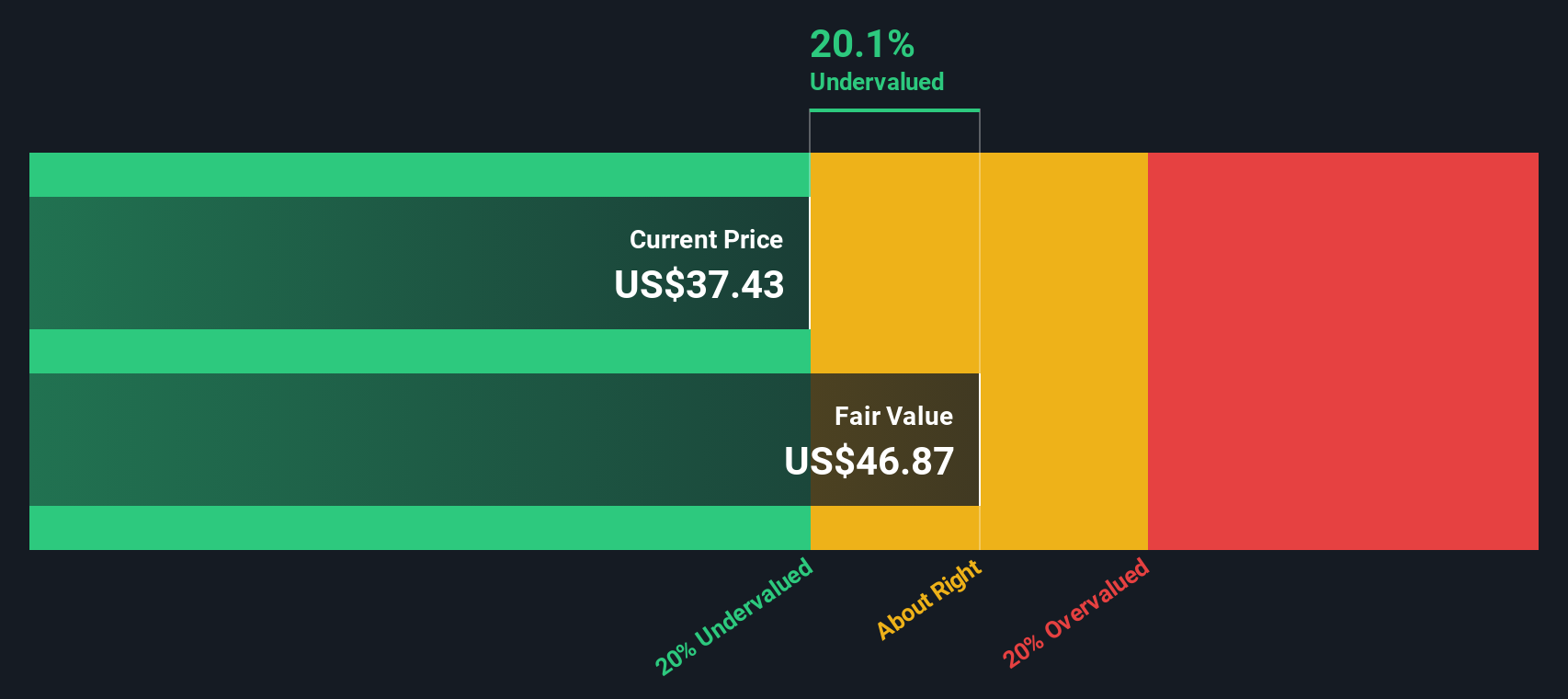
On this 2 Stage Free Cash Flow to Equity model, Intel’s last twelve months free cash flow is a loss of about $11.5b. Analysts provide detailed forecasts for the next few years, and from 2026 to 2035 the projections move from a free cash flow loss in 2026 to a positive figure that reaches about $24.0b in 2035, with the later years extrapolated rather than sourced directly from analyst estimates. All cash flows here are in $.
When those projected cash flows are discounted back, the model arrives at an estimated intrinsic value of about $30.24 per share. Against the current share price of US$50.24, that implies Intel is around 66.1% overvalued on this DCF view.
Result: OVERVALUED
Our Discounted Cash Flow (DCF) analysis suggests Intel may be overvalued by 66.1%. Discover 52 high quality undervalued stocks or create your own screener to find better value opportunities.
Approach 2: Intel Price vs Sales
For companies where earnings are weak or volatile, the P/S ratio is often a more useful gauge because it focuses on revenue, which tends to be more stable than profits from year to year.
Investors usually accept a higher or lower P/S based on what they expect for future growth and how risky they think the company is. Higher expected growth or lower perceived risk can support a higher “normal” P/S, while slower growth or higher risk typically points to a lower one.
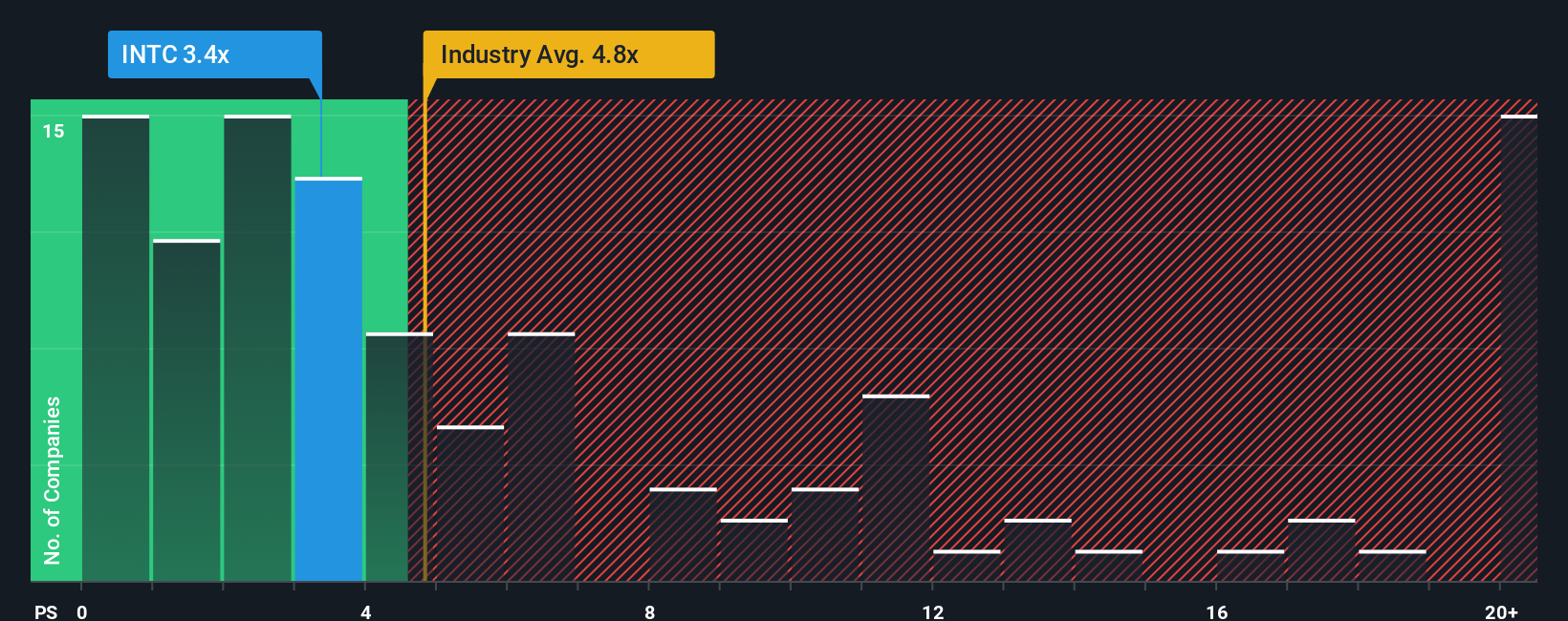
Intel currently trades on a P/S of 4.75x. That sits below the Semiconductor industry average of 5.76x and also below the peer group average of 14.30x, so on simple comparisons the stock screens as cheaper than many of its peers.
Simply Wall St’s Fair Ratio for Intel is 8.03x. This is a proprietary estimate of what a “reasonable” P/S might be for the company, given factors such as its earnings growth profile, profit margins, industry, market cap and company specific risks. Because it blends these elements together instead of relying only on broad peer or industry averages, it can give a more tailored view of what investors may be willing to pay.
Compared to this 8.03x Fair Ratio, Intel’s current 4.75x P/S suggests the shares screen as undervalued on this metric.
Result: UNDERVALUED
P/S ratios tell one story, but what if the real opportunity lies elsewhere? Start investing in legacies, not executives. Discover our 22 top founder-led companies.
Upgrade Your Decision Making: Choose your Intel Narrative
Earlier we mentioned that there is an even better way to understand valuation, so let us introduce you to Narratives, which are simply your story about Intel, tied directly to your own assumptions for fair value, future revenue, earnings and margins.
On Simply Wall St, Narratives live inside the Community page and give you an easy way to connect Intel’s business story to a financial forecast and then to a fair value. You can then compare that to the current share price and decide whether you see Intel as attractive or expensive.
Because Narratives on the platform are updated when new information such as news, earnings or guidance appears, you are not locked into a static view. You can see in real time how fresh data changes the gap between your Fair Value and today’s Price.
For Intel, for example, some investors currently publish Narratives with fair values around US$11.35 per share while others are closer to US$79.00 per share. By seeing the assumptions behind both extremes side by side, you can choose which story about Intel makes more sense for you and adjust your own Narrative accordingly.
For Intel however we'll make it really easy for you with previews of two leading Intel Narratives:
On Simply Wall St, these sit side by side so you can see how different investors are joining the dots between the same facts and price.
Fair value: US$79.00 per share
Implied undervaluation vs US$50.24: about 36.4% below this fair value
Revenue growth used in this view: 10%
- Author expects Intel’s heavy R&D spend and product roadmap across PC, mobile and data center chips to repair earlier missteps and gradually rebuild earnings power.
- The narrative leans on a rebound in global CPU demand, some market share being won back from AMD and long term upside from areas like foundry services and Mobileye.
- Key watchpoints include execution on new chip launches, funding needs if cash flows lag and how sector wide trends in AI, cloud and gaming actually play out.
Fair value: US$46.97 per share
Implied overvaluation vs US$50.24: about 7.0% above this fair value
Revenue growth used in this view: 5.50%
- Author leans on consensus forecasts that assume modest revenue growth, profit margins moving from a loss into single digits and earnings reaching US$5.2b over time.
- To reach the narrative fair value, Intel would need to support a future P/E that is much higher than today, helped by AI related products and progress in the foundry business.
- Main concerns are execution speed, organizational complexity, the cost of restructuring and the risk that AI and foundry efforts fall short of expectations.
Taken together, these two Intel stories show how the same company can look either attractively priced or a little ahead of itself, depending on what you assume for future growth, margins and the multiple investors are willing to pay. If you want to see how other investors are framing Intel’s risk and reward trade off, Curious how numbers become stories that shape markets? Explore Community Narratives.
Do you think there's more to the story for Intel? Head over to our Community to see what others are saying!
This article by Simply Wall St is general in nature. We provide commentary based on historical data and analyst forecasts only using an unbiased methodology and our articles are not intended to be financial advice. It does not constitute a recommendation to buy or sell any stock, and does not take account of your objectives, or your financial situation. We aim to bring you long-term focused analysis driven by fundamental data. Note that our analysis may not factor in the latest price-sensitive company announcements or qualitative material. Simply Wall St has no position in any stocks mentioned.