
Is It Too Late To Consider Liberty Energy (LBRT) After Its Strong Multi‑Year Share Price Run?
Liberty Energy, Inc. Class A LBRT | 28.10 | +0.64% |
- For investors wondering whether Liberty Energy still offers good value after a strong run, or whether the current price already reflects the story, this article walks through what the market may be pricing in and how that compares with different valuation checks.
- Liberty Energy last closed at US$27.47, with a 7 day return of a 3.2% decline, a 30 day return of 5.3%, and longer term returns of 45.5% year to date, 79.5% over 1 year, 80.9% over 3 years and 100.3% over 5 years.
- Recent moves in the share price sit against a backdrop of ongoing interest in energy services stocks and how they might respond to changing activity levels in oil and gas markets. At the same time, investors have been paying closer attention to balance sheet strength and capital discipline across the sector, which can influence how companies like Liberty Energy are valued.
- On our valuation framework, Liberty Energy scores 3 out of 6 on undervaluation checks. Next, we will walk through what different valuation approaches suggest about the stock, then finish with a way to combine those methods into a clearer view of value.
Approach 1: Liberty Energy Discounted Cash Flow (DCF) Analysis
A Discounted Cash Flow, or DCF, model takes estimated future cash flows and discounts them back to today to give an indication of what the entire business could be worth in present value terms.
For Liberty Energy, the model uses a 2 Stage Free Cash Flow to Equity approach. The latest twelve month free cash flow stands at about $42.6 million. Analysts have provided cash flow estimates for the next few years, and beyond that Simply Wall St extrapolates the figures. Within this framework, projected free cash flow reaches $403 million in 2030, with further estimates running through to 2035.
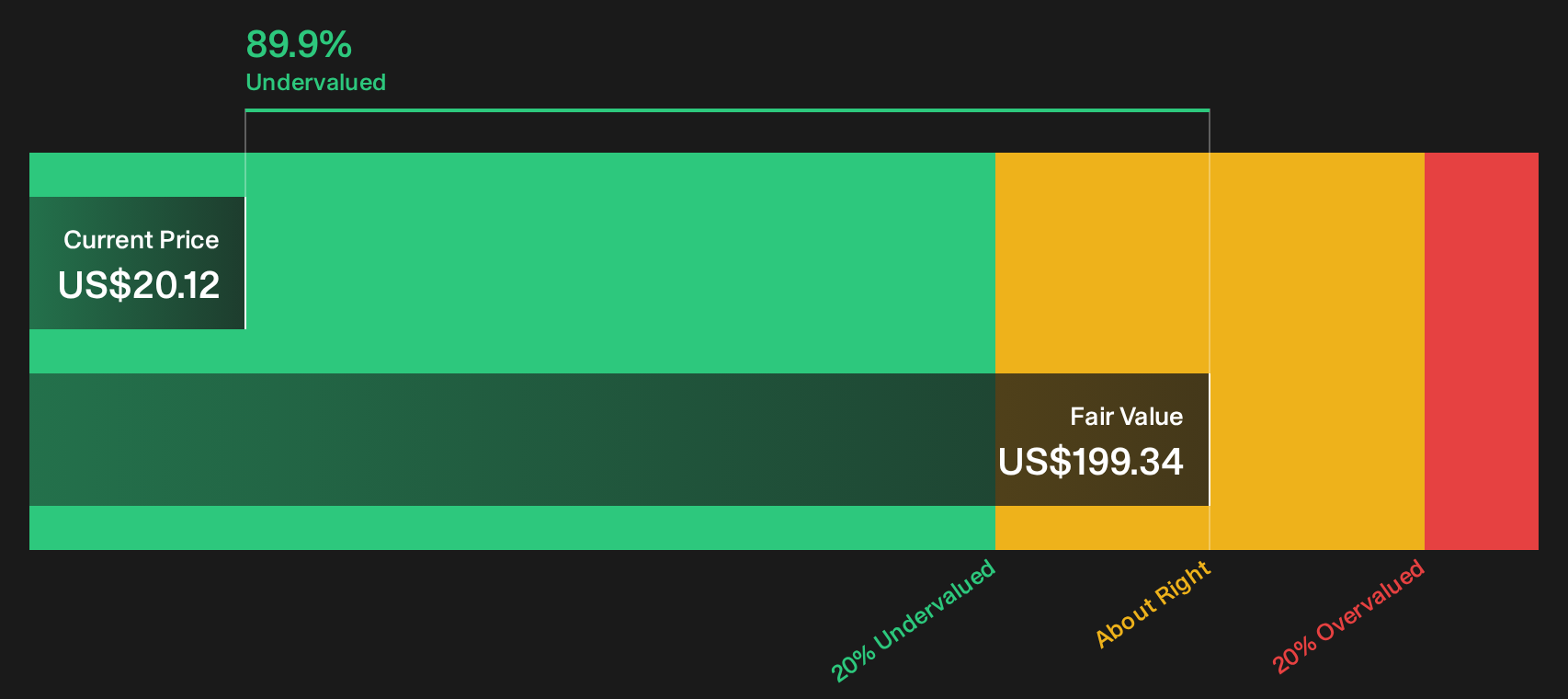
Bringing all of those projected cash flows back to today, the DCF model suggests an intrinsic value of about US$149.48 per share. Against the recent share price of US$27.47, this implies an intrinsic discount of 81.6%, which points to the stock trading well below this cash flow based estimate of value.
Result: UNDERVALUED
Our Discounted Cash Flow (DCF) analysis suggests Liberty Energy is undervalued by 81.6%. Track this in your watchlist or portfolio, or discover 47 more high quality undervalued stocks.
Approach 2: Liberty Energy Price vs Earnings
For profitable companies, the P/E ratio is a useful shorthand because it links what you pay per share to the earnings the business is already generating. A higher or lower P/E often reflects what the market is willing to pay for each dollar of earnings given its view on the company.
In general, stronger growth expectations and lower perceived risk can support a higher P/E, while slower growth and higher risk tend to line up with a lower P/E as a “normal” range. So a P/E is not good or bad on its own; it only starts to mean something once you compare it with relevant benchmarks and what you think is a reasonable earnings outlook and risk profile.
Liberty Energy currently trades on a P/E of 30.10x, compared with an Energy Services industry average of 27.09x and a peer group average of 33.31x. Simply Wall St’s “Fair Ratio” for Liberty Energy is 9.02x, which is its proprietary estimate of what a suitable P/E could be after weighing factors such as earnings growth, profit margins, industry, market cap and company specific risks. Because the Fair Ratio is tailored to the company, it can be more informative than a simple comparison with peers or the broad industry. On this framework, Liberty Energy’s current P/E of 30.10x sits above the Fair Ratio of 9.02x, indicating the shares trade at a richer multiple than this model implies.
Result: OVERVALUED

P/E ratios tell one story, but what if the real opportunity lies elsewhere? Start investing in legacies, not executives. Discover our 20 top founder-led companies.
Upgrade Your Decision Making: Choose your Liberty Energy Narrative
Earlier we mentioned that there is an even better way to understand valuation, so let us introduce you to Narratives. This is where you tell the story behind your numbers by linking your view of Liberty Energy’s future revenue, earnings and margins to a financial forecast and a fair value. You can then make a simple comparison between that fair value and today’s price, all within an easy tool on Simply Wall St’s Community page that updates as new news or earnings arrive. It can show, for example, one investor building a higher fair value around a more optimistic US$34.00 view, while another anchors closer to a lower US$14.00 fair value, helping you see where your own story sits on that spectrum.
For Liberty Energy, however, we will make it really easy for you with previews of two leading Liberty Energy Narratives:
Each one connects a clear story about future revenue, margins and power growth with a specific fair value, so you can decide which version of the future feels closer to your own view.
Fair value: US$34.00 per share
Implied discount to this fair value: about 19% below the narrative fair value at the current US$27.47 share price
Revenue growth used in this narrative: 16.91% a year
- Assumes Liberty Energy benefits from structural tightness in high spec frac fleets and a move toward digital, gas powered equipment that supports higher margins and cash flow resilience.
- Builds in meaningful upside from power and microgrid projects, including data center partnerships and advanced power solutions, as a second engine of earnings over time.
- Flags risks from decarbonization, ESG pressures and execution on shifting more capital into power, but still anchors on a higher fair value of US$34.00 than the current share price.
Fair value: US$25.17 per share
Implied premium to this fair value: about 9% above the narrative fair value at the current US$27.47 share price
Revenue growth used in this narrative: 10.25% a year
- Builds in softer completions activity, service pricing headwinds and a period where the core frac business may lean on maintenance level capital spending rather than expansion.
- Assumes power projects and nuclear related partnerships contribute later, which can leave a gap if oilfield activity or margins soften before those earnings ramp.
- Sees higher analyst targets as partly reflecting sector wide rerating, while also pointing out that some research views the shares as closer to fair value after the recent move.
If you want to see the full stories, including detailed revenue and earnings paths behind each view, and how other investors are framing the risks and opportunities, Curious how numbers become stories that shape markets? Explore Community Narratives for Liberty Energy and compare where your own assumptions fit between these fair values.
Do you think there's more to the story for Liberty Energy? Head over to our Community to see what others are saying!

This article by Simply Wall St is general in nature. We provide commentary based on historical data and analyst forecasts only using an unbiased methodology and our articles are not intended to be financial advice. It does not constitute a recommendation to buy or sell any stock, and does not take account of your objectives, or your financial situation. We aim to bring you long-term focused analysis driven by fundamental data. Note that our analysis may not factor in the latest price-sensitive company announcements or qualitative material. Simply Wall St has no position in any stocks mentioned.